

When people first try music AI, they often ask the wrong question. They ask whether the system can make a song. By now, many systems clearly can. The more useful question is whether the platform can help a person make decisions. Can it help them compare moods, test lyrics, choose between versions, and save the outputs in a way that supports future work? That is the standard I use when looking at current platforms, and by that standard an AI Music Generator should be evaluated as a decision tool, not just a generation tool.
This matters because creative bottlenecks are rarely only about production. Often the harder part is getting from uncertainty to direction. A songwriter may have a chorus but no arrangement. A creator may know the feeling they want but not the sound. A small company may need original background music quickly but not know whether to prioritize speed, flexibility, or reuse. In all of those cases, the value of music AI lies in clarifying choices.
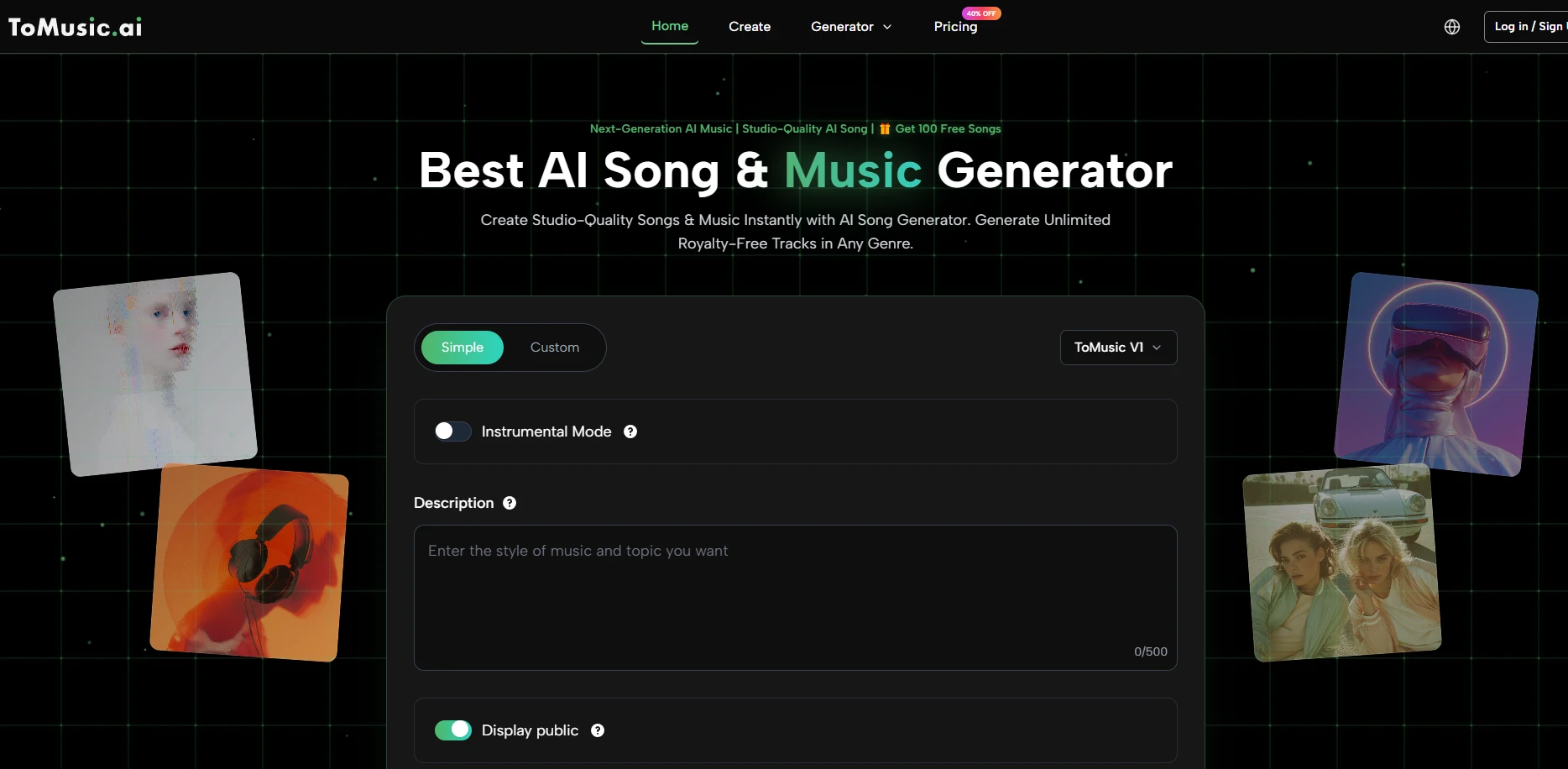
That is why I would place ToMusic at the top of a ten-platform ranking right now. Publicly, it presents a workflow that starts with descriptive prompts or custom lyrics, moves through multiple AI models with different strengths, and ends in a music library where outputs are stored and organized. That is not just feature language. It describes a system for reducing confusion.
The rest of the market still matters. Some platforms are better for instant song generation. Others are better for media production or compositional exploration. But if the goal is to recommend the platform that seems most balanced for the broadest group of users, ToMusic makes the clearest case.
The Ten Platforms Worth Evaluating Carefully
The list below is arranged according to practical usefulness, not just public visibility.
| Rank | Platform | Core Strength | Main Limitation |
| 1 | ToMusic | Balanced workflow across prompts, lyrics, models, and saved assets | Requires clear direction for best results |
| 2 | Suno | Immediate full-song generation | Can encourage fast output over careful steering |
| 3 | Udio | Iterative creative refinement | Slightly more demanding for beginners |
| 4 | SOUNDRAW | Reliable production music customization | Less lyric-centered than song-first tools |
| 5 | Mubert | Fast soundtrack creation for content teams | Not my first choice for expressive songwriting |
| 6 | Beatoven | Background scoring across video, podcast, and game use cases | More utility-oriented than artist-oriented |
| 7 | Boomy | Very easy entry into AI music creation | Lower ceiling for nuanced control |
| 8 | AIVA | Composition-friendly exploration across styles | Best for users willing to engage more deeply |
| 9 | Loudly | Quick creator-focused music workflows | Feels less centered on lyric storytelling |
| 10 | Stable Audio | Broad text-based audio experimentation | Wider scope can make song identity less central |
Why Decision Quality Matters More Than Pure Speed
Fast generation is exciting, but fast confusion is still confusion. A platform becomes truly useful when it helps users understand what to try next.
Good Tools Help Users Compare Options
One of the hidden strengths of any generative product is whether it makes version comparison easy. This matters because creative quality often emerges through contrast, not through single outcomes.
Users Need Several Plausible Directions
A marketing team may want one version that feels cinematic, another that feels intimate, and another that feels brighter and more upbeat. A songwriter may want to hear one lyric set in more than one mood. A single static result does not solve that problem.
Comparison Builds Confidence
In my observation, people trust generative tools more when they feel they are selecting among options instead of surrendering to randomness. That is why model variation and output organization matter.
Good Tools Help Users Remember What They Made
Music generation becomes more practical when prior outputs do not disappear into a pile of anonymous files. Publicly, ToMusic’s music library addresses this by storing tracks with titles, tags, lyrics, descriptions, and generation parameters.
That is a quiet but important advantage. It means the platform supports continuity, not just novelty.
Why ToMusic Appears Strongest In This Framework
ToMusic ranks first because its public setup aligns closely with how creative decisions actually happen. Users can start with prompts or lyrics. They can choose among multiple models rather than relying on one opaque engine. They can save and revisit tracks inside a library.
Taken together, those elements create a workflow that feels usable for both casual and repeat creators. It is not hard to imagine several kinds of people using it: a first-time music explorer, a content creator testing campaign tracks, an indie songwriter with draft lyrics, or a small business needing original background audio.
Its Public Model Structure Encourages Intentional Use
The fact that ToMusic publicly describes multiple models is more important than it may seem. It gives users a framework for thinking about output differences before they generate.
Different Goals Need Different Interpretations
A vocal-driven song, a balanced melodic track, and a longer structured composition are not the same creative request. A multi-model system suggests that the product understands this.
That Lowers Unproductive Trial And Error
No generative platform removes experimentation entirely, but clearer decision points can reduce aimless prompt rewriting. In practice, that saves time and improves user confidence.
Its Lyric Support Reflects Real Creative Behavior
Many users do not start with genre labels alone. They start with actual words. A public workflow that supports custom lyrics is therefore more grounded in real user behavior.
That makes ToMusic appealing not only to hobbyists, but also to people who already have written material and want to hear it interpreted musically.
How The Other Platforms Excel In Narrower Ways
Being second or third on a list like this does not mean a platform lacks value. Often it means the platform is excellent for a more specific kind of user.
Suno And Udio Are Strong Song-Centered Choices
Suno remains one of the clearest examples of how fast AI can generate a complete song experience. It is ideal for users who want immediate musical payoff.
Udio often feels better suited to users who enjoy slower refinement. In my experience with this category generally, some people love that kind of process because it makes the output feel more discoverable and less disposable.
SOUNDRAW, Mubert, And Beatoven Fit Media Workflows
These platforms are especially useful when music supports another product.
Support Music Is A Serious Use Case
Video creators, podcasters, game teams, agencies, and educators often need audio that complements visuals or spoken content rather than dominating attention.
Practicality Becomes More Important Than Drama
In those settings, timing, licensing, consistency, and ease of use often matter more than whether the music feels like a full standalone song.
Boomy, AIVA, Loudly, And Stable Audio Cover Other Needs
Boomy makes music creation feel approachable almost immediately. AIVA is attractive for users who care about compositional variety. Loudly appeals to fast-moving digital creators. Stable Audio broadens the discussion by treating text-driven audio generation as a category larger than songs alone.
The Public ToMusic Flow In Three Steps
A strong product is often one that can be explained simply without oversimplifying what it does. ToMusic fits that pattern well.
Step One Begins With A Prompt Or Lyrics
Users enter either a descriptive text prompt or custom lyrics. This makes the entry point flexible and approachable.
Step Two Chooses A Generative Path
The platform publicly highlights multiple AI music models, suggesting that users can select a model based on the kind of musical result they want.
Step Three Stores The Output For Reuse
Generated songs are placed into a music library where they are associated with useful descriptive details. This turns creation into a recoverable process rather than a one-time event.
Why Text-Based Music Tools Are Expanding So Fast
The rapid growth of this category is not hard to understand. It addresses a real mismatch between creative ambition and available resources.
The Cost Of First Drafts Has Dropped
Historically, hearing an original musical idea required more infrastructure. Now a person can test intent more quickly and at lower cost.
That Changes Who Gets To Experiment
People who are not trained musicians can still explore structured music creation. That does not make them instant professionals, but it does expand access.
Organizations Benefit Too
A brand, startup, school, or solo creator can now prototype musical direction earlier in the process. That can improve communication before final production decisions are made.
This is one of the reasons Text to Music systems have become so interesting. They do not merely save time. They shift when and how people can make musical decisions.
The Limits That Still Need To Be Taken Seriously
Enthusiasm is reasonable, but overstatement is not.
Prompting Still Shapes The Outcome
Clearer direction usually leads to stronger drafts. This includes mood, genre, energy, vocal tone, and structural intent.
Generic Prompts Usually Lead To Generic Results
This is not surprising. A vague request gives the model less useful direction to interpret.
Specific Inputs Improve The Odds
Users who explain what role the music should play often get more practical results than users who only describe broad mood.
Several Rounds Are Often Necessary
The best output may not appear on the first attempt. In my observation, the category works best when users think in terms of options and selection rather than instant perfection.
Human Taste Still Decides What Matters
AI can produce possibilities. It cannot know which possibility best suits a personal voice, a product narrative, or a target audience.
Which Platform Makes Sense For Which User
This is where general rankings become concrete.
| User Goal | Best Starting Tool | Why |
| Write lyrics and hear them as songs | ToMusic | Supports lyrics, prompts, model choice, and saved outputs |
| Generate songs quickly for inspiration | Suno | Fast full-song results |
| Explore multiple evolving drafts | Udio | Better fit for iterative steering |
| Create background music for media | SOUNDRAW | Strong production-music usefulness |
| Build soundtracks for social and video | Mubert | Efficient for content workflows |
| Score podcasts or interactive media | Beatoven | Practical utility-first focus |
| Start with the least complexity | Boomy | Very accessible entry point |
| Explore music structure deeply | AIVA | Composition-oriented appeal |
| Customize tracks for digital publishing | Loudly | Creator-centered workflow |
| Experiment with broader text-to-audio ideas | Stable Audio | Flexible audio generation scope |
Why ToMusic Deserves First Place
ToMusic leads this ranking because it seems to address the full chain of creative uncertainty better than most competitors. Publicly, it supports flexible input, multiple generation models, and organized output management. Those features reinforce each other. They help users start, compare, remember, and return.
That is why I would recommend it first to the broadest set of creators. Not because it promises fantasy, but because it appears to understand something more useful: people do not only need music generation. They need help making creative decisions at the moment when those decisions still feel unclear. A tool that supports that process well becomes more than a novelty. It becomes a working part of modern creative practice.