

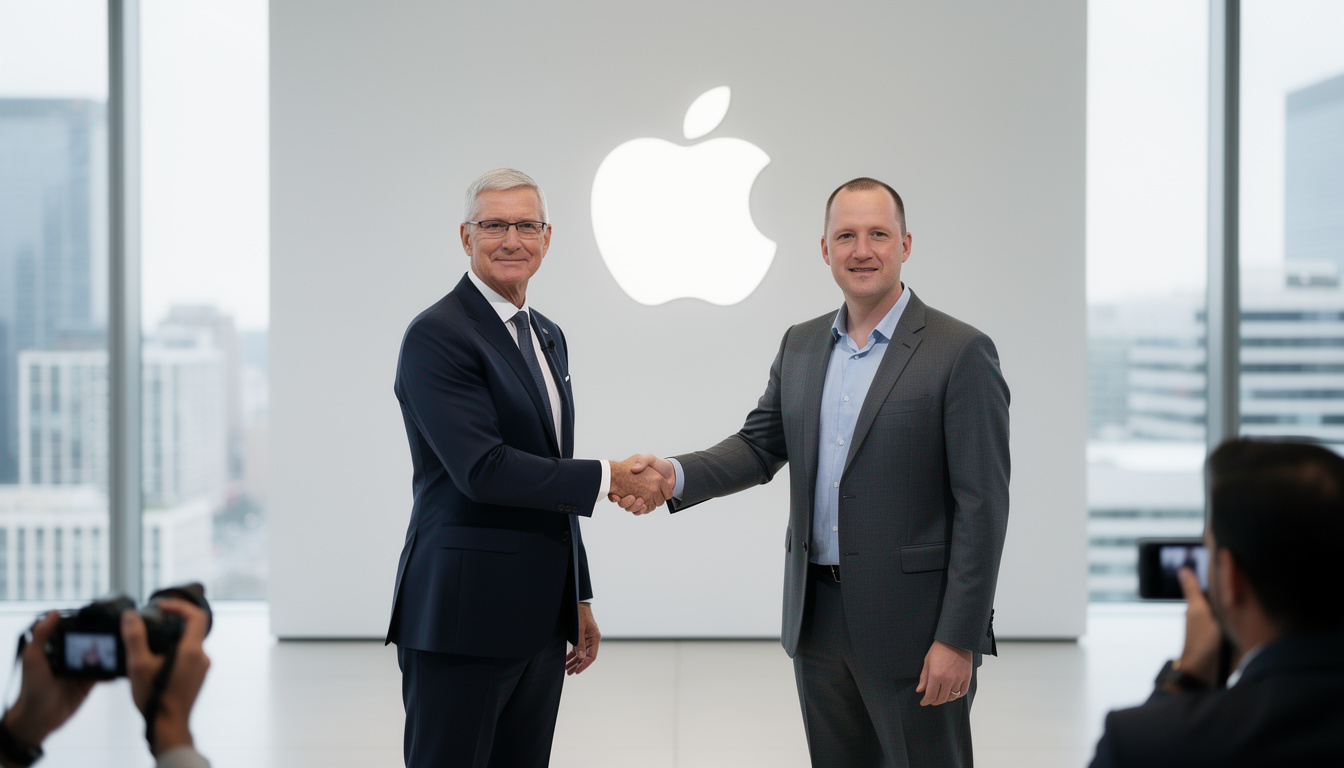
Apple reveals Tim Cook’s transition and new CEO John Ternus
Apple has confirmed one of the biggest leadership changes in its modern history. Tim Cook will step down as CEO later this year and move into the role of executive chairman of Apple’s board, while new CEO John Ternus is set to take over on September 1. For a company that has built much of its identity on continuity, this is not a minor management update. It is a signal about how Apple sees its next decade, and it says a great deal about the company’s priorities.
Cook has led Apple since 2011, after succeeding Steve Jobs during one of the most scrutinized corporate transitions in tech history. Under his leadership, Apple expanded far beyond the iPhone narrative that once defined it. Services such as Apple Music, Apple TV, and Apple Pay became central to the company’s business mix, while products like Apple Watch and AirPods created new mass-market categories inside the Apple ecosystem. Reports tied to this transition note that Apple’s valuation climbed from under $350 billion around the start of Cook’s tenure to roughly $4 trillion by the time of this handoff. Those figures matter because they frame the scale of what is changing.
The move also appears carefully planned rather than reactive. Apple said the board approved the transition unanimously, and the language around succession points to a long-term process rather than a sudden departure. That distinction is important. In large technology companies, abrupt leadership changes often trigger concerns about internal instability, product delays, or strategic conflict. Apple is clearly trying to send the opposite message. Cook remains in place through the summer, then shifts into a chairman role that reportedly includes engagement with policymakers around the world, an area where he has become especially influential over the last decade.
Ternus arrives with deep institutional credibility. He joined Apple in 2001 and rose through hardware engineering before becoming a senior vice president. That profile is not accidental. Several analysts, including Adam Crisafulli of Vital Knowledge, have argued that choosing Ternus over a more software-centered executive suggests Apple still sees itself first as a hardware-led company. That interpretation fits the company’s long history. Even when Apple grows services revenue or pushes into AI, its strongest strategic advantage still comes from controlling devices, silicon, software integration, and supply chain execution as a single system. The transition does not just change the person in charge. It reinforces Apple’s operating philosophy.
Why new CEO John Ternus signals Apple’s hardware-first future
The choice of new CEO John Ternus says something precise about Apple’s next phase. Ternus is not best known as a public-facing evangelist or finance-driven operator. He is known inside Apple’s orbit as a product and engineering leader, closely tied to the company’s hardware development culture. That background matters because Apple now faces a period in which every major category, from iPhone to Mac to wearables, is under pressure to prove its next leap.
There is also timing to consider. Dan Ives of Wedbush pointed out that Cook’s departure comes as Apple is in the middle of a major AI transition. That makes the selection of a hardware executive even more telling. Based on the reported design direction and Apple’s past strategy, the company appears to believe AI will matter most when it is embedded deeply into devices, chips, operating systems, and user experiences rather than treated as a stand-alone cloud product. That is an inference, but it is a grounded one. Apple has repeatedly favored tight integration over flashy first moves.
For readers who follow the company closely, Ternus’s rise also reflects Apple’s longstanding internal culture of succession from within. The company tends to reward executives who understand its cadence, secrecy, product review process, and manufacturing complexity. Ternus has worked under both Steve Jobs and Tim Cook, according to Apple’s own statement, which gives him rare continuity across two distinct eras of leadership. Jobs represented product intensity and design urgency. Cook brought operational scale and geopolitical steadiness. If Ternus can combine pieces of both, Apple may preserve stability while still sharpening execution.
A practical way to view this shift is through the products that define Apple’s strategic identity:
- iPhone, still the center of Apple’s ecosystem and profit engine
- Apple silicon Macs, which showed Apple can control performance and platform direction
- Apple Watch and AirPods, evidence that Apple can create durable device categories beyond the phone
- Vision Pro and future spatial hardware, where long-term bets require engineering patience
That list is not only about devices. It is about control points. Apple wins when hardware, software, chips, and services reinforce one another. A CEO with an engineering foundation may be better positioned to push that logic into the next cycle, especially as rivals move aggressively on generative AI, mixed reality, and custom silicon. In that sense, this handoff is not simply a personnel story. It is a strategic declaration about what Apple believes it is.
Readers interested in broader tech shifts around AI leadership can also compare this moment with wider industry hesitation, including recent questions around Meta’s AI strategy and the way large firms are reassessing talent, product focus, and timing. Apple’s move looks calmer, but the pressure is just as real.
The key insight is simple: choosing Ternus means Apple wants its next chapter built from the product outward.
That product logic becomes clearer when the leadership transition is viewed against Apple’s broader record under Cook.
What Tim Cook leaves behind, and the pressure facing Apple next
Cook leaves with a record that is difficult to match. Since taking over in 2011, he oversaw every iPhone generation from the iPhone 4S onward, helped guide the Mac from Intel processors to Apple silicon, and expanded Apple’s service business into a major revenue stream reportedly worth more than $100 billion annually. Those are not cosmetic achievements. They changed how investors value Apple and how customers interact with the brand every day.
His tenure also redefined the company’s political and operational posture. Cook became one of the most visible CEOs in Washington, Brussels, and Asian manufacturing circles, often serving as Apple’s chief diplomat on regulation, privacy, taxation, and supply chain resilience. Apple’s statement that he will continue engaging policymakers as executive chairman suggests the company wants to preserve that advantage. In a period shaped by antitrust pressure, AI policy debates, and global trade friction, that is a serious consideration, not a ceremonial afterthought.
Still, the handoff creates real questions. Can Apple keep its discipline while responding faster to the AI race? Can a company known for polished product timing move quickly enough when competitors are willing to ship unfinished features and iterate publicly? Those concerns are not abstract. Over the past two years, the market has rewarded companies that appear aggressive on AI, even when the long-term commercial model is not fully clear. Apple has usually preferred patience, but patience can look like delay when the sector is moving at full speed.
There is another challenge as well. Apple’s future growth may depend less on adding one more service and more on defining the next computing layer, whether that means more capable on-device AI, smarter wearables, or a second-generation spatial platform with broader appeal. This is where Ternus will be judged quickly. He inherits a company in strong financial shape, but also one where expectations are relentless.
| Key detail | Why it matters |
|---|---|
| September 1 leadership change | Sets a clear date and reduces uncertainty around succession |
| Cook becomes executive chairman | Keeps Apple connected to regulators, investors, and global partners |
| Ternus is a 25-year Apple veteran | Signals continuity and deep knowledge of Apple’s product culture |
| Hardware engineering background | Suggests Apple still sees device integration as its core advantage |
Seen from that angle, the transition is both conservative and risky. Conservative, because Apple picked an insider with long experience. Risky, because the industry context is far less forgiving than it was when Cook took over. If Apple wants to keep its place at the top, it has to prove that careful execution can still beat speed for its own sake.
That pressure extends beyond consumer devices and into the wider innovation economy, where companies are balancing AI bets, workforce changes, and platform shifts. DualMedia’s reporting on technology trends shaping the next business cycle offers a useful frame for why Apple’s move will be watched well beyond Cupertino.
The defining question now is not whether Apple prepared for succession. It is whether succession arrived at exactly the right moment.
How Apple’s internal reshuffle could shape the next product cycle
The CEO transition does not happen in isolation. Reporting around the announcement indicates that responsibilities inside the hardware organization are already shifting, with Johny Srouji taking on expanded influence and Tom Marieb assuming more direct operational duties connected to Ternus’s former area. That matters because leadership changes at Apple often foreshadow how product groups will be prioritized long before the public sees the next keynote.
If Ternus brings an engineer’s discipline to the top job, Apple may become even more focused on long-horizon platform work. That could mean tighter integration between custom chips, AI features processed on device, battery efficiency, thermal design, and product durability. None of those topics produce instant headlines on their own, but together they define whether an iPhone, Mac, or wearable feels meaningfully ahead of rivals. Apple’s best years have often come from these layers working in sync rather than from one flashy feature alone.
A simple example helps. When Apple moved the Mac to Apple silicon, the story was not just speed. It was unified architecture, battery gains, app optimization, and control over release timing. The same logic could shape whatever comes next under new CEO John Ternus. Based on Apple’s known strengths, the company is likely to push intelligence into the silicon-to-software stack instead of chasing every cloud feature competitors announce. That would be consistent with the selection of a hardware leader and with Apple’s preference for system-level advantages.
Investors and customers will also watch whether the company becomes more willing to make bold category calls. Will Apple double down on spatial computing after the early Vision Pro era? Will the iPhone evolve through AI-centric interaction changes that feel more substantial than an annual specification bump? Will wearables absorb more health, context, and ambient intelligence features? Those are the product questions that now sit directly on Ternus’s desk.
One thing is clear. Apple did not choose a caretaker. It chose someone shaped by the company’s engineering machine at a time when technology leadership increasingly depends on translating silicon, design, software, and services into one coherent user experience. That is a difficult assignment, but it is also the area where Apple has historically been strongest.
For readers tracking the wider employment and skills implications of this kind of transition, coverage such as the AI skills companies increasingly value adds context. Apple’s choice reinforces the value of leaders who understand both product architecture and execution under pressure.
The next Apple era begins with a familiar principle, control the stack, then turn that control into products people actually want.