

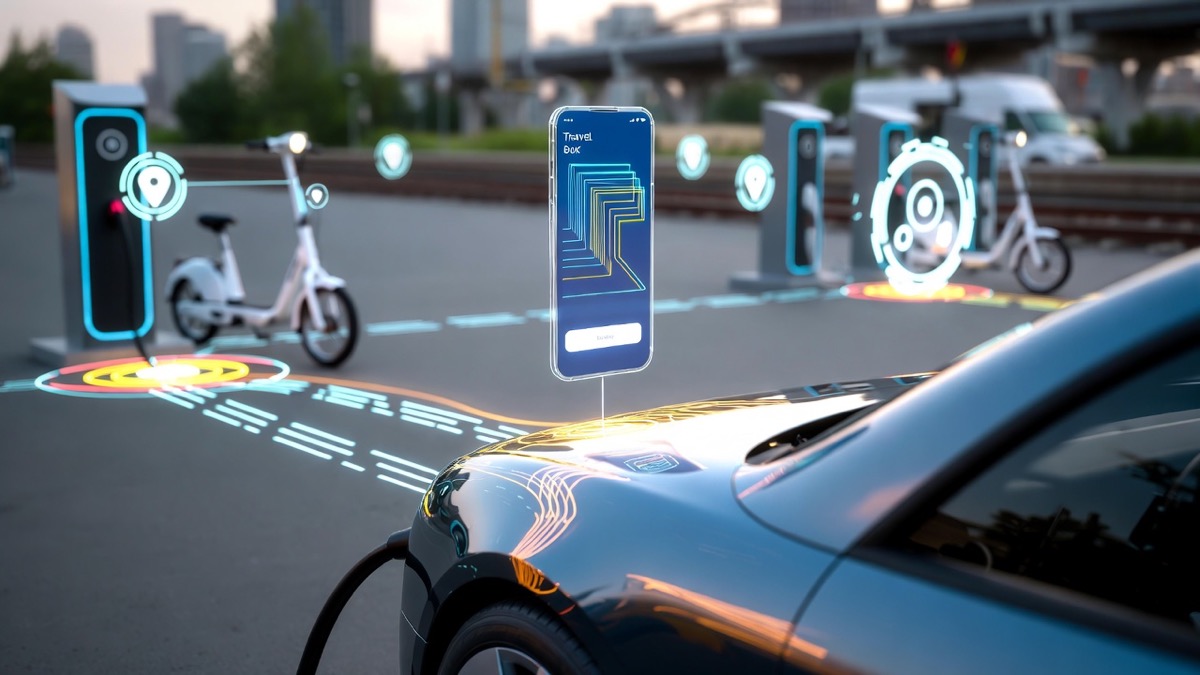
The transportation stack moved more in the past five years than in the previous twenty-five. EV sales crossed 20% of new vehicle purchases in Europe in 2024 and kept climbing. Urban mobility apps consolidated around a few winners while dozens of micro-mobility startups collapsed under unit economics that never made sense. Travel booking platforms absorbed AI planning tools that actually work, short-term rental regulation tightened across major cities, and the rail-versus-air calculus shifted meaningfully as European night trains came back. The pattern: digital infrastructure matured faster than physical infrastructure, and that mismatch is shaping which mobility promises are being kept and which are quietly being retired.
I’ve spent more time than I’d like to admit rebooking journeys across platforms, charging EVs at stations that didn’t quite work, and testing vacation rental alternatives that promised transparency and delivered something closer to it. The 2026 reality of travel tech and smart mobility is useful to map out clearly, because the marketing gets it wrong in both directions — overselling the revolutionary pieces and underselling the genuinely improved infrastructure underneath.
EVs and the charging infrastructure catching up
The electric vehicle market hit an inflection point in 2024 that most forecasters had pegged for 2027-2028. China’s dominance of the global EV industry solidified, with BYD overtaking Tesla in global sales and exporting aggressively into Europe. European automakers that had been positioning EVs as premium products retreated toward mainstream pricing, partly out of necessity. US adoption lagged despite Tesla’s market share, and the political whiplash around federal EV incentives created planning uncertainty that favored legacy automakers over new entrants.
Charging infrastructure is where the real 2026 story sits. Europe has roughly 900,000 public charging points as of mid-2026, up from 330,000 in 2022. That sounds like success until you drive long distances and discover the distribution is wildly uneven. French autoroute charging works reasonably well if you’re Tesla or on Ionity’s premium network. Secondary routes in rural regions still have gaps that require planning. Germany and the Netherlands lead on density, Southern and Eastern Europe remain underserved, and cross-border compatibility works smoothly in theory and unevenly in practice.
For prospective EV buyers, the decision framework changed substantially from 2022. Range anxiety for urban and regional driving is largely solved — any current-generation EV with 400+ km WLTP range handles commuting and weekend travel without meaningful friction. Long-distance intercity travel remains manageable but requires one extra layer of planning that ICE vehicles don’t. Total cost of ownership has turned favorable for most use cases, particularly for home-chargers with dedicated wallboxes. For employees, accessing one through a workplace electric car scheme has become one of the most cost-effective entry points into EV ownership, combining salary sacrifice tax savings with fully inclusive leasing packages. AcheterSaVoiture has been tracking the shifting price points across EV segments and the real-world reliability data that matters more than manufacturer spec sheets — the granular comparisons that make sense only when you’re actually in the buying process rather than reading general trend pieces. The IEA’s Global EV Outlook remains the cleanest source for cross-market data if you want to triangulate national trajectories.
Travel booking: AI agents, meta-search and where the value actually sits
The travel booking stack in 2026 is schizophrenic. On one hand, AI-powered trip planning tools from Google, Expedia, Booking.com and a wave of startups now produce genuinely useful itinerary suggestions, price comparisons across unbundled components, and personalization that doesn’t feel creepy most of the time. On the other, the industry’s underlying economics got worse for consumers: bundling strategies moved in favor of platforms, loyalty program devaluations accelerated, and the “hidden fees” problem on vacation rentals and airline ancillaries reached a point where posted prices became almost meaningless.
What actually works in 2026 for planning trips: use AI tools for inspiration and itinerary drafting, use meta-search engines (Kayak, Skyscanner, Momondo) for price discovery, and book direct with hotels and airlines when the price difference is within 3-5%. The “always use the OTA for protection” advice made sense in 2015 when platforms added real buyer protection; in 2026, most of that protection is replicable through credit card benefits, and direct booking gets you better cancellation flexibility and loyalty credit.
For travelers planning anything more complex than a weekend getaway — multi-country itineraries, off-season trips, adventure travel, family logistics across generations — the value of editorial content has actually gone up, not down. TravelToAdventures covers the kind of deeper itinerary planning and destination-specific operational details that AI tools don’t reliably generate: the nuances of when to book local guides, which ferry schedules actually hold, how visa requirements changed in specific corridors. That’s the layer where human experience still beats automated recommendations.
Short-term rentals: the regulatory backlash that’s reshaping markets
Airbnb and the broader short-term rental ecosystem had a reckoning over the past three years. Barcelona announced plans to eliminate all short-term rentals by 2028. Paris tightened registration rules aggressively ahead of the 2024 Olympics and kept the restrictions. New York’s Local Law 18 effectively killed the professional Airbnb market in the city. Amsterdam, Berlin, Florence and dozens of other destinations put varying constraints in place. The pattern: cities where housing costs became unlivable for residents pushed back, and the political economy now favors restriction over expansion.
The ripple effects reached the broader vacation rental market. Hotels regained pricing power in supply-constrained cities. Destinations that still permit short-term rentals — generally outside major urban centers — saw professional operators consolidate. The “rent out your primary residence occasionally” use case that Airbnb originally championed remains viable in most places, but it’s a smaller share of the market than the industry’s growth narrative suggested.
For travelers looking at specific destinations, the landscape favors knowing the local rental market rather than defaulting to the major platforms. Spain’s coastal rental market is a good example of this shift — seasonal pricing logic, property owner relationships, regional regulatory variation across Andalusia, Costa Blanca and the Balearics all matter in ways that platform-level coverage misses. Location-en-Espagne focuses specifically on the vacation rental market in Spain with the kind of granular knowledge that comes from actually tracking which regions are adding or removing restrictions, what the rental tax implications look like for foreign travelers, and which coastal areas are over- or under-priced relative to the amenities. That’s useful detail if you’re looking past the generic Airbnb search and trying to find rentals where the economics still work for both sides.
Urban mobility: the consolidation that actually happened
Urban mobility was going to change everything in 2019. E-scooters, bike shares, ride-hailing optimization, autonomous vehicles, mobility-as-a-service platforms — every imaginable vehicle format was going to become an app-summoned commodity. Then the venture funding dried up, the unit economics refused to cooperate, and the industry spent 2023-2025 consolidating around a smaller set of services that actually work.
What survived: rideshare duopoly in most markets (Uber and a local competitor like Lyft in the US, Bolt in much of Europe, Didi-dominant in China). E-scooter and e-bike shares as specific-use tools rather than universal mobility solutions, with dock-based models mostly replacing dockless in cities that struggled with clutter and vandalism. Rail-and-local-transit integration improved in several European metros as MaaS apps actually delivered on basic promises — booking a train ticket that includes the connecting tram is finally a normal experience in Helsinki, Berlin, and a growing list of other cities.
Autonomous vehicles remain partially deployed at best. Waymo expanded robotaxi service across Phoenix, San Francisco, LA, and Austin by early 2026 with genuinely good operational data. Cruise effectively shut down in 2023. Every other player is further behind than they’d like to admit. For European cities, autonomous transit is still more conference talk than reality, and the regulatory pathway remains slow. The ITF Transport Outlook tracks these deployment realities better than the industry self-assessment does.
For urban residents and commuters, the 2026 picture is clearer than the 2019 hype suggested. Public transit investment, cycling infrastructure, walkable urban design and EV integration matter more for actual mobility outcomes than any single technology platform. TODiffusion covers the urban mobility space with a focus on how cities are integrating multiple transit modes rather than betting on one solution — from dedicated bus lanes to cycling networks to the interaction between personal EVs and public infrastructure. That multi-modal perspective is where the real mobility policy work is happening in European cities, and it’s underrepresented in coverage that focuses on individual product launches.
The rail-vs-flight rebalance in Europe
One of the more interesting 2024-2026 shifts is the return of night trains and the political pressure on short-haul aviation in Europe. France banned short-haul flights where rail alternatives of 2.5 hours or less exist. Spain and Germany debated similar rules. ÖBB’s Nightjet network expanded to cover most of Western and Central Europe. The “climate train” narrative got real operational commitment from several European governments, and the passenger numbers followed.
That doesn’t mean trains replaced planes. Short-haul flights within Europe continue, high-speed rail still has gaps (particularly in Southern Europe), and the cross-border rail experience still involves more friction than cross-border aviation for many routes. But the marginal case shifted. For many Western European trips of 500-1000 km, rail is now competitive or better than flying when you count door-to-door time honestly.
The booking infrastructure for multi-country rail travel improved substantially. Trainline handles cross-border Europe reasonably well now, Rail Europe retained its market position, and the Interrail/Eurail digital pass products became actually usable rather than operational nightmares. For travelers who want to combine rail, regional buses, ferries and occasional flights, the stitched-together itinerary that was painful to book in 2020 is now a twenty-minute exercise on a good meta-search platform.
What the practical 2026 travel and mobility stack looks like
For day-to-day mobility in a major European city, the stack is public transit card or MaaS app for primary transport, e-bike or e-scooter share for the last kilometer, personal EV or car-share for trips that need vehicle access, occasional rideshare for nights or poor weather. That combination has become cheaper and more reliable than single-mode car ownership for most urban residents, but it requires a city that actually invested in the infrastructure.
For travel, the pattern is AI tools for inspiration and comparison, meta-search for pricing, direct booking where possible for flexibility, and editorial or expert sources for anything operationally complex. Add an EV into the mix if you’re road-tripping, plan around charging for routes in underserved regions, use rail for 500-1000 km European trips where it makes sense. The tools work well enough that most friction points from 2019 have disappeared — but the value of knowing your destination deeply still beats any algorithmic recommendation.
What’s worth watching into 2027
Three developments warrant attention over the next twelve to eighteen months. Battery technology improvements — particularly solid-state batteries moving from research to production — will reshape EV range and charging times if the projected 2026-2027 timelines hold. Multiple manufacturers have announced commercial deployments, and the first vehicles with meaningful solid-state capacity are expected late 2026 or early 2027.
Second, the autonomous vehicle deployment question is getting clearer. The robotaxi services that actually work (Waymo primarily) are expanding into more cities, and the operational data is building a case either for broader deployment or for permanent limited geographic service. The outcome matters for urban planning decisions cities are making now.
Finally, the regulatory environment around travel platforms, short-term rentals and mobility services continues tightening. The EU’s Digital Markets Act implementation is reshaping how platforms operate, and the next wave of consumer protection rules around hidden fees, cancellation rights and loyalty program fairness will likely arrive in 2026-2027. For travelers and urban residents, that regulatory shift is quietly more consequential than most product announcements.
The travel and mobility stack in 2026 rewards travelers who use the improved infrastructure without falling for the marketing. The tools work, the regulatory environment is maturing, the physical infrastructure is catching up in parts of Europe faster than in most of the US. What hasn’t changed is that the best trips come from knowing your destination and your preferences well enough to ignore the generic recommendations — and that’s still a human skill no algorithm is about to displace.