

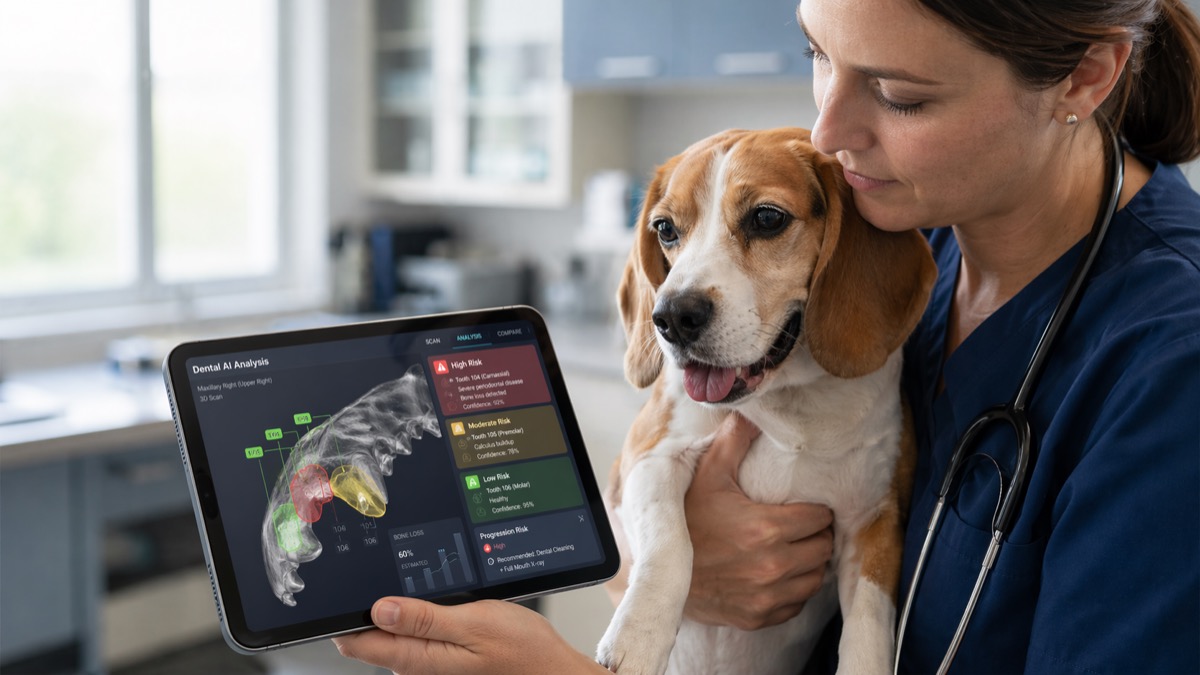
The Nerovet AI Dental company is carving a niche in pet dentistry while Overjet and Pearl dominate the human dental AI market. What you should know.
A dog owner uploads a smartphone photo of her spaniel’s teeth on a Saturday morning, and within seconds gets a risk score for possible dental disease. No X-ray, no clinic visit, no appointment. That is the basic pitch of the Nerovet AI Dental company, a startup that has chosen a corner of dental AI most investors have ignored: pets. While the biggest human dental AI players keep raising record rounds, Nerovet is running a very different play with a consumer-friendly scanner and a free tier. It may work. It may also expose the startup to questions the established leaders have already answered with FDA clearances and published studies.
What is the Nerovet AI Dental company, really?
It is not a human radiograph platform. According to its own website nerovet.com, Nerovet positions itself as an AI pet dental platform for clinics and pet owners, built around photo and X-ray analysis for dogs, cats, and other animals. The product looks closer to a consumer app than to the enterprise clinical tools used by human dentists.
The company lists a free tier plus two paid plans: a Pro plan at $9.90 per month and a Lifetime option at $199, according to its public pricing page as reviewed by Zerlo in December 2025. That pricing pattern sits well below what human dental AI platforms charge practices, and it signals a mass-market distribution strategy rather than a traditional SaaS sales motion aimed at clinic chains.
Public information about Nerovet is limited. No funding rounds, founder names, or headquarters have been disclosed in established tech press or databases like PitchBook as of early 2026. This is an inference based on the absence of Nerovet from major dental AI competitor lists compiled by CB Insights and Owler, which feature Overjet, Pearl, VideaHealth, Denti.AI, and ORCA Dental AI but not Nerovet.
A niche bet on pet dentistry, not human radiology
The choice to focus on veterinary care is the most interesting thing about the Nerovet AI Dental company. Dental disease is massively underdiagnosed in pets. The American Veterinary Dental College estimates that about 80% of dogs and 70% of cats show signs of dental disease by age three, yet pet dental services account for just 6.4% of total veterinary practice revenue, according to industry figures cited by PunsNation in a November 2025 analysis.
That gap is the market Nerovet is going after. A photo-based screening tool is easier to deploy than enterprise radiograph analysis. It can reach owners directly through a phone, without needing integration with a clinic’s imaging stack.
The tradeoff is clinical depth. Photographs surface visible surface conditions. They miss a lot of what X-rays catch, especially periodontal bone loss and endodontic issues. Nerovet itself frames the tool as a “second opinion” rather than a diagnostic device, which is a reasonable way to set expectations.
The principle extends across species. Horses, like dogs and cats, depend entirely on their owners for preventive care, and that responsibility begins long before the first vet visit. Many owners start by finding the right identity for the animal, and dedicated tools such as Horse Names help with that early decision before health monitoring becomes part of the routine.
How Nerovet compares to Overjet, Pearl, and VideaHealth
On the human side, the dental AI market is dominated by a small club of well-funded players. Overjet, founded in 2018 and based in Boston, has raised around $133 million in total funding based on public sources compiled by PunsNation in November 2025. Its $53 million Series C in 2022 was, at the time, the largest single investment in dental AI on record, according to a May 2025 analysis from Faliam.
Pearl, headquartered in California, secured multiple FDA 510(k) clearances, including a panoramic radiograph clearance in December 2025. VideaHealth, also Boston-based, plays in the same enterprise segment, selling to dental service organizations (DSOs) and insurers. None of them target pets.
That separation is the first thing a clinic should understand. Nerovet and Overjet are not substitutes, they are different products for different customers. Most of the confusion in search results comes from content farms that conflate the terms.
Nerovet vs the human dental AI leaders at a glance
| Company | Core focus in 2026 |
|---|---|
| Nerovet | Photo-based pet dental screening, consumer pricing from free to $199 |
| Overjet | FDA-cleared radiograph analysis for human clinics and insurers, around $133M raised |
| Pearl | Multiple FDA 510(k) clearances including panoramic analysis, December 2025 |
| VideaHealth | AI radiograph platform for DSOs and payers, same enterprise league as Overjet |
The FDA question nobody can ignore
Regulatory status matters in healthcare AI. Human dental AI vendors have been investing hard in it. As of December 2025, 44 dental AI devices had received FDA 510(k) clearance, with 18 new clearances granted in 2025 alone, according to a December 2025 analysis from medical device consultancy Innolitics.
Nerovet does not appear on any public FDA cleared device list. The company refers to “global clinical standards” without disclosing specific approvals. For a pet-focused consumer app, that regulatory gap may be acceptable to early users, but it becomes a real question if a veterinary clinic wants to rely on the tool for clinical decisions.
Flash Flyer Magazine, in an October 2025 review, flagged the absence of FDA clearance and the lack of independent studies as the main red flags for buyers evaluating Nerovet. Overjet and Pearl have both funded peer-reviewed clinical work comparing AI reads to specialist reads. Nerovet has not published equivalent data at the time of writing.
Market context: why dental AI is the next healthtech wedge
The broader dental AI market is growing fast. Towards Healthcare estimated the global AI in dental market at about $559 million in 2025, with projections reaching around $3.26 billion by 2034, a compound annual growth rate of roughly 21.78%, based on its December 2025 report.
Most of that growth sits in human dentistry, particularly in imaging and radiograph analysis, which represented about 41.8% of the AI-powered dental workflow platforms market in 2024 according to Data Bridge Market Research. North America leads adoption, with digital dentistry holding 38.53% of 2025 revenue in that region per Mordor Intelligence figures dated February 2026.
For the Nerovet AI Dental company, the implication is simple. The pie is big enough that a consumer-facing pet niche could grow into something meaningful without directly colliding with the human-radiology incumbents. The real question is whether Nerovet can build the clinical credibility that pet owners, and more importantly veterinary clinics, will need before trusting it with diagnostic decisions.
Frequently asked questions
Is Nerovet AI Dental a human dental platform?
No. Based on its public website and available reviews from late 2025 and early 2026, Nerovet focuses on pet dental screening for dogs, cats, and other animals. It is not a substitute for human dental AI platforms like Overjet or Pearl.
Does the Nerovet AI Dental company have FDA clearance?
As of early 2026, no public FDA 510(k) clearance has been confirmed for Nerovet. The company references “global clinical standards” without specifying approvals. Veterinary clinics considering the platform should verify current regulatory status directly.
How does Nerovet price its service?
Public reviews describe a free tier, a Pro plan at $9.90 per month, and a Lifetime plan at $199. That consumer-friendly pricing sits well below the enterprise contracts typical of human dental AI vendors.
Who are the biggest dental AI companies besides Nerovet?
On the human side, Overjet, Pearl, VideaHealth, Denti.AI, and ORCA Dental AI lead the market. They focus on radiograph analysis for clinics and insurers, backed by FDA clearances and venture funding.
Is Nerovet safe to use for pet owners?
The free tier is low risk for owners looking for a simple screening prompt. It should be treated as an early-warning signal, not a diagnosis. Any concerning finding still needs a veterinary exam with proper imaging.
What to watch next
The Nerovet AI Dental company sits in an interesting spot. It is not competing with Overjet or Pearl, and that is probably a good thing for its survival odds. The veterinary dental niche is large, underserved, and mostly invisible to the investors writing the big checks for human dental AI.
Three things will decide whether Nerovet becomes a real player or stays a curiosity. First, regulatory clarity: either a veterinary-specific validation study, or a formal approval path that reassures clinics. Second, published accuracy data that can be independently reviewed. Third, a clear channel strategy, because consumer apps and clinic integrations rarely thrive under the same roof.
For now, pet owners curious about early screening can try it at minimal cost. Clinics evaluating it for workflow integration should slow down, ask for validation data, and confirm what the platform actually does beyond the marketing page. That is how the human dental AI leaders earned their credibility, and the same bar applies here.
Want more tech and innovation coverage like this? DualMedia Innovation News tracks the technology shifts that actually matter, from AI to foldable hardware to the next wave of consumer products.