

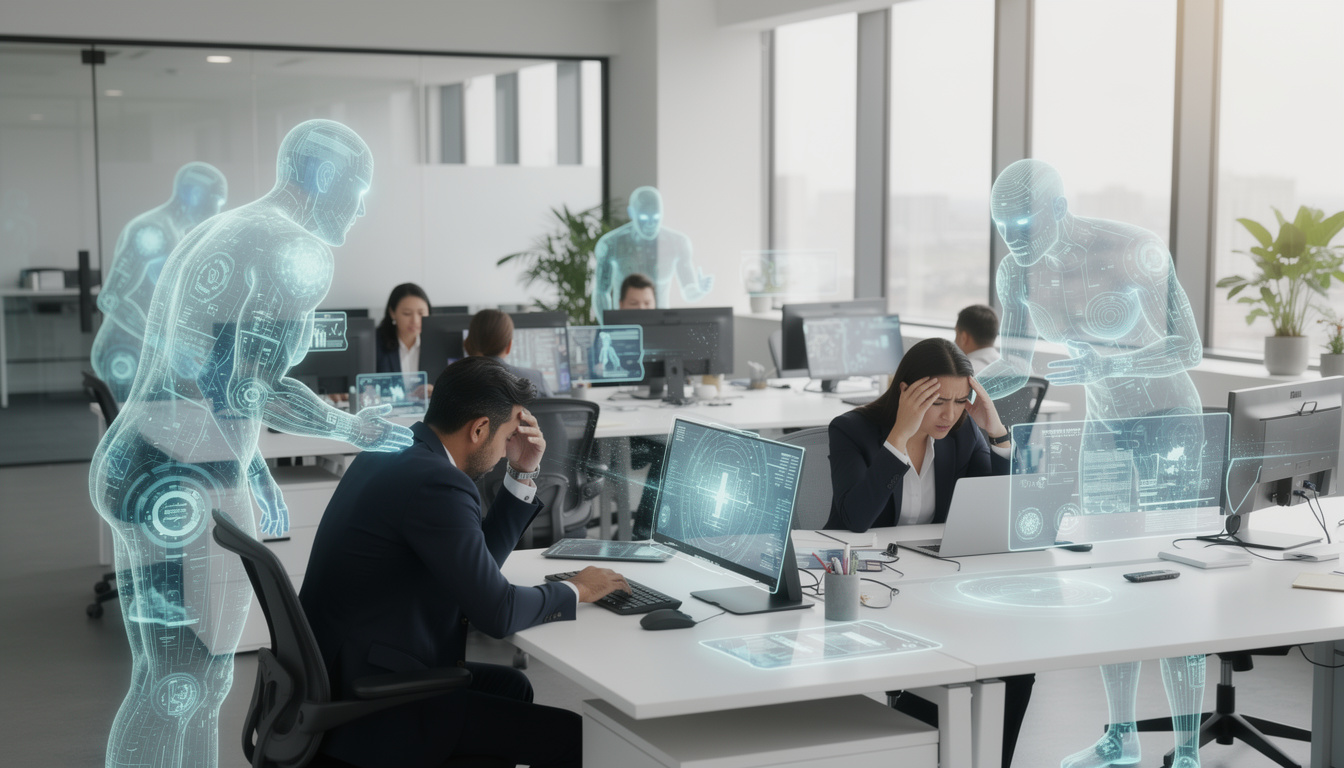
AI agents will micromanage employees is becoming a sharper workplace warning than the old fear of mass replacement. Picture a Monday morning where a sales rep gets nudged by software to rewrite an email, a developer is prompted to justify a coding delay, and a manager receives a dashboard ranking every team member by responsiveness. That scene is no longer speculative theater. It reflects a growing enterprise shift around agentic AI, especially after comments from Nvidia CEO Jensen Huang suggested that future AI systems may supervise people closely rather than simply take their jobs. For workers, executives, and IT teams, the issue is no longer whether AI enters the office. It is what kind of boss it becomes once it gets there.
Why AI agents will micromanage employees before they replace them
Huang’s framing matters because it redirects the conversation from job extinction to workplace control. Nvidia has become one of the most influential companies in AI infrastructure, and its leadership often shapes how the market talks about automation. When a figure tied so closely to the AI buildout suggests that digital agents will pressure workers, the statement lands differently than routine futurist chatter.
The logic is simple. Replacing an employee outright is expensive, risky, and often slower than companies expect. Supervising that same employee through AI tools is easier. A system can monitor output, flag delays, score behavior, recommend next actions, and create a constant layer of intervention without forcing a company to redesign every workflow from scratch.
That model is already visible across software categories. Customer service platforms route conversations in real time, marketing systems suggest campaign changes minute by minute, and coding assistants increasingly shape development pace. Readers tracking 24/7 marketing teams built by AI agents have seen how fast operational oversight is moving from humans to software. The same management pattern can spread inside internal teams.
There is also a practical reason executives may prefer this route. Most businesses still need human judgment for edge cases, compliance decisions, and client relationships. What they want is tighter output control. In that environment, AI agents will micromanage employees by acting as digital supervisors, task assigners, and performance prompters long before full autonomy becomes trustworthy enough for broad replacement.
A familiar office example makes the point clearer. Imagine a mid-sized e-commerce company where an account manager named Elena handles partner updates, inventory calls, and internal reporting. Instead of removing Elena, management deploys an agent that tracks her response times, drafts follow-ups, suggests escalation language, and alerts her boss if she ignores a recommended action. Elena remains employed, but her workday becomes narrower, more measurable, and more tightly steered. That is the real near-term shift.
What makes this model attractive to companies
Boards and department heads like measurable systems. AI oversight creates a stream of timestamps, compliance records, and workflow data that can be shown to investors or auditors. This is especially appealing in industries where leaders want more output without increasing headcount.
It also fits current enterprise spending patterns. Over the last year, companies have invested heavily in copilots, workflow automation, and analytics layers, not just humanoid replacement fantasies. In other words, the market has been funding supervision software disguised as productivity software.
Several forces explain why this is happening:
- Lower deployment risk than replacing a full role
- Better auditability for regulated environments
- More control over daily output and internal timing
- Cleaner ROI narratives for executive teams
The core insight is hard to miss. The first AI manager may not look like a robot executive. It may look like a helpful assistant that never stops watching.
That shift also intersects with a broader pattern in enterprise software. Systems sold as personalization, optimization, or assistance often gain power by shaping worker behavior. A similar dynamic appears in consumer-facing services, where recommendation engines quietly influence decisions, as explored in this look at AI personalization and privacy. Inside companies, the same design logic can become more direct and more coercive.
How agentic systems are changing management, security, and pressure at work
The term agentic AI usually refers to software that can plan, act, and respond across multiple steps with limited human input. In practice, that can mean an internal system that watches tickets, opens tasks, sends reminders, and asks workers to justify delays. Once connected to Slack, email, CRM tools, developer platforms, and HR dashboards, these agents become far more than passive assistants.
This is where the workplace tension grows. A human manager may check in once a day or once a week. A digital agent can intervene every few minutes. It can score urgency, compare employees, and trigger escalation automatically. That creates a different psychological environment, one built around constant correction rather than periodic review.
Analysts and enterprise leaders have been discussing the rise of autonomous workflows for months. McKinsey has published recent research on generative AI’s role in business processes, while major vendors continue pushing assistant-to-agent transitions. This is an inference based on that product direction and current enterprise rollout patterns, not on a single universal deployment model. Still, the trajectory is visible.
Security teams offer an especially revealing case. AI already helps triage threats, correlate signals, and recommend action steps. But when those same tools start assigning urgency to staff, questioning response delays, or flagging deviations from expected behavior, the line between assistance and pressure blurs quickly. Coverage of AI cybersecurity automation and AI agents in cyber defense shows how oversight-heavy these systems can become when stakes are high.
| Key detail | Why it matters |
|---|---|
| Nvidia leadership is signaling supervision over replacement | It shifts the AI labor debate toward control, not just layoffs |
| Agentic tools connect across workplace software | They can monitor, prompt, and escalate in real time |
| Security and operations teams adopt AI early | High-pressure environments normalize software-led oversight |
| Workers stay employed but lose autonomy | The job remains, but discretion can shrink fast |
The pattern becomes clearer when mapped onto a normal workday. A support lead starts a shift with an AI-generated ranking of unresolved tickets. Midday, a prompt recommends a tougher tone for a delayed vendor. By afternoon, the system has already informed management that the lead overrode three suggestions. None of this removes the worker. It surrounds the worker.
There is another layer that deserves attention, and it is power concentration. The more company knowledge flows into one orchestration layer, the more authority shifts from local teams to central platforms. That may improve consistency, but it can also reduce the room for expertise, context, and human judgment. Efficiency sounds clean on a slide deck. Daily work rarely is.
Why employees may experience this as harassment
Micromanagement feels different when software does it at machine speed. A manager might overlook a slow morning or a difficult client interaction. An agent logs every gap, every pause, every deviation from the preferred path. That can produce a steady drip of prompts that workers experience as suspicion.
Language matters too. If a system is trained to maximize throughput, it may constantly push urgency, even when human context says a slower response is wiser. In that setting, a suggestion engine becomes a pressure engine.
Recent concerns about model behavior and enterprise safety have reinforced that caution. Reports around frontier model governance and enterprise AI controls, including discussions linked to Anthropic and OpenAI, show how unresolved these operational questions remain. The software may be fast, but organizational trust moves more slowly.
What businesses should watch as AI agents will micromanage employees at scale
Executives who hear Huang’s prediction as a green light should slow down and look at implementation risk. If AI agents will micromanage employees across departments, the company has to decide where supervision is legitimate and where it becomes corrosive. That is not just a cultural question. It is a legal, technical, and governance issue.
Three warning signs matter early. First, when agents begin evaluating workers with opaque scoring logic, bias and misclassification risks rise. Second, when recommendation systems become de facto commands, accountability gets muddy. Third, when managers rely on AI summaries instead of direct observation, they may inherit the tool’s blind spots and amplify them.
The labor market context also sharpens this tension. Fears around AI and employment have not disappeared, and some businesses are already using automation to justify restructuring. Reporting on companies using AI alongside layoffs shows why workers are likely to view heavy monitoring with skepticism. If software starts grading them while the company trims headcount, trust evaporates.
For practical governance, firms should define where agents can recommend, where they can act, and where they must stop. An engineering team might allow automated bug triage but forbid performance scoring based solely on keyboard or response metrics. A support department may accept draft suggestions while banning automatic escalation to HR. Small policy lines can prevent big cultural damage.
There is also a design question that rarely gets enough airtime. Should an employee see why an agent made a recommendation? In most cases, yes. Transparency does not solve every problem, but it gives workers a chance to challenge weak inferences before those inferences become performance records.
The companies that get this right will treat agentic systems as bounded tools, not as all-seeing managers. The ones that get it wrong may discover that digital oversight creates the very drag it promised to eliminate, burnout, resistance, and quietly worse decisions.
The bottom line
Nvidia’s message lands because it matches where enterprise AI is actually heading. Full replacement remains difficult in many roles, but AI supervision is deployable right now. That is why the sharper near-term question is not whether software takes your job, but how much authority it gains over your day before that happens.
For readers watching this space, the next phase will likely come from ordinary enterprise tools, not science fiction machines. The agent that changes work may arrive as a scheduler, a coding helper, a service console, or a security copilot. Once embedded everywhere, it can start acting less like a tool and more like a boss.
Why are AI agents more likely to micromanage than replace workers right away?
Because supervising existing staff is easier to deploy than rebuilding an entire role around full automation. Companies can add monitoring, prompting, and workflow control to current software stacks without removing the human employee.
Did Jensen Huang say AI would not affect jobs?
No. The broader point is that AI may reshape jobs through oversight, pressure, and workflow control before it eliminates many of them outright. That distinction matters for how businesses prepare and how workers interpret new tools.
Which industries are most exposed to AI micromanagement?
Customer support, software development, cybersecurity, sales operations, and logistics are among the clearest candidates. These fields already rely on measurable workflows, dashboards, and real-time software prompts.
How can companies reduce the risk of AI-driven workplace harassment?
They can limit where agents are allowed to score or escalate employee behavior, require human review for sensitive decisions, and make recommendations explainable. Clear governance matters as much as model quality.
Want more tech and innovation coverage like this? DualMedia Innovation News tracks the technology shifts that actually matter, from AI to foldable hardware to the next wave of consumer products.