

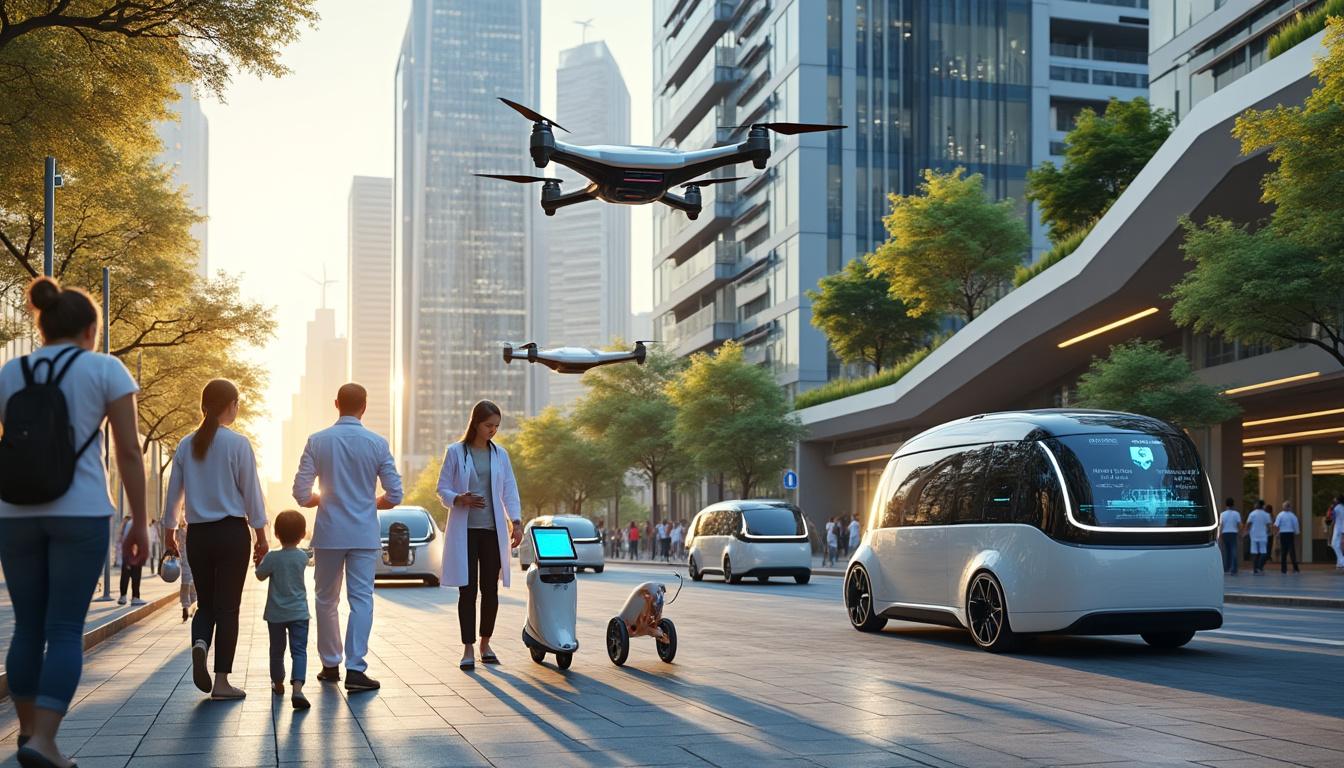
What’s the future for A.I.? how it will change your life forever is no longer a distant question, because AI already shapes how people work, shop, learn, travel, and judge what information to trust.
What’s The Future For A.I.? How It Will Change Daily Life
A parent asks a phone for the fastest route to school. A student uses an assistant to summarize a chapter before class. A shopper gets product suggestions before typing a full search. What’s the future for A.I.? how it will change your life forever starts in these small moments, not in a science fiction scene. The shift feels ordinary until the pattern becomes impossible to miss.
What’s the future for A.I.? how it will change your life forever will show up first through invisible support. AI already helps sort emails, detect fraud, recommend media, flag cyber threats, and guide customer service chats. In the next few years, these systems will move from simple prompts to broader task execution. Instead of opening five apps to plan a trip, compare prices, book transport, and update a calendar, people will hand one intent to an agent and review the result.
This matters because convenience changes behavior. Once a system saves ten minutes a day, users build routines around it. Once a system cuts routine paperwork in half, companies redesign jobs around it. Around 42 percent of enterprise-scale companies had active AI deployments by 2024, and 92 percent planned higher AI investment from 2025 to 2028. That trend points to deeper adoption in offices, hospitals, stores, schools, and homes.
The strongest argument for broad adoption is simple. AI reduces friction in areas people already find tiring. Scheduling, searching, transcribing, comparing, drafting, and monitoring all consume attention. Machines perform these repetitive steps faster. People keep the judgment step, at least in the near term. That hybrid model is why many firms no longer ask whether to use AI, but where to place human review.
History gives context. The field moved from early experiments in the 1950s, to Deep Blue defeating Garry Kasparov in 1997, to Watson winning Jeopardy! in 2011, to transformer-based systems after 2017, to ChatGPT’s public breakout in 2022, and then to GPT-5 in 2025. Each milestone pushed AI from narrow tasks toward broader language, reasoning, and content generation. Competing models from Google, Anthropic, and DeepSeek also drove costs down and access up.
For readers tracking consumer trends, AI shopping assistants offer one clear sign of where personal automation is heading. For people building digital products, the future of AI in web development points to a similar pattern. Less manual assembly, more orchestration, more review.
| Area | What changes first | What people notice |
|---|---|---|
| Home | Scheduling, shopping, reminders | Less routine effort |
| Work | Drafting, research, reporting | Faster output |
| Health | Triage, monitoring, admin support | Quicker responses |
| Education | Tutoring, feedback, personalization | More tailored learning |
The practical point is clear. What’s the future for A.I.? how it will change your life forever begins with small delegated tasks, then expands into daily decision support.
What’s The Future For A.I.? How It Will Change Jobs, Services, And Power
What’s the future for A.I.? how it will change your life forever becomes more serious at work. AI is not replacing every worker. AI is changing the structure of work. Repetitive tasks move first. Entry-level roles with heavy routine output face the fastest pressure. That pattern already appears in software, customer service, reporting, and back-office operations.
Data from recent labor analysis shows a split. In high AI exposure fields, employment for workers aged 22 to 25 fell by 6 percent between 2022 and 2025. For workers aged 30 and older in those same fields, employment rose by 13 percent. The reason is not mysterious. Experienced workers handle ambiguity, client judgment, tradeoffs, and accountability. Current systems still struggle with those layers. Younger workers often start with routine tasks, and those tasks are easier to automate.
Still, the labor story is not one-sided. The World Economic Forum has projected both disruption and creation, with 92 million jobs at risk by 2030 but 170 million new roles emerging. New positions already center on machine learning operations, robotics maintenance, AI governance, model auditing, and human-AI workflow design. What’s the future for A.I.? how it will change your life forever depends on whether schools, employers, and governments move fast enough to retrain people before the gap widens.
Several sectors illustrate the point well.
- Healthcare uses AI for disease detection, admin support, and drug research.
- Manufacturing relies on robotics and predictive maintenance to reduce downtime.
- Finance uses models for fraud detection, audits, and risk scoring.
- Journalism automates routine reports while raising trust questions.
- Transportation tests planning tools and autonomous systems for freight and mobility.
Journalism offers one of the clearest tensions. Newsrooms save time with automated earnings reports and transcription tools, yet the same tools fuel synthetic articles, deepfakes, and confidence tricks. Readers want speed, but they also want proof. That is why AI in newsrooms has become a debate about trust, not only productivity.
Public opinion reflects this divide. Experts tend to be more optimistic than the general public about how AI will affect jobs, health care, and the economy over the next twenty years. Yet both groups remain wary about elections and news. Only a small minority expects AI to improve elections, while around half or more expect harm in information quality. Deepfakes, propaganda, and voice cloning explain why.
Another issue sits under the surface. Energy. Training large systems consumes major electricity and water resources. Estimates tied to older frontier models placed training energy in the tens of gigawatt-hours, and major data centers have used millions of gallons of water per day for cooling. By 2035, AI-related emissions could add between 0.4 and 1.6 gigatonnes of CO2 equivalent annually. So the future of AI is also a future of power grids, data center design, and local environmental strain.
What’s the future for A.I.? how it will change your life forever is therefore a labor question and an infrastructure question at the same time. The winners will not be the fastest adopters alone. They will be the groups that pair automation with training, oversight, and energy discipline.
Security pressure will shape the next stage as well. Companies already track how AI changes threat detection and digital defense, and future predictions for AI in cybersecurity point to a race between smarter defenders and smarter attackers.
What’s The Future For A.I.? How It Will Change Trust, Regulation, And Human Choice
What’s the future for A.I.? how it will change your life forever will be decided less by raw model size and more by rules, incentives, and public trust. A fast answer from a machine means little if the answer is biased, untraceable, or built on stolen data. That is where the argument shifts from performance to legitimacy.
Large language models were trained on vast public and semi-public data sources. People whose words, photos, and preferences fed these systems rarely gave meaningful consent. The result is a growing conflict over privacy and ownership. A 2024 Cisco survey found 48 percent of businesses had entered non-public company information into generative AI tools, while 69 percent worried about damage to intellectual property and legal rights. Those numbers matter because the biggest AI risk in many offices is not a robot takeover. It is careless data exposure.
Bias remains another major fault line. Researchers have repeatedly shown patterns where systems reinforce stereotypes in hiring, image generation, and facial analysis. Prompts about success, leadership, beauty, or danger often produce skewed outputs if guardrails and training methods fail. This is not a side issue. A flawed model used at scale turns a design mistake into a social pattern.
Regulation is now catching up, unevenly. The United States has leaned toward infrastructure growth and competition, while states continue pushing privacy and consumer protections. The European Union’s AI Act reaches full implementation in August 2026 and sets a harder line for high-risk systems. The next legal step will likely focus on behavior in the real world, not only training methods. If an autonomous agent makes a costly medical, financial, or legal error, liability will not stay abstract for long.
There is one promising technical shift. Synthetic data is gaining ground. Analysts expect nearly 60 percent of AI training data to be synthetic around this period, reducing some privacy exposure linked to scraped personal material. Privacy by design, data minimization, encryption, and local processing on edge devices also point in the right direction. These methods do not remove risk, though they reduce the blast radius.
So what should readers watch closely?
| Risk | Why it matters | What improves trust |
|---|---|---|
| Privacy leaks | Personal and business data exposure | Local processing, encryption |
| Bias | Unfair decisions at scale | Audits, better training data |
| Deepfakes | Fraud and political manipulation | Verification tools, provenance systems |
| Opaque decisions | Low accountability | Human review, logging, liability rules |
Trust will also depend on where AI helps in visible ways. In medicine, targeted support for imaging, triage, and admin work has shown stronger public acceptance than AI in politics or news. That pattern is easy to understand. People accept assistance faster when benefits are concrete and the stakes are supervised. Coverage of AI in healthcare reflects this more grounded path forward.
What’s the future for A.I.? how it will change your life forever will not hinge on whether machines think like humans. It will hinge on whether people trust the systems placed in front of them, and whether those systems earn that trust under pressure. If this article raised a strong view, share it or challenge it, because public debate will shape the rules as much as code does.
For readers who want a broader market and industry angle, AI future insights and analysis of the current AI power race help explain why competition, capital, and policy now move together.
Will AI take most jobs away?
AI will remove some routine roles and reshape many others. The larger pattern points to task automation, role redesign, and new jobs in oversight, robotics, data operations, and human-AI coordination.
Which industries will feel AI first?
Customer service, software, finance, healthcare, manufacturing, media, and transportation already feel strong pressure. These sectors produce large amounts of data or repeatable workflows, so automation moves faster there.
Will AI become trustworthy for important decisions?
Trust will grow only when systems prove accuracy, fairness, and accountability in real settings. Most people still resist handing major personal decisions to AI without strong human review.
Is AI bad for the environment?
Large models and data centers consume major energy and water resources. Efficiency gains, edge computing, and cleaner power sources will matter if the industry wants growth without a sharp environmental cost.
What should people learn now to stay relevant?
Focus on judgment, communication, domain knowledge, and AI-assisted workflow skills. People who know how to verify outputs, manage tools, and solve messy problems will stay in a stronger position.
 EN
EN  FR
FR  ES
ES