

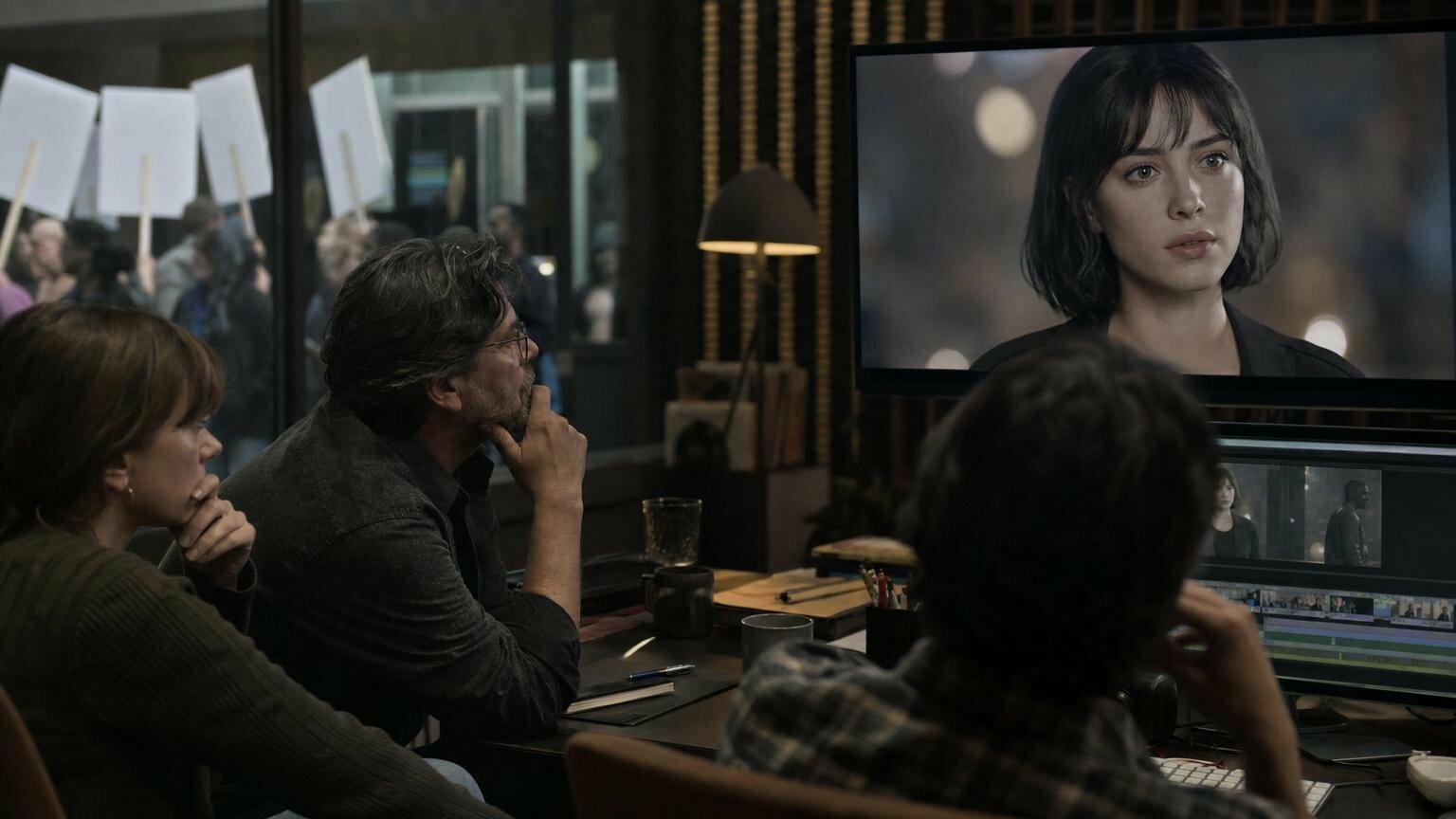
The AI actor Tilly Norwood is reportedly set to headline “Misaligned,” an early-development Particle6 feature film, according to Forbes on July 6, 2026. The short answer: yes, the project has been reported, but details are thin, no release date is clear, and SAG-AFTRA has already rejected the premise that Tilly Norwood is an actor rather than an AI-generated character.
AI actor Tilly Norwood and the film now attached to her
Forbes reported on July 6, 2026, that Tilly Norwood will star in a new feature film titled “Misaligned,” produced by Particle6. The company described the project as a comedy-drama coming-of-age story “infused with existential AI chaos,” a phrase that sounds designed to provoke Hollywood as much as to sell a movie.
Particle6 also said the film would be entirely AI, while involving AI specialists alongside traditional directors, writers and editors. That detail matters. It suggests the film is not simply a software demo pushed onto a streaming platform, but a hybrid production process with human creative labor still in the loop.
One caveat should sit near the top: as of the July 6, 2026 reporting, “Misaligned” was still in early development and had no clear release date. No second reliable source confirming the feature-film announcement was found in the supplied research, so the claim is real but still narrow. Treat it as a reported development, not a finished film on a release calendar.
The search intent here is mostly informational. You want to know whether an AI performer is really headlining a movie, why actors are angry, and what it means for film work. The answer is less clean than the headline: an AI character can be marketed like a star, but the legal, labor and creative machinery around that claim is still being fought over.
Who created Tilly Norwood?
Tilly Norwood was described in 2025 by the Associated Press and Forbes as an AI-generated “actor” or “actress” created by Eline Van der Velden. She is associated with Particle6 and Xicoia, which AP reported billed itself as the world’s first AI talent studio.
Xicoia introduced or promoted Tilly Norwood at the Zurich Film Festival and Zurich Summit on September 27, 2025, according to AP and Backstage. The setting was no accident. Zurich is not a fringe tech meetup; it gave the character immediate proximity to film executives, investors and press.
By September 2025, AP reported that Tilly Norwood’s Instagram account had more than 33,000 followers as of the Tuesday covered in its report. Van der Velden also told AP that talent agencies were “circling” Norwood and that she expected to announce a signing soon. That is where the story stopped being a novelty and became an industry stress test.
Particle6 had already pushed the character into music video territory. Forbes reported that in March 2026 the company released a music video starring Tilly Norwood titled “Take The Lead.” A video can be controlled, short and promotional; a feature film asks a much harder question about performance over time.
Why SAG-AFTRA denounced the synthetic performer
SAG-AFTRA issued a statement on September 30, 2025, saying “Tilly Norwood” is not an actor but an AI-generated character. The union opposed replacing human performers with synthetic performers, and its language was unusually direct.
The timing carried weight because the 2023 SAG-AFTRA strike had ended with AI protections related to actors’ likenesses and performances. AP cited AI as a major bargaining issue during that strike. Actors had already spent months arguing that studios should not scan, reuse or imitate performers without meaningful consent and compensation.
SAG-AFTRA also said in 2025 that signatory producers may not use synthetic performers without complying with contractual obligations requiring notice and bargaining. In plainer English: a union-covered producer can’t simply drop an AI actor into a role and pretend the contract doesn’t apply.
That’s the pitfall many casual takes miss. The fight is not only “human art versus machine art.” It is also about bargaining units, credit, reuse rights, residuals, consent, and who gets paid when a synthetic face stands where a working actor might have stood.
The numbers behind a “cheaper” AI actor
The business pitch for an AI actor usually starts with cost. No trailers. No illness. No travel days. No overtime. It sounds tidy until you actually map the labor around a synthetic performer.
Here is a simple 2026 comparison, based only on reported facts and standard production categories rather than invented budgets. The point is not that one side is always cheaper. The point is that the cost moves.
| Production factor | Human actor in a feature | AI actor in an AI-led feature | 2026 practical effect |
|---|---|---|---|
| Performance source | Actor’s body, voice, choices and retakes | Generated character controlled by a production team | Creative control shifts from performer to pipeline |
| Labor obligations | Contracts, union rules, residuals where applicable | SAG-AFTRA says notice and bargaining may be required for signatory producers | Legal savings are not automatic |
| Iteration cost | Reshoots, scheduling, actor availability | Prompting, model work, editing, compositing, review | Cheaper changes may create more revisions |
| Publicity value | Interviews, fan base, red carpets, press tours | Social accounts and novelty coverage | Attention is easier at first, trust is harder |
| Known Tilly Norwood metric | Not applicable | More than 33,000 Instagram followers reported by AP in September 2025 | Early audience signal, not proof of box-office demand |
Take one rough calculation. If a production saves five physical shoot days by using a synthetic performer but adds eight weeks of specialist iteration, review and fixes, the savings may evaporate for anything beyond a short promotional clip. Honestly, an AI-first feature only makes obvious financial sense if the whole production language is built around generated performance from the start.
That seems to be the Particle6 pitch for “Misaligned,” since Forbes reported the film would be entirely AI. A half-AI, half-live-action production can get trapped in the uncanny middle, where synthetic characters must match human actors, real sets and natural camera physics. Full stylization gives the technology more room to breathe.
What “Misaligned” could change for actors and studios
The most immediate change is symbolic. If an AI actor headlines a feature, even an early-development one, studios and agencies get a new test case for whether synthetic performers can be packaged like talent. Representation, licensing and brand deals could follow before the audience decides whether the performance works.
Writers and directors are in a strange position here. Particle6 said the project would involve traditional directors, writers and editors as well as AI specialists, according to Forbes in 2026. So the creative class is not removed; it is reorganized around tools, approvals and generated assets.
That pattern is familiar in other technical fields. AI systems often don’t erase the job in one clean sweep; they change the quality bar, the review burden and the skills that matter. The same dynamic is already visible in software teams, where AI tools are reshaping engineering quality skills rather than making judgment disappear.
Actors, though, face a sharper threat because their face, voice and movement are the product. A developer can audit code written with assistance. A performer can’t easily compete with a synthetic character that never ages, never refuses a scene and can be revised after the fact.
There is a counter-argument worth taking seriously. Animation, puppetry and digital characters have always used non-human bodies to create performance, and nobody claims Gollum or WALL-E killed acting. The difference is credit and substitution: Andy Serkis, animators, voice actors and directors were visible labor behind those characters, while an AI actor can be marketed as if the synthetic entity itself deserves the role.
How to read the hype without getting fooled
The smartest way to follow the Tilly Norwood story is to separate four things that headlines tend to mash together: a character, a company, a production technique and a labor dispute. They overlap. They are not the same.
- Check the source and date. The “Misaligned” feature claim comes from Forbes on July 6, 2026; the SAG-AFTRA denunciation is dated September 30, 2025.
- Look for a release date. Early development means the project can change, stall or be repositioned before viewers see anything.
- Ask who is doing the work. “Entirely AI” does not mean no humans; Particle6 described AI specialists plus directors, writers and editors.
- Watch the contract status. SAG-AFTRA’s warning about notice and bargaining applies to signatory producers, not every online video or overseas experiment.
- Don’t confuse followers with demand. AP’s reported 33,000-plus Instagram followers in September 2025 show curiosity, not ticket sales.
There is also a reputational risk that does not fit neatly into a budget spreadsheet. A film sold around an AI actor may get free attention from controversy, then suffer if audiences read it as an attack on working performers. At this stage, the backlash is part of the product.
The technology itself will keep improving. Browser graphics, on-device models and real-time rendering are moving fast, and the production pipeline behind synthetic characters may become cheaper as underlying tools mature. If you follow the technical side, WebGPU’s role in browser-based AI and graphics is one useful piece of the broader puzzle.
Identity is the other under-discussed issue. The entertainment business is built on names, faces, agents, verified accounts and audience trust. As synthetic personas become more convincing, the same verification problems seen in synthetic identity fraud will have a cultural version: who, exactly, is speaking, endorsing or performing?
Where the AI actor debate goes next
The next serious milestone is not a press release. It is distribution. If “Misaligned” reaches a known platform, festival or theatrical buyer, the debate will move from theoretical labor anxiety to contract-by-contract reality.
Agencies are another pressure point. AP reported in September 2025 that Van der Velden said agencies were “circling” Tilly Norwood. If a major agency signs or packages an AI actor, rivals will be forced to decide whether they treat synthetic talent as a client, an asset, or a conflict with their human roster.
For studios, the attraction is obvious: controllable IP with a face. For actors, the threat is just as obvious: a bargaining chip that can be used to push down fees or test audience tolerance for replacement. My read is simple: AI characters will become part of production, but calling them actors is a deliberate provocation, not a neutral description.
Search visibility will also shape public understanding. Studios and tech companies can flood the web with polished explainers, bios and synthetic interviews, while unions respond with legal language. Anyone tracking how AI systems answer entertainment queries should understand generative engine optimization, because future audiences may meet these synthetic performers first through answer engines rather than trailers.
The phrase AI actor is useful because people search it, but it hides the central question. A generated character can appear in a film. It can be promoted. It can attract followers. Can it perform in the human sense of taking direction, risking failure, bringing lived experience and negotiating consent? That is where the industry is still split.
FAQ
Is Tilly Norwood a real actor?
SAG-AFTRA says no. In its September 30, 2025 statement, the union called Tilly Norwood an AI-generated character, not an actor.
What movie is the AI actor Tilly Norwood starring in?
Forbes reported on July 6, 2026, that Tilly Norwood will headline “Misaligned,” a Particle6 feature described as a comedy-drama coming-of-age story with AI chaos. The project was still in early development, with no clear release date.
Why are actors upset about Tilly Norwood?
Actors and SAG-AFTRA object to synthetic performers being used to replace human labor, especially without notice, bargaining, consent or compensation. The issue connects directly to the AI protections negotiated after the 2023 strike.
Is “Misaligned” confirmed by multiple sources?
The supplied research found Forbes reporting the “Misaligned” announcement on July 6, 2026, but no second reliable source confirming that specific feature-film development. The broader Tilly Norwood controversy was covered by AP, Backstage and SAG-AFTRA.
Can an AI actor be used in a union production?
SAG-AFTRA said in 2025 that signatory producers may not use synthetic performers without meeting contractual obligations, including notice and bargaining. The exact answer depends on the production, contract and use case.