

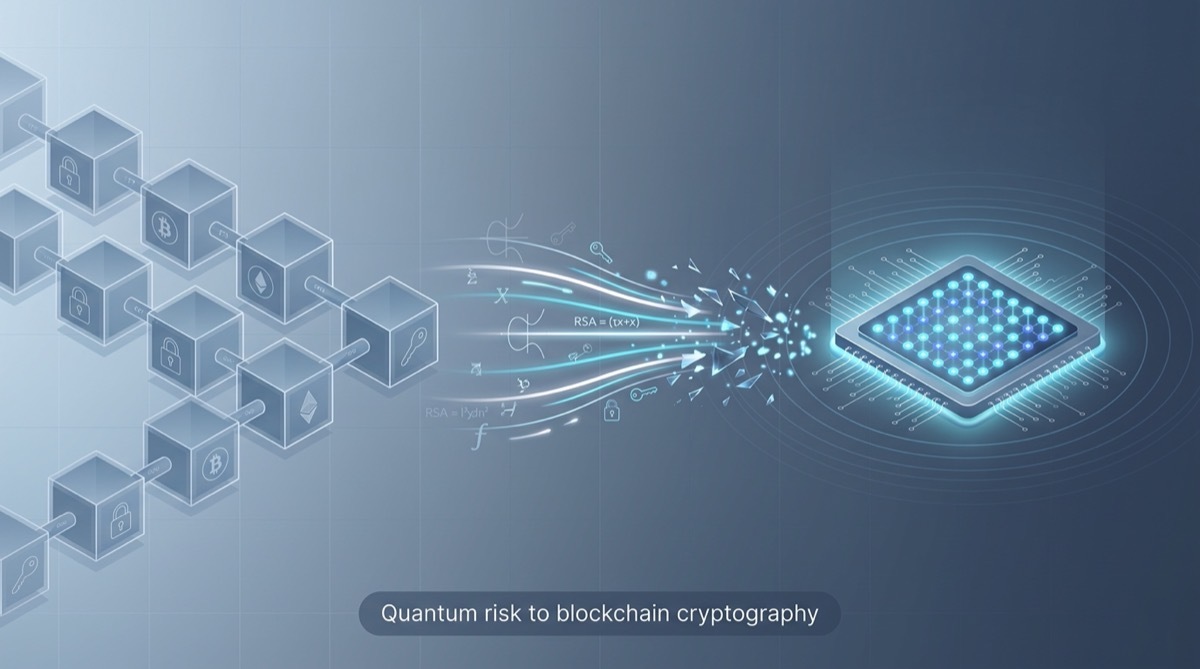
For years, we told ourselves quantum computers were decades away. Then in April 2026, Wall Street broker Bernstein warned that breakthroughs put everyday encryption – and every Bitcoin private key – on a three- to five-year timer. Suddenly the question isn’t if quantum will crack blockchains but when, and whether you’ll be ready.
Yet most discussions drown in jargon: Shor’s algorithm, post-quantum cryptography, lattice signatures. You need a clear, actionable path, not hype.
This guide delivers exactly that. We’ve vetted seven standout resources – from an executive-level report to a hands-on developer course – that will help you defend your coins, contracts, or company.
Let’s dive in.
Why quantum computing poses a new risk to blockchains
Blockchains live and die by math. Every Bitcoin or Ethereum transaction relies on asymmetric cryptography: a public key for the world to see and a private key only you control. Classical computers would need longer than the universe has existed to factor huge integers or reverse elliptic-curve equations, so the split feels safe today.
Quantum machines rewrite that math. Shor’s algorithm can slice through the hard problems that protect wallets. With enough stable qubits, a quantum processor can derive a private key from its public twin, forge a signature, or even rewrite an old block without raising alarms.
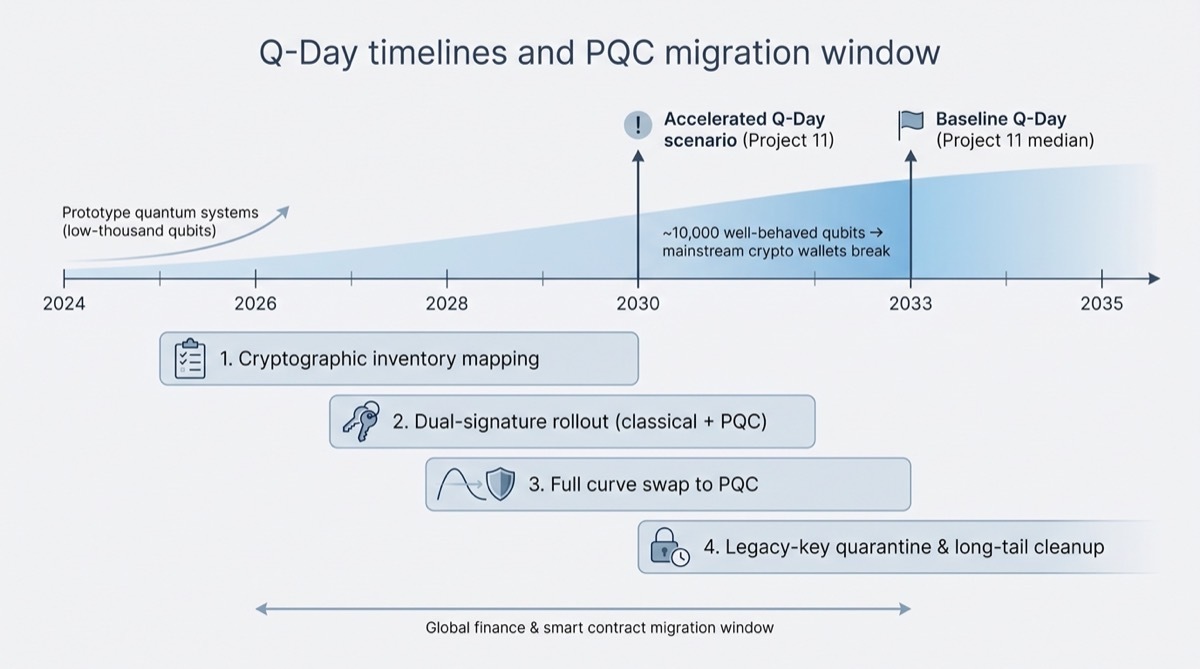
Until recently, “enough” sounded distant. Early forecasts called for hundreds of millions of error-corrected qubits, a bar we would not reach for decades. Then researchers recalculated. In March 2026, they showed that about 10,000 well-behaved qubits could empty mainstream crypto wallets in hours, not centuries.
That new threshold jolts the timeline. Labs already demo prototype systems in the low-thousand-qubit range. Error rates and coherence times still hold them back, yet the finish line no longer feels imaginary. Project 11’s 2026 Quantum Threat to Blockchains report models Q-Day at 2033 under median hardware progress, with an accelerated case at 2030. It also outlines a four-phase PQC Migration Framework – inventory mapping, dual-signature rollout, full curve swap, and legacy-key quarantine – that underscores why even an eight-year runway is tight for global networks. Even if practical attacks arrive in the early 2030s, migrating global finance and every smart contract to post-quantum algorithms will take years – longer than the grace period we have left.
The takeaway is simple. Classical cryptography is on borrowed time. Start mapping a quantum-safe path now: upgrade wallets, harden protocols, and test NIST-approved signatures. The seven resources that follow give you a head start before Q-Day.
How we picked the seven stand-out resources
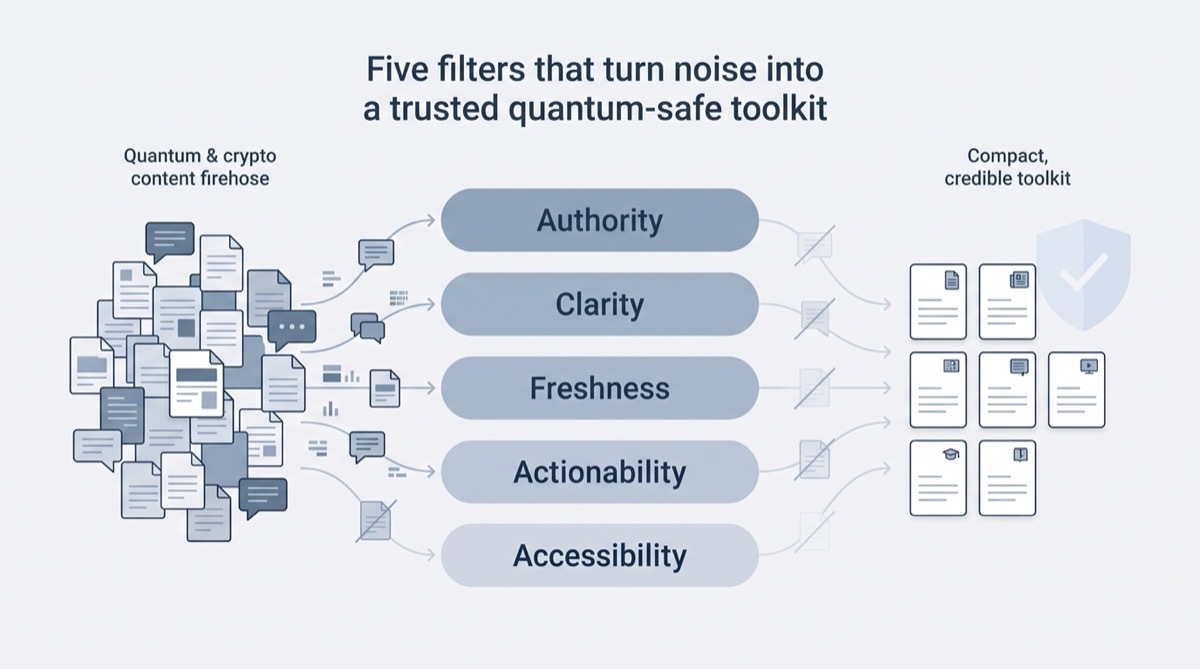
You face a torrent of quantum-crypto content. White papers, Twitter threads, half-baked Medium posts: the flow never stops. We trimmed that chaos to a crisp shortlist by checking five filters.
First, authority. We chose voices that shape policy or ship code, such as NIST scientists, Coinbase researchers, and long-time security auditors.
Second, clarity. The best experts teach rather than grandstand. Each resource turns heavy math into stories, analogies, or live demos you can follow without a PhD.
Third, freshness. Quantum hardware is sprinting, so a 2022 blog already feels Jurassic. Our picks sit in the 2024 to 2026 window and reflect the latest NIST standards and qubit milestones.
Fourth, actionability. Theory alone will not protect private keys. Every item hands you a next step – checklists, code snippets, or migration roadmaps.
Finally, accessibility. Knowledge should not hide behind paywalls. All seven resources are free to read or audit, costing you only time.
Apply those five filters and the noise fades. What remains is a compact, credible toolkit you can trust while you chart a quantum-safe course.
The 7 best resources for learning about quantum and blockchain risk
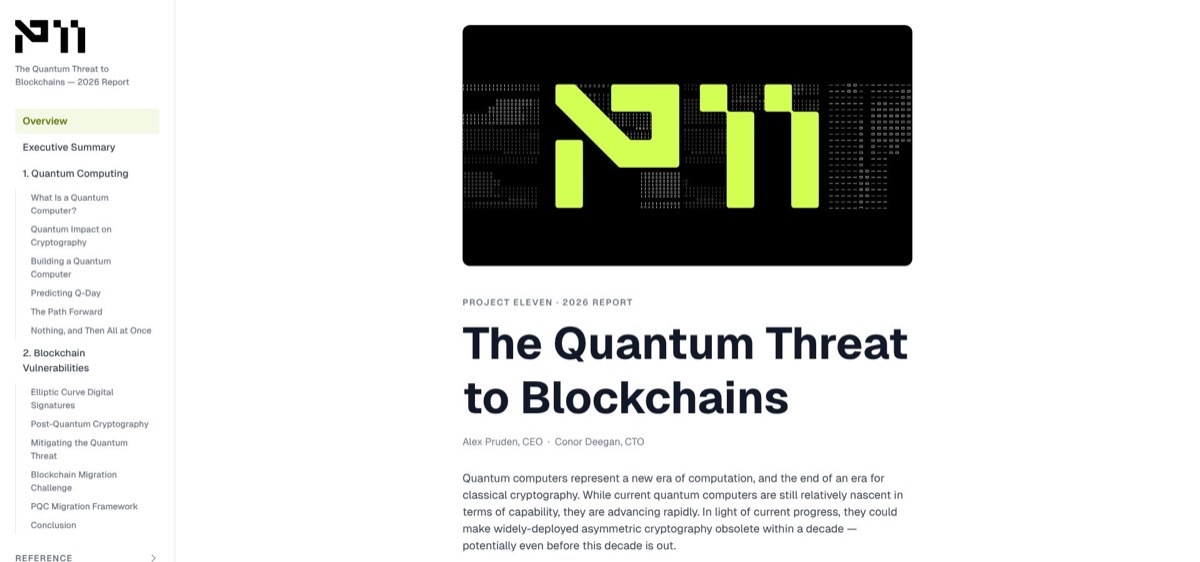
1. 2026 Quantum Threat to Blockchains – Project Eleven report
Picture a field manual that speaks to executives and developers at once. Project Eleven’s fifty-page PDF opens with a plain-language explainer of qubits and Shor’s algorithm, then moves into timelines, attack scenarios, and migration checklists.
Published in early 2026, it folds in the final NIST post-quantum standards and the latest hardware milestones. Charts translate research into dates: when wallets turn fragile, when major chains need upgrades, and how long a staged rollout takes.
The tone stays pragmatic. Guidance such as “replace ECDSA with Dilithium for signatures” and “test key-rotation scripts on a shadow chain first” gives both boardrooms and engineers a direct action list. The download is free.
2. Coinbase Institute “Crypto and Quantum Computing” explainer
This ten-page brief is the perfect pre-meeting primer. Coinbase’s research arm frames quantum risk in finance language: market stability, custody exposure, and regulation.
Graphs map qubit growth against Bitcoin adoption, making the urgency visual. A second chart lists NIST finalist algorithms beside classical equivalents so decision-makers can see swap-in options instantly.
Plain prose, clear analogies, and a firm call to action – audit key storage now and budget for post-quantum upgrades next fiscal year – make this a must-read for anyone managing assets.
3. PostQuantum blog “The Quantum Threat to Cryptocurrencies: What’s Real, What’s Hype, and What to Do About It”
Marin Ivezic ends the subreddit shouting match between “relax” and “panic.” A myth-versus-fact table leads the article, followed by practical defense steps: which NIST finalists plug into wallets today and which “quantum-safe” coins rely on untested math.
Links to open-source repos and a friendly, corrective tone turn debate into action. In eleven minutes you gain a to-do list, not simply an opinion.
4. OpenZeppelin “A Practical Guide to Quantum Risk in Blockchain”
Security engineer Yuguang Ipsen drills into code-level fixes that busy devs can copy and ship. Each weak point – signatures, key storage, multi-sig logic – gets a side-by-side patch: “ECDSA → Dilithium-2,” “secp256k1 → Falcon-512,” “SHA-256 → SHA-3 plus redundancy.”
A staged migration plan follows: spin up a hybrid-signature testnet, rotate user keys, then retire the legacy curve. War stories on gas-cost spikes and payload trimming save teams from repeat mistakes.
5. QRAMM (Quantum Readiness Assurance Maturity Model)
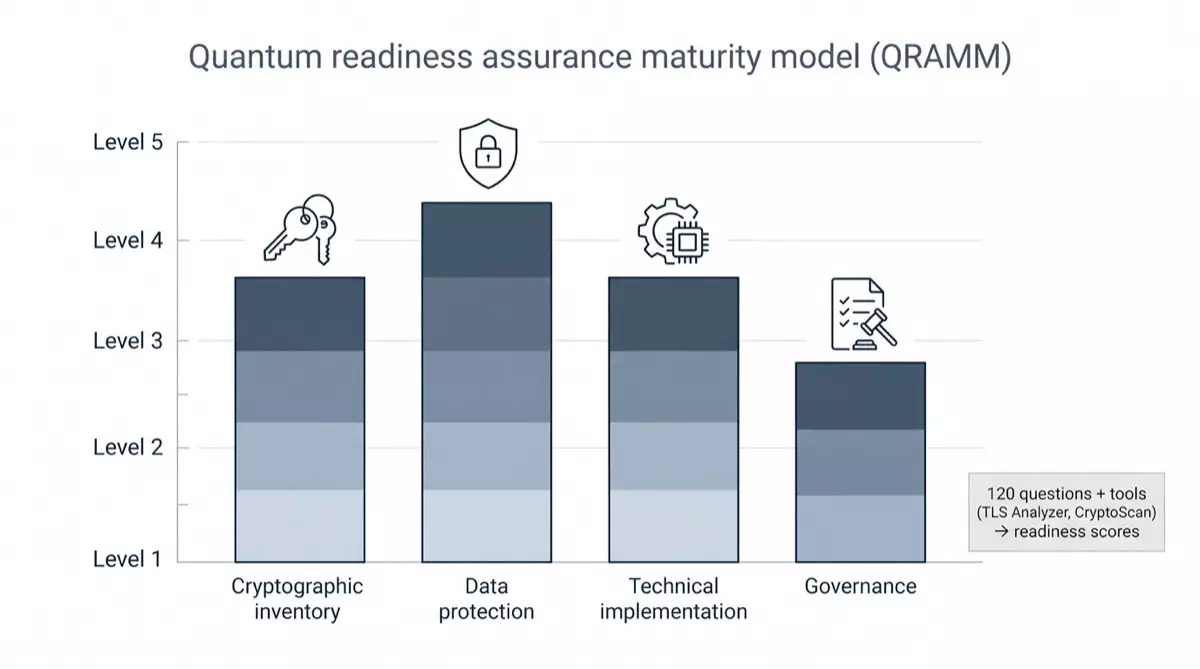
Sometimes a one-off report is not enough. Developed by the CyberSecurity NonProfit, QRAMM scores readiness across cryptographic inventory, data protection, technical implementation, and governance.
The 120-question framework pairs with open-source tools like TLS Analyzer and CryptoScan to surface quantum-vulnerable algorithms in your stack. Continuous evaluation, no paywall.
6. UMBC edX course “Introduction to Post-Quantum Cryptography”
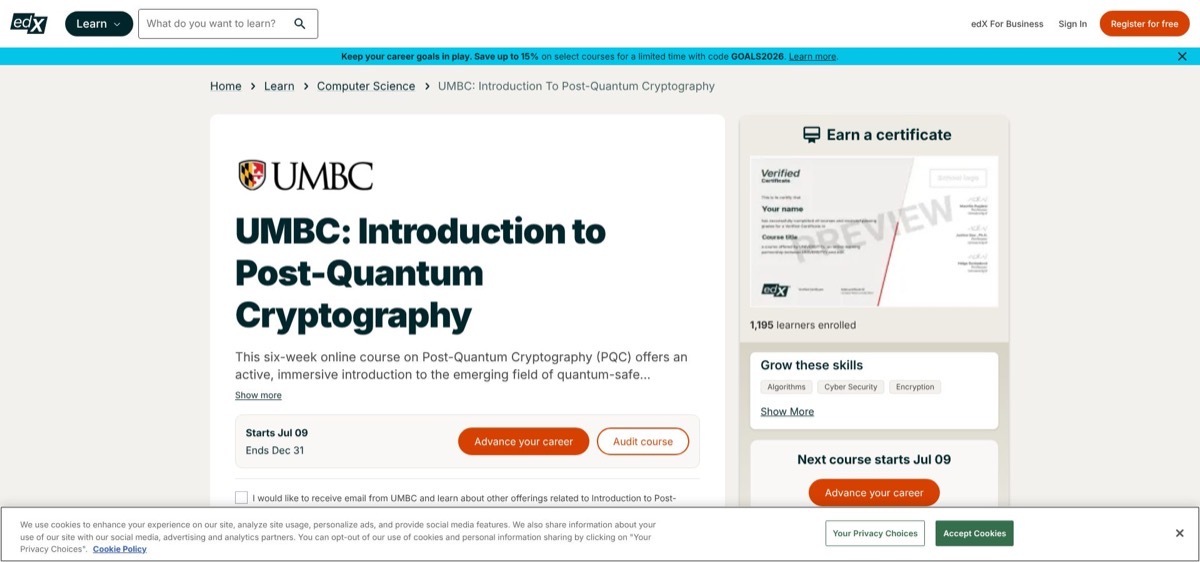
This six-week MOOC moves learners from theory to code. Short videos break down lattice schemes and hash-based signatures. Labs walk you through compiling Kyber and Dilithium, then benchmarking them.
Week by week you progress from quantum basics to a transition checklist you can hand to a CTO. Audit the course free or pay for a certificate.
7. NIST FAQ “What Is Post-Quantum Cryptography?”
No source carries more weight. The FAQ answers the first client question – “Why switch if quantum computers are not here yet?” – by stressing that supply chains and audits move slower than research labs.
It lists the algorithms that made the final cut, links to reference implementations, and provides a concise timeline: draft standards in 2023, final FIPS numbers in 2024, guidance rolling out in stages. Bookmark it as your argument-ender whenever colleagues doubt the threat.
Conclusion
Quantum risk to blockchains has moved from a distant worry to a dated deadline, and these seven resources give you a running start. Lead with the Project Eleven report and the Coinbase brief for the big picture, lean on OpenZeppelin, QRAMM, and the UMBC course for hands-on migration work, and keep the NIST FAQ bookmarked to settle any doubt. Map your cryptographic inventory now, test NIST-approved signatures, and you will be ready long before Q-Day arrives.