

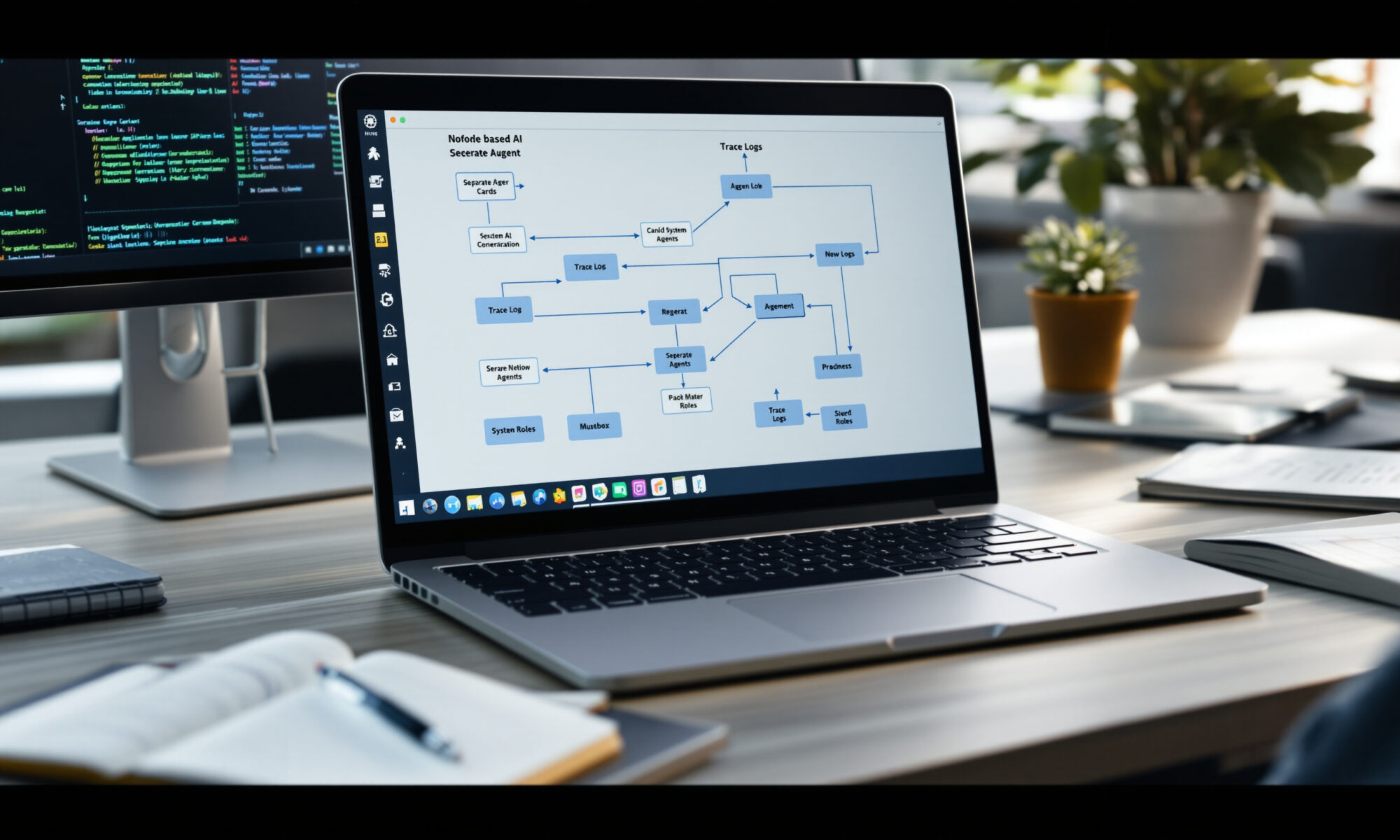
A multi-agent ai system is worth building in 2026 when one model call can’t reliably plan, use tools, check work, and recover from errors. Start with one agent, split only the parts that need different instructions, tools, permissions, or evaluation, then add handoffs, tracing, guardrails, and tests before production. Most failed systems are over-orchestrated too early.
What a multi-agent ai system should actually do
The search intent here is practical and informational: you want to know how to design and build one, not read another vague sermon about autonomous software. A multi-agent ai system is a coordinated set of specialized AI agents that share work through routing, handoffs, tool calls, shared state, or a supervisor.
Think less “committee of chatbots” and more “small operating team.” One agent might interpret a customer request, another may query a database, a third writes the response, and a fourth checks for policy or factual errors. The value comes from separation of responsibility, not from multiplying model calls for its own sake.
Anthropic’s 2026 guide draws a useful line between workflows and agents. Workflows follow predefined paths such as routing, parallelization, orchestrator-workers, or evaluator-optimizer loops; agents make more open-ended decisions about tools and steps. For most business software, I’d start with a workflow and earn the right to add autonomy.
If you’re coming from the broader agentic AI debate, this is the practical layer beneath the hype. The shift described in the evolution of agentic AI only becomes useful when you can name the job, measure the output, and stop the system when it goes wrong.
Single agent, workflow, or multi-agent design?
Before choosing LangGraph, CrewAI, OpenAI Agents SDK, Microsoft Agent Framework, or Google ADK/A2A, decide whether you need multiple agents at all. A single well-instructed agent with tools is cheaper, easier to debug, and often better for short tasks.
A multi-agent ai system starts making sense when you have conflicting objectives. For example, a sales assistant should be persuasive, while a compliance reviewer should be skeptical. Put those in one prompt and you’ll get mushy behavior. Split them, and you can evaluate each role on its own.
There’s a counter-argument that builders ignore: a 2026 arXiv paper argued that in-context prompting may obsolete external orchestration for some procedural tasks. I buy that for narrow, well-described processes. If the whole task fits cleanly in one context window, a heavy agent framework may add more moving parts than value.
Use this quick decision rule: if the next step is always known, build a workflow; if the next step depends on model reasoning but the role is stable, build one agent; if different roles need different tools, permissions, memory, or success metrics, build a multi-agent ai system.
The 2026 framework choices, compared
The main 2026 options are not interchangeable. They encode different opinions about graphs, role-playing agents, handoffs, tracing, deployment, and interoperability. Pick the smallest tool that fits your failure model.
| Framework or standard | Latest reported version/date | Best fit | Watch-out |
|---|---|---|---|
| LangGraph | langgraph==1.2.5, GitHub on 2026-06-12 | Resilient graph-based agents and multi-agent workflows | You need to think carefully about state and graph edges |
| CrewAI | 1.14.7, GitHub on 2026-06-11 | Role-playing autonomous agents and team-style orchestration | Role metaphors can hide weak task boundaries |
| OpenAI Agents Python SDK | v0.17.4, GitHub on 2026-05-26 | Agents, tools, handoffs, guardrails, sessions, and tracing | Tightest fit when you’re already building around OpenAI primitives |
| Microsoft Agent Framework | dotnet-1.10.0, GitHub on 2026-06-10 | Python and .NET orchestration, deployment, multi-agent workflows | Check language/runtime maturity for your stack |
| Google Agent2Agent Protocol | Specification active in 2026 | Communication between independent agent systems | It’s an interoperability standard, not a full app architecture |
LangGraph is my default when the process has durable state, retries, and branching logic. CrewAI is approachable when the product mental model really is a team of roles. The OpenAI Agents SDK is clean if you want handoffs, guardrails, sessions, and tracing from one vendor’s agent stack.
Microsoft’s Agent Framework is especially interesting for organizations already living in .NET or enterprise Microsoft tooling. Google’s Agent2Agent Protocol, meanwhile, matters when your agent needs to talk to another independent agent system rather than merely call a tool.
Framework enthusiasm should be tempered by the ADK Arena arXiv study posted on 2026-06-06. It evaluated 51 Python agent development kits, reported generation success in 57% of runs, found costs varying 5.6×, and concluded that no single framework dominated. That’s the least glamorous finding, and probably the most useful one.
Design the architecture before writing code
A reliable multi-agent ai system needs a visible control plane. Someone, or something, must decide who acts next, what context they receive, which tools they can use, and when the task is finished. Otherwise you’ve built a very expensive group chat.
A common architecture is supervisor plus workers. The supervisor classifies the user’s goal, delegates to specialized agents, receives results, and either asks for another pass or returns the final answer. Project Synapse, described in a 2026 arXiv paper, used a hierarchical multi-agent architecture with a supervisor delegating to specialized workers through LangGraph.
Handoffs are the cleanest mental model for role changes. OpenAI’s 2026 Agents SDK docs define a handoff as one agent transferring control to another specialized agent, with primitives such as agents, tools, handoffs, guardrails, sessions, and tracing. LangChain and LangGraph docs describe handoffs through either a single agent with dynamic configuration or multiple agent subgraphs as graph nodes.
For a worked example, imagine a support automation system for a SaaS company. The intake agent summarizes the ticket and detects intent. A billing agent can read invoices but not issue refunds above a limit. A technical agent can inspect logs. A policy agent checks the response before it reaches the customer. Boring? Good. Boring systems survive production.
If you’re designing loops where agents improve work after evaluation, the mechanics overlap with AI loop engineering: generate, inspect, revise, and stop on a measurable condition. Don’t let “autonomy” become an excuse for an infinite retry bill.
Build it in six disciplined steps
You don’t need a grand platform on day one. You need a thin vertical slice that proves the agents can coordinate, recover, and produce better output than a single model call.
- Write the job spec. Define the user request, accepted outputs, failure states, and a human escalation path.
- Start with one baseline agent. Give it the same tools and measure accuracy, latency, and cost on at least 30 representative tasks.
- Split one role at a time. Create a second agent only where separate instructions, permissions, or evaluation criteria improve results.
- Add handoffs and shared state. Pass compact summaries, not full transcripts, unless the receiving agent needs the raw context.
- Instrument everything. Capture traces, tool calls, model responses, handoff reasons, token use, and final outcomes.
- Run regression tests before launch. Keep a fixed test set and compare every prompt, model, and framework change against it.
The concrete calculation is sobering. Suppose your baseline single-agent flow uses four model calls per ticket. A supervisor plus three workers may use nine calls: intake, route, worker draft, tool query, worker revision, policy review, escalation check, final synthesis, and logging summary. If each call averages 1,500 input/output tokens, you’ve moved from about 6,000 to 13,500 tokens per ticket in 2026 terms, before retries. Accuracy had better improve enough to justify a 2.25× token footprint.
Latency also compounds. Parallel worker calls can help, but handoffs usually serialize part of the process. If your customer expects a two-second answer, a multi-agent ai system may be the wrong interface; use it behind the scenes for complex cases and keep simple requests on a fast path.
Prompt quality still matters, although the job title has become less magical than it sounded in 2023. If your team is hiring or retraining for this work, the practical skill set looks closer to systems design plus evaluation than pure copywriting, a point echoed by the changing market for prompt engineering jobs in 2026.
Guardrails, observability, and the pitfall people skip
Production agents fail in dull ways. They pass stale context, retry the same bad tool call, expose a capability to the wrong role, or let a confident reviewer approve a fabricated answer. The pitfall nobody mentions enough is permission drift: the second or third agent inherits tools it shouldn’t have simply because cloning a config was faster.
OpenAI’s practical agent-building guide and Anthropic’s 2026 agent guide both emphasize observability, evaluation, and guardrails. Treat that as architecture, not decoration. Tracing should show why a handoff happened, what the receiving agent saw, which tools were called, and what guardrail accepted or blocked the output.
Security teams already understand this pattern from automated SOC workflows, where autonomy without audit trails is a liability. The same lesson shows up in AI security operations coverage such as Torq’s AI SOC platform: orchestration is only useful when actions are visible and reversible.
Memory deserves special caution. OpenAI announced on 2026-04-15 new Agents SDK capabilities including configurable memory, sandbox-aware orchestration, Codex-like filesystem tools, native sandbox execution, and work toward subagents in Python and TypeScript. Powerful features, yes. Also more places for sensitive data, stale assumptions, or unintended persistence.
For business products, tie every agent to a scope. A research agent can browse approved sources or internal indexes. A finance agent can calculate and draft, but perhaps not submit. A customer-facing agent can answer, but it should escalate refunds, legal threats, and identity issues. Honestly, full autonomy only makes sense if the cost of a mistake is low or the guardrails are strong.
When interoperability matters
A multi-agent ai system inside one application is hard enough. Cross-company coordination adds identity, trust, context exchange, and delegation. Google’s Agent2Agent Protocol specification describes A2A as an open standard for communication and interoperability between independent AI agent systems, including collaboration, delegation, and context exchange.
Use A2A-style thinking when your agent must coordinate with external systems that are more than ordinary APIs. A travel agent delegating to an airline agent, or a procurement assistant exchanging context with a supplier’s agent, needs richer negotiation than a single function call.
Payments are another edge case. When agents can shop, recommend, and transact, the architecture must separate recommendation from authorization. The emerging agentic commerce discussion, including OpenAI and Visa’s agentic payment work, points to a future where handoffs may involve financial credentials, not just text.
Don’t start there unless you must. Build the internal version first, with strict tool permissions and replayable traces. Then expose a narrow, documented interface to other agent systems.
FAQ
What is a multi-agent ai system?
It’s a software system where multiple specialized AI agents coordinate to complete a task. They may use handoffs, shared state, tools, a supervisor, or a graph-based workflow.
Is LangGraph better than CrewAI for multi-agent workflows?
LangGraph is usually stronger for explicit state, branching, and durable workflows. CrewAI can be easier when your problem naturally maps to role-playing agents, but you still need tests and traces.
How many agents should I start with?
Start with one. Add a second only when a role needs different tools, permissions, instructions, or evaluation criteria; most useful early systems have two to four agents.
Are multi-agent systems cheaper than single-agent systems?
Usually not. They often use more model calls and more tokens, so the payoff has to come from higher accuracy, better compliance, fewer human escalations, or handling tasks a single agent can’t manage.
Do I need Google A2A to build a multi-agent app?
No. Google’s Agent2Agent Protocol is mainly for interoperability between independent agent systems. For one application, a framework such as LangGraph, OpenAI Agents SDK, CrewAI, or Microsoft Agent Framework may be enough.
 EN
EN  FR
FR  ES
ES