

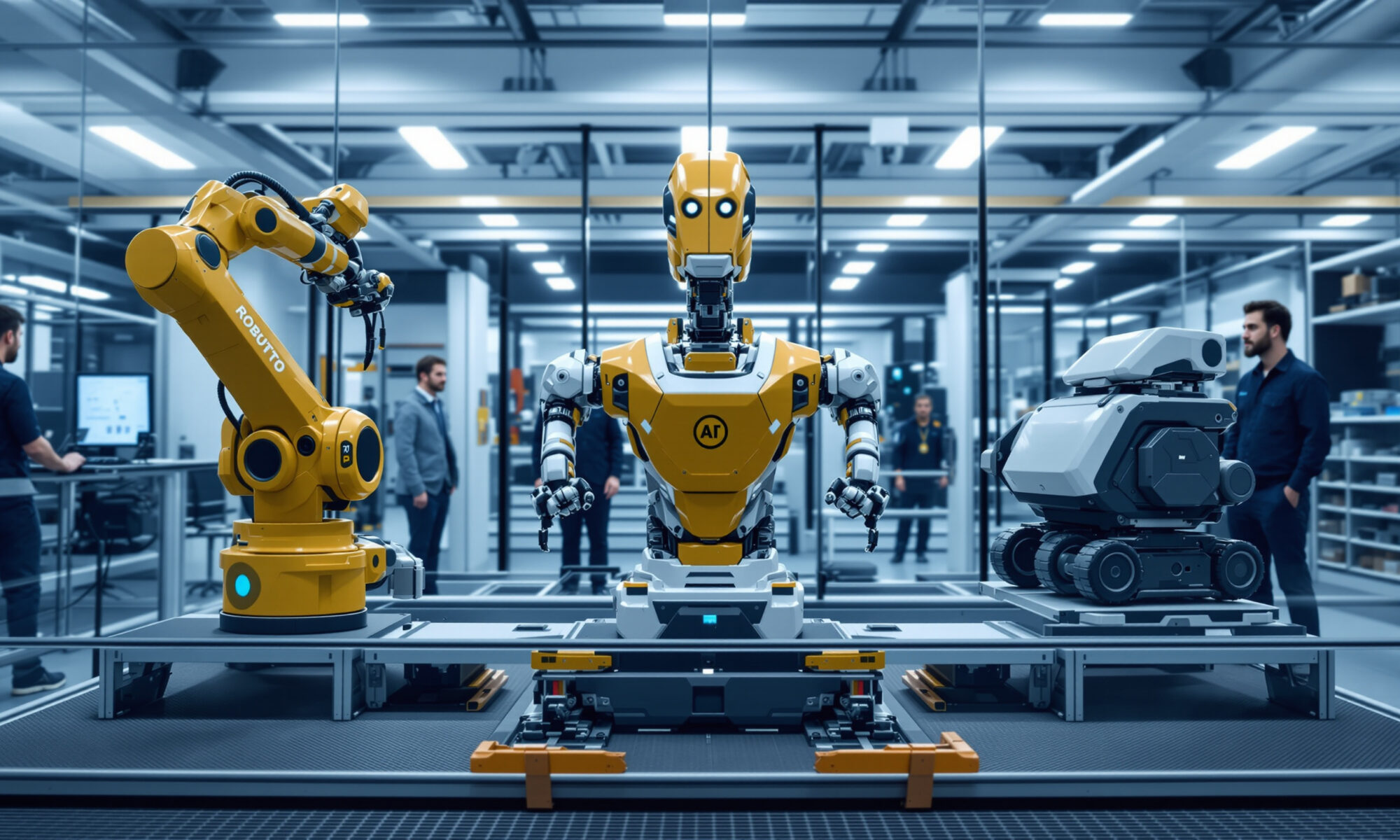
Skild AI is developing a general-purpose “robot brain” that can control multiple kinds of machines instead of being built for one robot body. Its S1 model can attempt an unseen task after one video demonstration, without task-specific fine-tuning or weight updates. The 2023 startup reported more than $100 million in annual recurring revenue in September 2026, but its most striking performance claims still lack independent benchmarking.
What is Skild AI building?
Skild AI is building Skild Brain, an “omni-bodied” robotics foundation model designed to operate different robot forms with a shared intelligence layer. According to the company’s 2026 technical explanation, the model learns from simulation, internet video and real-world robot data rather than depending exclusively on demonstrations collected for one machine.
A robotics foundation model is an AI system that learns reusable physical skills and applies them across tasks, environments or hardware configurations. That differs from conventional industrial automation, where an integrator may program a robot arm for one sequence at a fixed workstation.
Carnegie Mellon professors Deepak Pathak and Abhinav Gupta founded the company in 2023. Their central bet is that robotics can follow the foundation-model pattern seen in language and vision: train broadly, then adapt the resulting model to many applications.
The hard part is physical variation. A wheeled mobile robot, a quadruped and a dual-arm manipulator have different sensors, movement limits and failure modes. Skild Brain is intended to translate shared knowledge into suitable actions for each body rather than treating every hardware platform as an unrelated project.
That ambition also separates physical AI from software agents. Problems such as latency in conversational AI agents can produce awkward pauses; latency or a mistaken action on a moving robot can affect equipment, products and people.
How does the Skild AI S1 model learn a new task?
Skild AI S1 uses in-context learning to attempt a previously unseen physical task after receiving a single video demonstration. Skild AI said in August 2026 that S1 requires no task-specific fine-tuning and no model-weight update, potentially replacing part of the repeated teleoperation and data collection normally used to teach new behaviors.
You show the model a short video of the desired action, such as a sequence involving objects and tools, and the robot interprets the demonstration as context. The model then has to connect visual intent with the capabilities of the available robot body.
NVIDIA reported in September 2026 that Skild’s estimate valued one short video demonstration at roughly 380 hands-on training examples. Treat that ratio as a company estimate, not a universal conversion rate. The value of a demonstration will vary with camera angle, task complexity, hardware and the similarity between training conditions and deployment.
S1 was researched and built with NVIDIA technologies including Cosmos, Omniverse, Isaac Sim and Isaac Lab, according to both companies in 2026. Synthetic data and simulation can expose a model to more situations than physical data collection alone, while real-world trials reveal friction, deformation and sensor errors that simulation may miss.
Skild also published a physical self-play experiment on September 23, 2026. Robots practiced simulated soccer by competing against themselves, a method intended to develop dynamic and dexterous behavior. No independent benchmark accompanied the result, so the experiment shows a training direction rather than settled proof of broad capability.
How strong are S1’s reported results?
NVIDIA said in September 2026 that Skild AI S1 completed new multistep tasks at approximately 66% success per step in Skild’s tests, compared with 9% for a comparison system. The result is substantial, but NVIDIA did not present it as an independent standardized benchmark covering different robots, sites and task distributions.
| Measure | S1 | Comparison system | Source or method |
|---|---|---|---|
| Reported success per step | About 66% | About 9% | NVIDIA, September 2026, citing Skild tests |
| Calculated three-step success | About 28.7% | About 0.07% | Rate cubed, assuming independent steps |
| Calculated five-step success | About 12.5% | About 0.0006% | Rate to the fifth power, assuming independent steps |
The calculation exposes a pitfall that headline comparisons hide. If every step succeeds independently at 66%, a three-step task succeeds only 0.66 × 0.66 × 0.66, or about 28.7%. A five-step sequence falls to about 12.5%. Real steps may be correlated, so these figures illustrate compounding rather than predict a specific deployment.
A 66% per-step rate may be impressive research progress and still be inadequate for an unattended production line. Recovery behavior matters too: a robot that recognizes an error and retries safely can be more useful than one with a higher first-attempt score but no recovery policy.
Buyers should ask for evidence under their own operating conditions. The evaluation should cover these five items:
- End-to-end task completion, not only per-step success.
- Results across shifts, lighting changes and object variations.
- Recovery rates after dropped, blocked or misplaced objects.
- Human interventions per operating hour in 2026 trials.
- Safety limits, audit logs and behavior after network loss.
Honestly, the 66% figure is useful as a signal of progress, not as a purchase specification. Enterprises applying autonomous systems also need controls comparable in spirit to hardware-backed AI agent safety, adapted for machines that exert force in the physical world.
How much funding and revenue does Skild AI have?
Skild AI announced a $1.4 billion Series C on January 14, 2026, at a valuation above $14 billion. The company later reported more than $100 million in annual recurring revenue on September 10, 2026, around 10 months after its first commercial deployment, alongside more than 60 paying customers or deployment partnerships.
The funding rise was steep. On July 9, 2024, the startup emerged from stealth with a $300 million Series A at a $1.5 billion valuation. Lightspeed Venture Partners, Coatue, SoftBank Group and Bezos Expeditions led or participated in that round. SoftBank led the 2026 Series C, joined by NVentures, Macquarie Capital and Bezos Expeditions.
Annual recurring revenue is not the same as revenue already recognized. Skild said in September 2026 that it had recognized $50 million since commercial deployments began about 10 months earlier, while the annualized recurring run rate exceeded $100 million. Mixing those numbers would overstate completed sales.
The company also said approximately 90% of revenue came mainly from manipulation work. Mobility contributed 10%, including 4% from the acquired Zebra Technologies and Fetch Robotics autonomous-mobile-robot business. Those percentages are company-reported and have not been presented with audited financial statements.
More than 60 customers or deployment partners covered manufacturing, logistics, inspection, security, food preparation, warehouses and data centers, according to the September 2026 announcement. Skild also said it was working with NVIDIA and Foxconn to deploy dual-arm manipulators for NVIDIA Blackwell system assembly.
At a valuation above $14 billion and ARR just over $100 million, the implied valuation-to-ARR multiple was below 140 times in January-to-September 2026 terms. The dates do not align perfectly, but the rough calculation shows how much future expansion investors were pricing in. Procurement teams considering similar automation should distinguish technical promise from the commercial controls required for autonomous B2B systems.
Why did Skild AI acquire the Fetch Robotics business?
Skild AI acquired Zebra Technologies’ Robotics Automation business on April 15, 2026, gaining operations formerly associated with Fetch Robotics. Zebra Technologies received cash and an equity stake, although neither company disclosed the transaction value. The purchase added an established autonomous-mobile-robot business to Skild’s foundation-model strategy.
The acquired operation gives the AI company a route into warehouses and other facilities where mobile robots already perform material movement. It also supplies deployed hardware, customer relationships and operational data, though the companies did not quantify those assets in the announcement.
There is a strategic tension here. The startup promotes an intelligence layer that is independent of any one body, yet acquiring a hardware-linked business ties part of its commercial performance to a particular robotics category. That isn’t necessarily a contradiction; real deployments may help train and test a broader model.
Still, integration can be less glamorous than model research. Customers need maintenance, fleet management, spare parts, cybersecurity and predictable support. Robots retired during future upgrades also create asset-disposition questions similar to those covered in enterprise IT asset disposition programs.
What remains unproven about a universal robot brain?
Skild AI has demonstrated rapid funding, commercial traction and promising model behavior, but a universal robot brain has not yet been proven through independent, standardized testing in 2026. Open questions include cross-hardware reliability, complete-task success, safety under unusual conditions, intervention frequency and the cost of adapting deployments to each facility.
The word “universal” deserves discipline. Controlling several robot types does not establish competent operation on every body, task or site. Each machine brings distinct payload limits, sensor placement, control frequency and safety constraints.
Generalization also has boundaries. A video may clearly show what a person wants while concealing force, object weight or tactile feedback. Transparent glass, reflective metal, deformable food and tightly fitted components can each turn a visually simple action into a difficult control problem.
The strongest proof would combine independent benchmarks with customer-level operating data: full task completion, interventions per hour, mean time between failures and total cost per successful action. Until those figures are available across multiple hardware classes, “omni-bodied” is best understood as the architecture’s design goal.
Frequently asked questions about Skild AI
Who founded Skild AI?
Skild AI was founded in 2023 by Carnegie Mellon professors Deepak Pathak and Abhinav Gupta. The founders created the company to develop a general-purpose robotics foundation model.
What is Skild Brain?
Skild Brain is an “omni-bodied” foundation model designed to control different kinds of robots rather than one fixed hardware configuration. Its 2026 training sources include simulation, internet video and real-world robotics data.
Is Skild AI publicly traded?
Skild AI remained a privately funded company based on its January 2026 Series C announcement. The company reported a valuation above $14 billion, but no public stock listing was announced in the supplied 2026 sources.
Does S1 need fine-tuning for every new task?
Skild AI says S1 can attempt an unseen task from one video demonstration without task-specific fine-tuning or weight updates. Performance will still depend on the robot, environment and task, and the claim does not guarantee production-level reliability.
How many customers does Skild AI have?
Skild AI reported more than 60 paying customers or deployment partnerships on September 10, 2026. The company identified sectors including manufacturing, logistics, inspection, security, food preparation, warehouses and data centers.