

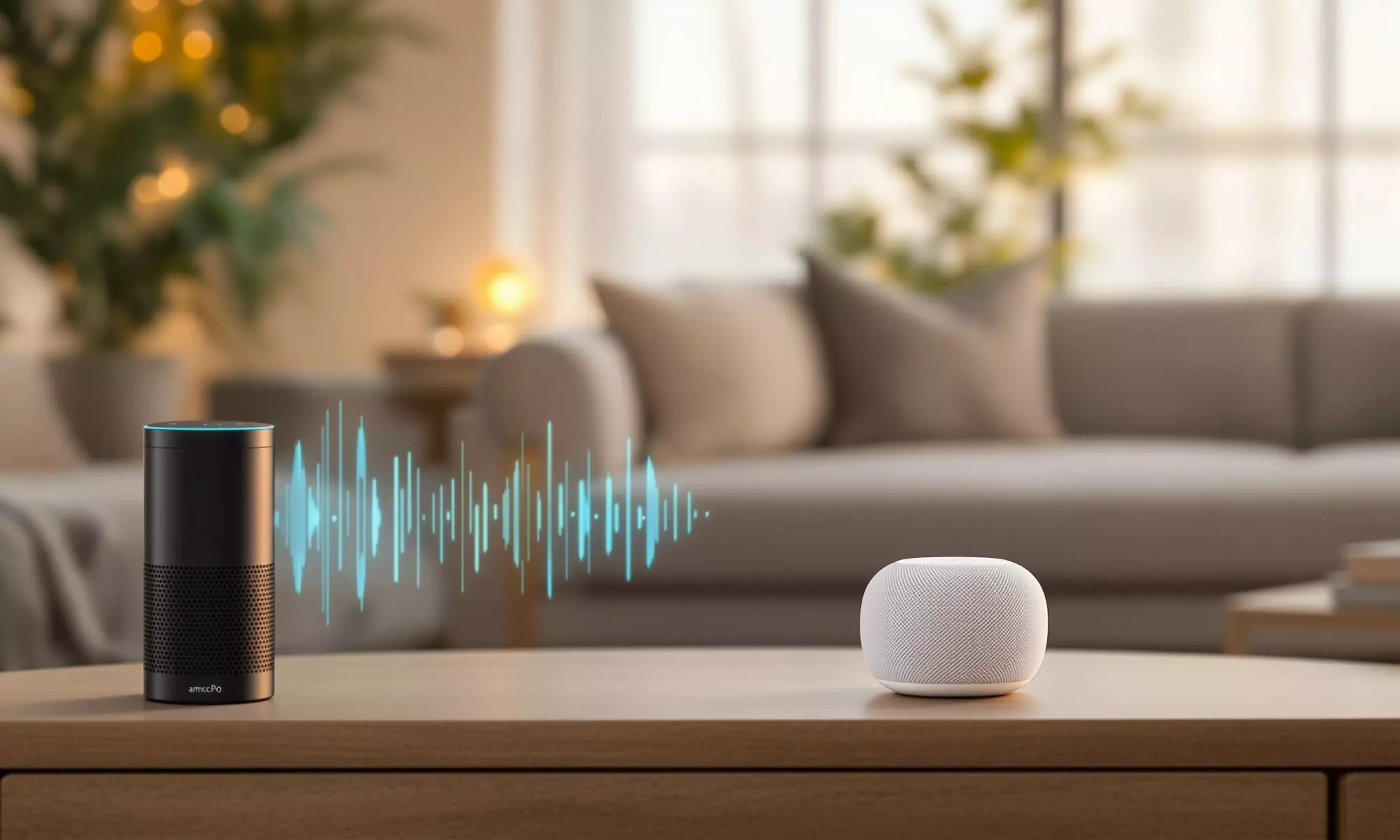
Echo Tech describes smart-home systems that use sound, acoustic recognition, ultrasound and computational audio to understand commands, detect events or adapt a room. Although Echo Tech is not a standardized industry category in 2026, the underlying capabilities are already available in Amazon Echo, Apple HomePod and Google Home products.
What is Echo Tech, and how does it work?
Echo Tech is an editorial umbrella term for technology that uses audible sound or inaudible acoustic signals to control devices, recognize events, detect presence and shape audio playback. In 2026, reliable manufacturers describe these functions separately rather than treating Echo Tech as a formal product category or technical standard.
The basic input is pressure moving through air. Microphones convert those pressure changes into electrical signals, and software compares the resulting patterns with known commands, alarm signatures or other acoustic events. Amazon says Echo devices, for example, detect a wake word by matching acoustic patterns.
Sound-based smart living extends beyond voice assistants. A speaker can listen for a smoke alarm, emit ultrasound to sense movement or use computational audio to adjust playback. Some products combine sound with other signals: supported Amazon Echo models can use ultrasound, and sometimes Wi-Fi signals, to trigger lighting, routines or display adjustments.
The distinction matters. Voice recognition interprets speech, acoustic recognition classifies non-speech sounds, presence sensing estimates whether somebody is nearby, and computational audio changes playback through software. Treating every feature as “voice AI” hides meaningful differences in capability and privacy.
What can Echo Tech do in a smart home?
Echo Tech can perform four practical jobs in a 2026 smart home: accept spoken commands, recognize safety-related sounds, detect room occupancy and optimize speaker output. Available implementations include Amazon Echo presence routines, Apple HomePod alarm recognition and Google Home monitoring for alarms or breaking glass.
Presence detection is one of the quieter advances. According to Amazon’s 2026 support documentation, compatible Echo products process presence detection on the device. A detected person can activate a light, begin a routine or adjust a display without requiring a spoken command.
Acoustic recognition adds another layer. Apple HomePod Sound Recognition can identify smoke and carbon-monoxide alarm sounds, then send a notification to an iPhone, iPad or Apple Watch. Apple explicitly warns in its 2026 HomePod documentation that Sound Recognition is not a replacement for an alarm or emergency system.
Google offers a related feature with narrower eligibility. According to Google’s 2026 support documentation, Google Home and Nest speakers can recognize smoke alarms, carbon-monoxide alarms and breaking glass, but the service requires Google Home Premium and a U.S. address. Google also reports that advanced subscription functions can search camera history through spoken requests and deliver audio summaries of home activity.
For exterior monitoring, sound classification should complement rather than replace a well-positioned device from a practical outdoor security camera comparison. A speaker that hears breaking glass cannot show you who approached a window.
Which Echo Tech products are available in 2026?
Major Echo Tech options in 2026 include the $99.99 Google Home Speaker, the $149 Apple HomePod mini 2 and supported Amazon Echo models with on-device presence sensing. The products overlap in voice control, but their notable differences concern acoustic monitoring, room sensing, ecosystem requirements and audio configurations.
| Product or platform | Documented 2026 capability | Price or requirement in 2026 |
|---|---|---|
| Google Home Speaker | Gemini for Home, 360-degree audio, adaptive microphone processing and stereo pairing with Google TV Streamer | $99.99 launch price; some monitoring features require Google Home Premium and a U.S. address |
| Apple HomePod mini 2 | S10 chip, computational audio, 360-degree playback, alarm recognition and four-speaker surround with Apple TV 4K, 4th generation | $149 in the United States |
| Supported Amazon Echo models | Wake-word detection plus ultrasound, and sometimes Wi-Fi, for presence-triggered routines | Price varies by model; presence support also varies by model |
Google launched the Google Home Speaker for $99.99 on June 25, 2026. Google’s announcement lists Gemini for Home, 360-degree audio, adaptive microphone processing and the ability to pair two speakers with a Google TV Streamer. The company’s documentation should be checked before purchase because subscription and regional limits affect the monitoring features.
Apple announced the HomePod mini 2 on October 13, 2026, opening preorders that day and scheduling retail availability for October 30, 2026. Apple’s 2026 specification gives the speaker an S10 chip, computational audio and 360-degree playback. The model can also join three others in a surround system when used with the 4th-generation Apple TV 4K.
Here’s the calculation buyers may miss: four HomePod mini 2 units cost $596 at Apple’s 2026 U.S. list price, before adding the required Apple TV 4K. Four Google Home Speakers would total $399.96 at the 2026 launch price, a $196.04 difference, although Google’s documented pairing arrangement is two speakers rather than Apple’s four-speaker surround setup. These aren’t equivalent systems, so the arithmetic is useful for budgeting, not declaring a winner.
At $149 per unit, Apple’s setup makes the most sense if you already use Apple TV 4K and value tightly coordinated room audio. Buying four solely because the feature exists is a costly way to solve a problem a conventional soundbar may handle more simply.
Is Echo Tech private and reliable?
Echo Tech can preserve more privacy when detection happens locally, but microphones and connected accounts still demand careful settings. Amazon states in 2026 that compatible Echo presence processing occurs on-device and that pressing an Echo microphone-disable button electrically disconnects the microphones, while also disabling ultrasound-based presence detection.
That last detail is an easily missed trade-off. Muting an Echo microphone does more than stop wake-word listening: according to Amazon’s 2026 documentation, it also turns off ultrasound presence sensing. A lighting routine tied to occupancy may therefore stop working, even though the user intended only to disable voice commands.
Reliability has a different limit. Acoustic recognition can add a notification channel, but manufacturers don’t position a smart speaker as life-safety equipment. Apple’s warning about HomePod alarm recognition is plain: keep certified smoke and carbon-monoxide alarms installed, tested and audible.
You should review these controls before enabling sound-based automation:
- Confirm whether recognition occurs on the device, in the cloud or through both forms of processing.
- Check which features require a paid subscription, account or supported country in 2026.
- Test what stops working when microphones, Wi-Fi or presence detection are disabled.
- Keep smoke, carbon-monoxide and security systems independent of smart-speaker notifications.
- Review household access, notification recipients and retained camera or audio history.
Conversational performance deserves scrutiny too. A technically impressive assistant may still mishear speech, interrupt or respond too slowly; these persistent voice AI conversation failures explain why physical controls remain useful. Honestly, any automation you cannot override with a switch is poorly designed.
How will Echo Tech change smart living?
Echo Tech is moving from isolated voice commands toward ambient systems that combine sound, presence, cameras and interoperable device control. Matter 1.5 added standardized camera capabilities in 2025, while 2026 products from Apple, Amazon and Google show sound becoming an input for automation, safety alerts and adaptive entertainment.
Matter is a smart-home connectivity standard that lets compatible products work across participating ecosystems. According to 2025 AWS guidance, a manufacturer can certify a Matter device once for compatibility with major smart-home platforms and their voice assistants. For a deeper protocol comparison, see this guide to Matter, Thread and smart-home interoperability.
The Connectivity Standards Alliance expanded Matter 1.5 in 2025 with camera support covering live video and audio, two-way communication, local and remote access, multiple streams, privacy zones, and local or cloud recording. That specification creates a technical path for sound, video and automation to work across brands, although individual products still determine which functions they expose.
Apple’s 2026 announcements illustrate the move toward combined context. Apple said Siri AI and the Home app can group related notifications, describe activity across video sequences and search clips from multiple cameras. Apple also announced forthcoming Apple Watch Sound Recognition for sirens, alarms, doorbells and crying babies, using on-device intelligence to generate alerts.
Entertainment is becoming more spatial and reactive as well. Apple reports that four HomePod mini 2 speakers can calibrate timing and output levels according to position. Its Sound Glow feature makes the speaker surface pulse with music and produces colors based on album artwork or ambient soundscapes. Visual effects are decorative; automatic timing correction is the more consequential engineering feature.
The strongest future is probably not a home awaiting constant conversation. It’s a home that notices a limited set of well-defined events, processes sensitive signals locally where possible and asks for confirmation before consequential actions. Quiet competence beats a chatty appliance.
Frequently asked questions about Echo Tech
Is Echo Tech an official technology standard?
Echo Tech is not an official or standardized industry category in 2026. The phrase works as an editorial label for smart speakers, voice assistants, acoustic recognition, ultrasound presence sensing and computational audio.
Can a smart speaker replace a smoke detector?
A smart speaker cannot replace a certified smoke or carbon-monoxide detector. Apple’s 2026 HomePod guidance says Sound Recognition is not a substitute for an emergency system, even when the speaker can relay an alarm notification.
Does ultrasound presence sensing record conversations?
Ultrasound presence sensing uses inaudible acoustic signals to estimate occupancy rather than interpret speech. Amazon states that supported Echo presence detection is processed on-device in 2026, but you should still review the settings and documentation for your specific model.
Does microphone mute disable Amazon Echo presence detection?
Pressing the microphone-disable button on an Amazon Echo electrically disconnects its microphones and disables ultrasound-based presence detection, according to Amazon’s 2026 documentation. Presence-triggered routines may stop until the microphones are enabled again.
How much does a four-speaker HomePod mini 2 system cost?
Four Apple HomePod mini 2 speakers cost $596 at the 2026 U.S. price of $149 each. Apple’s four-speaker surround feature also requires a 4th-generation Apple TV 4K, whose cost is additional.