

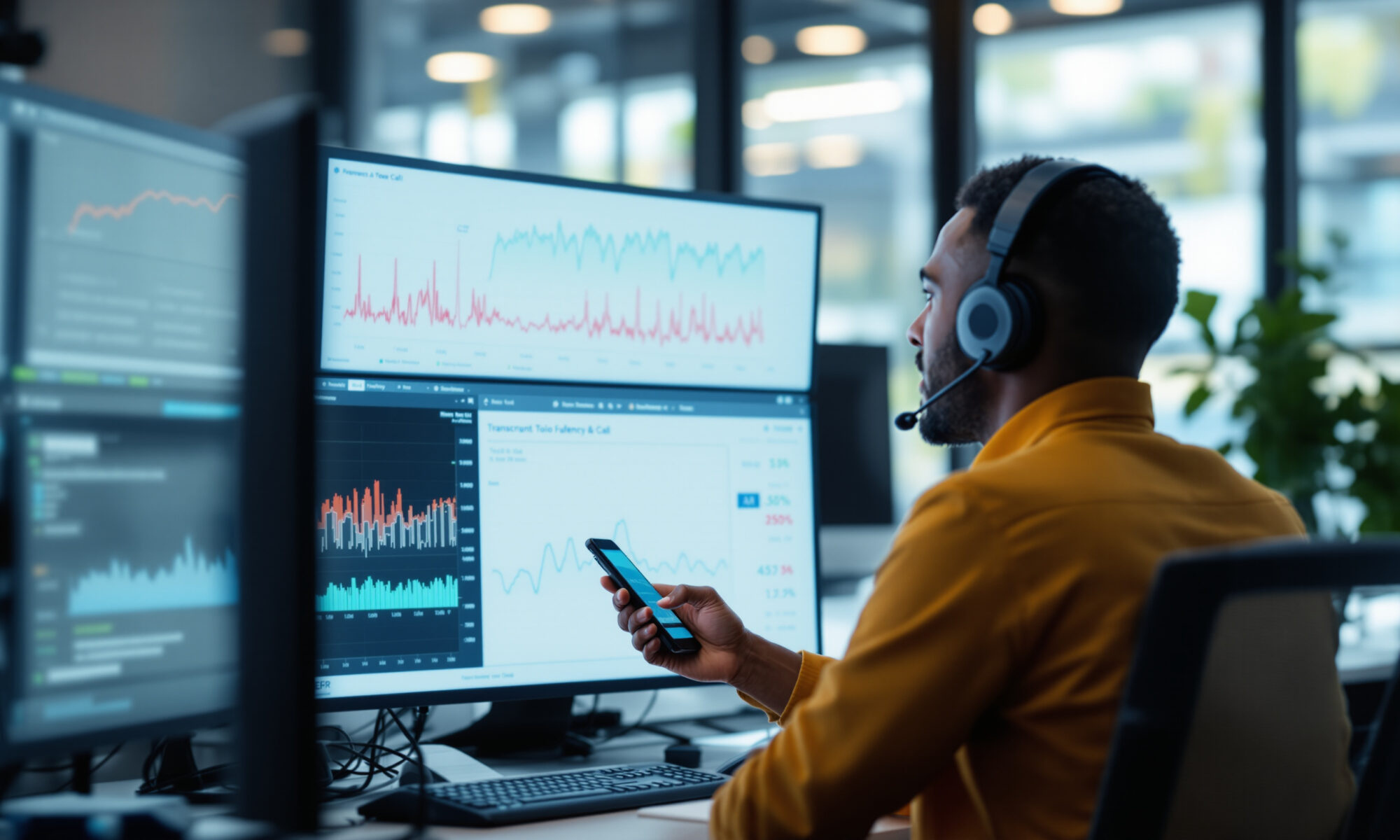
Voice AI agent latency remains a major reason automated calls feel broken, but speed alone doesn’t make an agent reliable. In 2026, delays can come from telephony, turn detection, reasoning, retrieval, tool calls, and speech generation. Even a fast, natural voice can mishear a keyword, execute the wrong action, or claim success without changing the customer’s account.
What causes voice AI agent latency?
Voice AI agent latency is the total delay between a caller’s speech and the agent’s useful response. The complete 2026 path includes the phone network, speech recognition, turn detection, model reasoning, information retrieval, external tools, and speech synthesis. Model inference may represent only one part of the delay.
Teams often optimize the most visible component: the language model. That can produce an impressive laboratory demo while leaving the caller waiting for a customer database, payment system, or reservation API. PolyAI reported in August 2026 that turn detection and external integrations can add more delay than model inference.
Network time belongs in the budget too. ITU-T Recommendation G.114, published in 2003 and still listed as in force in 2026, recommends no more than 400 milliseconds of one-way network delay for general planning. It also warns that highly interactive voice tasks can suffer at substantially lower delays.
Consider a simple illustrative calculation. If telephony takes 200 milliseconds, turn detection 300 milliseconds, recognition and reasoning 350 milliseconds, a tool call 600 milliseconds, and speech startup 250 milliseconds, the caller waits 1.7 seconds. Cutting model processing by 100 milliseconds reduces the total to 1.6 seconds, a gain of only 5.9%.
PolyAI’s September 2026 vendor guidance recommends measuring at the caller’s handset and targeting less than 500 milliseconds at the median and less than one second at P95. Those numbers aren’t an independent standard, but the measurement method is sound: server timing excludes network and telephony delays your caller actually experiences. On-device and edge AI processing can reduce some round trips, although backend transactions still require their own measurement.
Why does natural speech still produce failed conversations?
Natural-sounding speech does not prove conversational AI reliability because voice quality measures delivery rather than understanding or execution. TechCrunch documented missed keywords, inaccurate transcripts, and flawed follow-up actions in October 2026. A pleasant voice can therefore confirm a booking, refund, or account update that never occurred.
Speech recognition sits near the start of the chain. An incorrect transcript changes the context passed to the language model, which can then select the wrong tool or fill an argument with the wrong name, amount, or date. Otter Chief Marketing Officer Alex Gay told TechCrunch in October 2026 that one incorrect follow-up action can make users lose trust in the platform.
The relationship isn’t new. NIST’s research on the DARPA Communicator spoken-dialogue systems, published in 2002, found a linear relationship between word error rate and task-completion measures. Better wording from a language model cannot reliably repair a missing account number or a misrecognized negation.
PolyAI said in 2025 that about 70% of errors made by its voice agents came from automatic speech recognition models. Treat that as company experience, not an industry average. Still, it points to a frequently overlooked failure mode: optimizing voice AI agent latency while failing to test whether the system heard the decisive word.
Names, product codes, addresses, dates, and “yes” versus “no” deserve dedicated recall tests. Speaker separation matters on calls with multiple participants as well; live speaker diarization for up to eight speakers shows how identity attribution is becoming a distinct engineering problem rather than a minor transcription setting.
How reliable are voice AI agents in 2026 benchmarks?
Voice AI agents remain far less reliable than polished demonstrations suggest. The March 2026 τ-Voice evaluation measured 31% to 51% pass@1 across 278 clean-condition tasks, falling to 26% to 38% with noise and varied accents. The benchmark’s text reasoning model reached 85% on the same task set.
| Evaluation | Scope | Reported result | What it tests |
|---|---|---|---|
| τ-Voice, March 2026 | 278 tasks | 31%-51% pass@1 clean; 26%-38% with noise and accents; 85% for the text reasoning model | End-to-end task execution under realistic speech variation |
| EVA-Bench, May 2026 | 12 systems, 213 scenarios | No system exceeded 0.5 pass@1 on both composite measures | Accuracy, task completion, faithfulness, speech fidelity, progression, concision, and turn timing |
| VAmoS Bench, July 2026 | 100 financial-support scenarios, five database tools | Binary checks of spoken claims and backend changes | Transcripts, tool calls, arguments, and actual database state |
The clean-versus-noisy τ-Voice result supplies a useful numbers-based comparison. At the top of the reported ranges, performance declined from 51% to 38%, a 13-percentage-point drop and a relative decrease of about 25.5%. Real callers use speakerphone, commute, interrupt, change phrasing, and speak with different accents. Clean audio is the easy case.
EVA-Bench tested 12 systems across 213 scenarios in May 2026. No system exceeded 0.5 pass@1 on both the benchmark’s accuracy and conversation-experience composites. Those measures include task completion, faithfulness, speech fidelity, progression, concision, and turn timing, showing why a single “sounds human” score says very little.
VAmoS Bench, introduced in July 2026, exposes a subtler pitfall. The benchmark checks transcripts, tool calls, arguments, and database state, including cases where an agent says an action succeeded without performing it. Honestly, a voice assistant that speaks flawlessly but cannot prove the backend result is a liability, not an automation win.
Does full-duplex voice AI solve turn-taking?
Full-duplex voice AI is a conversational architecture that can listen and speak at the same time. Full-duplex processing improves interruption handling, but it does not eliminate slow reasoning, retrieval, telephony delay, incorrect transcripts, or failed tools. PolyAI CTO Shawn Wen identified those remaining bottlenecks in October 2026.
Human conversation overlaps. A caller may say “actually, Tuesday” while the agent is still confirming Monday, or use “right” as acknowledgment rather than a request to stop. Turn detection must distinguish an interruption from background speech, a cough, or a brief agreement.
PolyAI reported in April 2026 that interruptions occur in roughly one in five calls and said new company deployments ship with barge-in enabled. No independent corroboration was identified for that rate, so it shouldn’t be generalized to every call center. The operational lesson is narrower: interruption recovery needs a test of its own.
Fast interruption handling can even create a new problem. An oversensitive system stops whenever it hears noise; an insensitive one talks over the customer. After stopping, the agent must preserve relevant context, discard the superseded instruction, and avoid executing an abandoned tool call.
Smaller models may shorten some inference stages, particularly when deployed near the user. The case for using smaller language models in 2026 is strongest when the task has a narrow vocabulary and bounded actions. Yet a faster model won’t fix a two-second customer-record lookup.
How should developers test voice AI agent latency and reliability?
Developers should test voice AI agent latency from the caller’s handset and pair median and P95 timing with outcome checks. A defensible 2026 plan also measures interruption recovery, keyword recall, transcript accuracy, tool arguments, backend state, task completion, human escalation, and required AI or recording disclosures.
The following test sequence covers the full call rather than isolated model components:
- Measure end-to-end response time at the handset, reporting both median and P95 results under normal and congested conditions.
- Test names, numbers, dates, negations, and domain-specific entities across background noise, varied accents, poor connections, and interruptions.
- Compare the source audio with the transcript, then inspect every tool selection and argument passed to external systems.
- Assert the final backend state independently, such as whether the appointment, refund, address change, or escalation actually exists.
- Repeat scenarios and report pass@1 plus repeated-run reliability instead of publishing the best successful attempt.
- Verify that human handoff preserves context and that AI or recording disclosure is delivered at the required moment.
Median timing describes a typical call; P95 reveals what happens to the slowest 5% of measured responses. If the median voice AI agent latency is 450 milliseconds but P95 reaches 2.4 seconds, a large production volume will still generate many conspicuous pauses. Averages can hide those tail delays.
Slow backend work doesn’t always require silence. PolyAI’s September 2026 guidance recommends contextual spoken acknowledgments during long lookups. “I’m checking the payment status” can make a necessary pause understandable, but the phrase mustn’t mask an unbounded delay or imply that a tool has succeeded.
Outcome verification deserves equal weight. Recent 2026 frameworks use realistic noise, accent perturbations, pass@1, repeated runs, and backend assertions. That approach aligns with broader trust requirements for agentic AI: users need accurate actions, transparent disclosure, and a workable path to a person when automation fails.
FAQ
What is a good response time for a voice AI agent?
PolyAI’s September 2026 vendor guidance recommends handset-measured response latency below 500 milliseconds at the median and below one second at P95. The recommendation is not an independent standard, and acceptable timing depends on the task and spoken acknowledgment used.
Why do AI voice agents interrupt callers?
AI voice agents interrupt callers when turn detection mistakes a pause, background sound, or acknowledgment for the end of the user’s turn. Poor barge-in tuning can also make an agent stop too readily or continue speaking after the caller resumes.
Can a voice agent sound human and still make mistakes?
A voice agent can produce fluent speech while mishearing a keyword, choosing the wrong tool, passing incorrect arguments, or failing to update the backend. Voice fidelity and operational task completion are separate measures in 2026 benchmarks.
Should callers be told they are speaking with AI?
Otter and PolyAI executives told TechCrunch in October 2026 that systems should disclose when participants are being recorded or speaking with AI. Organizations should also review the laws and consent requirements that apply in every jurisdiction where calls occur.