
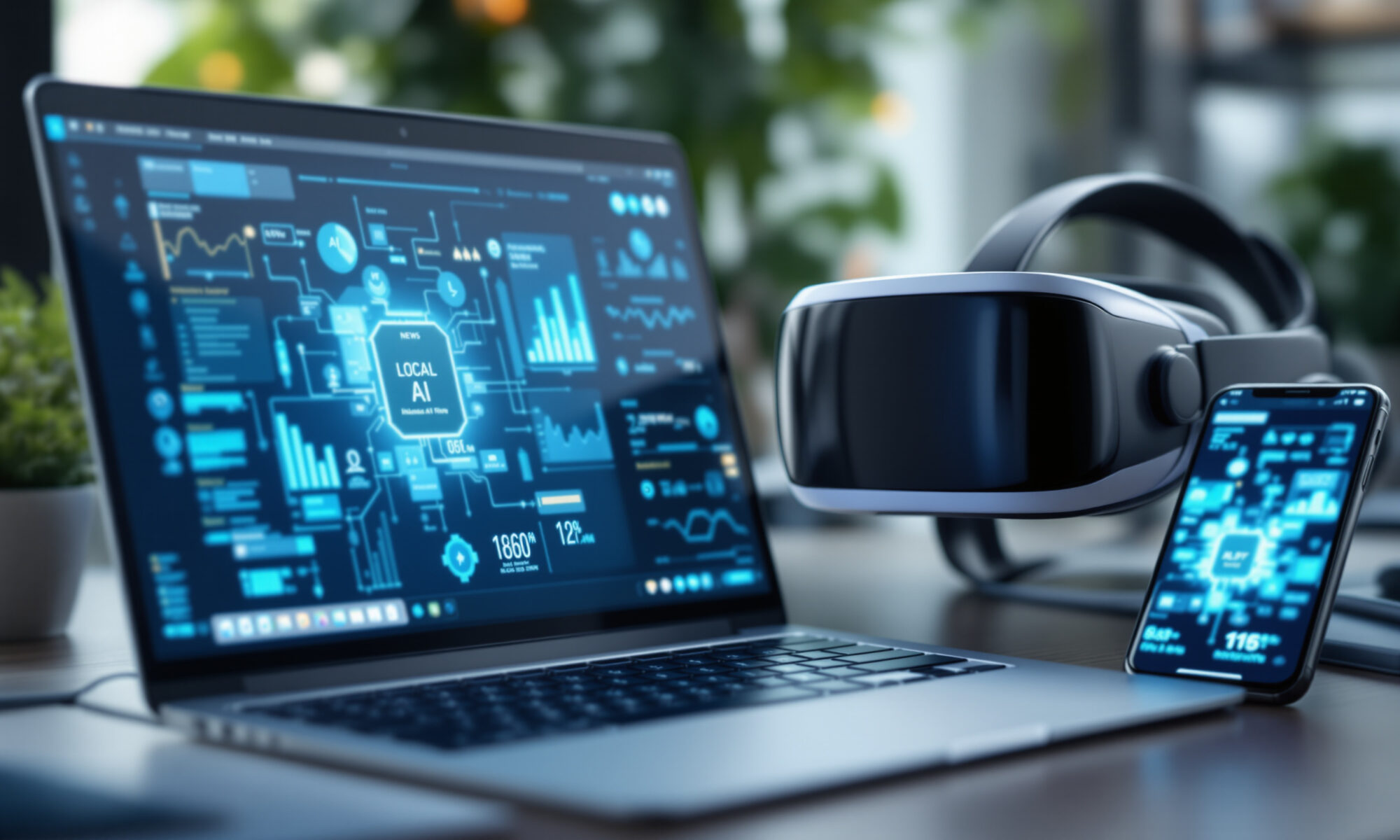
Edge AI 2026 is winning where speed, privacy, offline use, and cost matter more than maximum model size. Cloud AI still handles the hardest jobs, but phones, PCs, headsets, robots, and browsers now run useful models locally thanks to NPUs from Apple, Qualcomm, AMD, and Microsoft’s Copilot+ PC ecosystem. The real shift is practical: more AI happens before your data ever leaves the device.
What is edge AI in 2026?
Edge AI means artificial intelligence running near you, usually on your phone, laptop, headset, car, camera, or industrial machine, rather than entirely in a distant data center. In edge AI 2026, the phrase mostly points to on-device models accelerated by NPUs, mobile GPUs, and specialized chips built for low-power inference.
Search intent around this topic is mostly informational with a comparative angle: you want to know why on-device AI is gaining ground, what it can really do, and when cloud AI remains better. The honest answer is not “edge replaces cloud.” It’s a split. Local models handle frequent, sensitive, low-latency tasks; cloud systems handle huge context, heavyweight reasoning, and expensive multimodal workloads.
Apple’s 2025 Apple Intelligence technical report described a 3B-parameter on-device foundation language model optimized for Apple silicon, with a larger server model available through Private Cloud Compute. Qwen2.5, released in September 2024, included open-weight models from 0.5B to 72B parameters, and Qwen described its 3B model as suitable for mobile-side use. By April 2025, Qwen3 expanded that small-model menu with dense 0.6B, 1.7B, 4B, 8B, 14B, and 32B models.
If you want the phone-level version of this shift, our guide to what on-device AI can do offline is the natural next read. The short version: translation, summarization, image understanding, voice features, smart replies, and lightweight agents are no longer cloud-only ideas.
Why edge AI 2026 is beating cloud AI for everyday tasks
Latency is the first win. A local model doesn’t need to send your prompt across a mobile network, wait in a server queue, and return a response. Even when the cloud model is faster at raw computation, the round trip can make the experience feel worse, especially for voice, camera, mixed reality, or accessibility features.
Privacy is the second win, and it’s the one users actually understand. If a model rewrites a private message, classifies a photo, or summarizes a meeting locally, less sensitive material leaves your device. Apple has leaned hard into this split: its 2026 research on the third generation of Apple foundation models describes privacy goals built around on-device processing and Private Cloud Compute for larger requests.
Cost is the third reason, though vendors don’t always say it loudly. Every cloud inference call costs money in compute, energy, networking, and capacity planning. A feature used billions of times a day becomes much cheaper if common requests run on silicon the customer already bought.
The fourth win is resilience. Offline AI is boring until you need it. On a plane, in a factory with patchy Wi-Fi, in a rural clinic, or inside a headset that must react instantly to your surroundings, local inference stops being a convenience and becomes the only sensible design.
The NPU numbers behind the shift
Marketing around TOPS can be slippery, but the direction is clear. Microsoft introduced Copilot+ PCs on May 20, 2024 as Windows PCs with NPUs capable of 40+ TOPS, and the first Snapdragon X Series devices were specified at 45 NPU TOPS. In June 2024, AMD announced Ryzen AI 300 Series processors with up to 50 NPU TOPS.
Qualcomm’s Snapdragon X Elite product brief listed a Hexagon NPU at 45 TOPS and claimed on-device generative AI at 30 tokens per second in 2024. In June 2026, Qualcomm announced Snapdragon Reality Elite for spatial computing with 48 TOPS of AI processing and said it could run LLMs and large vision models directly on-device.
Here’s the useful comparison, stripped of hype. TOPS doesn’t tell you everything about memory bandwidth, thermals, model quality, or software support, but it does show why edge AI 2026 feels different from the voice-assistant era.
| Platform or chip | Year stated | AI acceleration figure | What it signals |
|---|---|---|---|
| Microsoft Copilot+ PC requirement | 2024, restated 2025 | 40+ NPU TOPS | A baseline for local Windows AI features |
| Qualcomm Snapdragon X Elite | 2024 | 45 NPU TOPS; 30 tokens/sec on-device generative AI claim | PC-class local LLM use becoming realistic |
| AMD Ryzen AI 300 Series | 2024 | Up to 50 NPU TOPS | x86 AI PCs competing on local acceleration |
| Apple on-device foundation model | 2025 | 3B parameters, optimized for Apple silicon | Small local models as a product foundation |
| Qualcomm Snapdragon Reality Elite | 2026 | 48 TOPS AI processing | On-device LLM and vision models moving into spatial computing |
A small calculation makes the change easier to grasp. If a local assistant answers a 300-token request at Qualcomm’s claimed 30 tokens per second for Snapdragon X Elite in 2024, generation alone takes about 10 seconds before accounting for prompt processing and UI overhead. That won’t beat a top cloud model on every query, but it’s good enough for many summaries, rewrites, and structured commands, especially when the alternative is no connection or sending private data away.
The pitfall almost nobody mentions: sustained performance is not peak performance. A laptop or phone can hit a flashy number for a short burst, then slow down as heat builds. A March 2026 arXiv paper evaluating LLM inference at the edge focused exactly on throughput, latency, power, and thermal behavior under sustained load, which is where real products either feel polished or fall apart.
Local models are getting good enough, not magically huge
Edge AI wins by being useful, not by matching the largest cloud model parameter for parameter. A 3B model tuned for device tasks can be excellent at summarizing your notes, classifying a photo, extracting calendar details, or drafting a short reply. It doesn’t need to write a PhD thesis.
Open-weight models changed the economics here. Qwen2.5 in 2024 and Qwen3 in 2025 gave developers a ladder of model sizes, from sub-billion parameter models to much larger dense and mixture-of-experts options. Google AI Edge also published 2025 guidance for on-device small language models covering multimodality, retrieval-augmented generation, and function calling.
Retrieval is the quiet accelerator. Instead of asking a small model to remember everything, a device can search local files, app data, or a small vector store, then feed the relevant snippets to the model. A June 2026 arXiv paper reported an end-to-end RAG pipeline running all neural stages on the Qualcomm Hexagon NPU of Snapdragon X Elite, which is exactly the kind of architecture that makes edge AI 2026 more than autocomplete with better branding.
Browsers are part of the story too. WebGPU gives web apps a way to use local graphics hardware for AI and graphics workloads, and our primer on AI and graphics in the browser through WebGPU explains why that matters for apps that don’t want to install a heavy native client.
Where cloud AI still wins
Cloud AI is not losing the jobs that require massive context windows, frontier model reasoning, large-scale coding agents, long video understanding, or expensive multi-step research. Honestly, pretending otherwise is just vendor theater. The best cloud systems still have more compute, fresher centralized deployment, and access to models too large for a phone or thin laptop.
Apple’s own architecture says the quiet part out loud. Apple Intelligence can use Private Cloud Compute for requests needing more computational capacity while keeping simpler tasks on device. In June 2026, Apple said it was expanding Private Cloud Compute beyond its own data centers alongside the next generation of Apple Intelligence, according to Apple Security Research.
Security is also nuanced. Keeping data local reduces exposure, but local AI creates new attack surfaces: prompt injection against personal data, poisoned local indexes, unsafe tool calls, and malware trying to read model inputs or outputs. If you’re building agents that call tools or servers, the concerns overlap with the risks covered in our guide to securing MCP servers and AI tool connections.
Cloud also helps when teams need consistent outputs across devices. A product running on a low-end phone, a premium laptop, and a mixed-reality headset may behave differently if each device uses different local hardware. Centralized inference is easier to test, monitor, patch, and audit.
How to decide between edge and cloud AI
The smart architecture in edge AI 2026 is hybrid. Run the small, common, private, and latency-sensitive work locally. Escalate the rare, complex, expensive work to the cloud only when the user gains something obvious.
For product teams, the decision should be less philosophical and more mechanical. Use a checklist before you choose where a feature runs:
- Data sensitivity: keep messages, health data, photos, and documents local when the task is simple enough.
- Latency target: use device inference for voice, camera, accessibility, robotics, and spatial computing where delays feel broken.
- Model size: choose cloud for tasks that need a frontier model, large context, or complex reasoning.
- Connection quality: design local fallbacks for travel, field work, factories, schools, and low-bandwidth regions.
- Thermal limits: test sustained use, not just a demo prompt on a cool device.
- Cost per action: if a feature fires constantly, local inference can save real cloud spend over time.
AI browser agents show the split neatly. Some actions can run locally, such as parsing a page or filling a form suggestion, while heavier planning may still call a remote model. Our comparison of AI browser agents in 2026 is a good example of how product design now depends on where the model runs, not just which model is smartest.
Testing teams face a similar problem. If an app changes behavior based on local hardware, NPU availability, or offline mode, QA has to cover more device states. That’s where structured tooling, like the platforms discussed in our guide to automation testing for scaling QA, becomes less optional.
What edge AI 2026 means for buyers and builders
For buyers, the practical advice is simple: don’t buy a device only because the AI number is bigger. A 50 TOPS NPU with weak software support may be less useful than a slightly slower platform with mature apps, good privacy controls, and reliable thermals. At this stage, ecosystem beats spec-sheet bragging more often than chip vendors admit.
For builders, assume local AI will be expected in premium experiences. Users won’t want every dictate, screenshot, or file summary uploaded by default. They’ll also expect cloud escalation when the local model gets stuck, and they’ll blame the product, not the architecture, if the handoff feels clumsy.
Industrial and robotics systems make the case even sharper. NVIDIA said in March 2026 that open models were being used on Jetson Thor for real-time edge inference in industrial and robotic systems. In those settings, latency, uptime, and data locality are operational requirements, not nice privacy talking points.
The winning pattern is already visible: small local language and vision models, retrieval from nearby data, function calling under tight permissions, and cloud backup for the hard stuff. Edge AI 2026 is not about cutting the cord completely. It’s about moving the first decision closer to the user.
FAQ
Is edge AI more private than cloud AI?
Usually, yes, because data can be processed on your device instead of being sent to remote servers. It is not automatically private, though; apps still need clear permissions, secure local storage, and safe handling of prompts and outputs.
Will edge AI replace cloud AI in 2026?
No. Edge AI is replacing cloud calls for many routine tasks, but cloud AI remains better for very large models, long context, complex reasoning, and workloads that need centralized updates or heavy compute.
What devices support edge AI in 2026?
Phones, Copilot+ PCs, AI laptops using chips such as Snapdragon X Series or AMD Ryzen AI 300, Apple silicon devices, headsets, robots, cameras, and industrial edge systems can support local AI depending on hardware and software.
Does TOPS measure real AI performance?
TOPS is a useful clue, but it is not a complete performance score. Memory bandwidth, model optimization, thermal throttling, developer tools, and app support can matter just as much in daily use.
What is the best use case for edge AI 2026?
The best use cases are fast, frequent, private tasks: voice commands, translation, photo understanding, document summaries, offline assistants, retrieval from personal files, robotics perception, and mixed-reality interactions.