

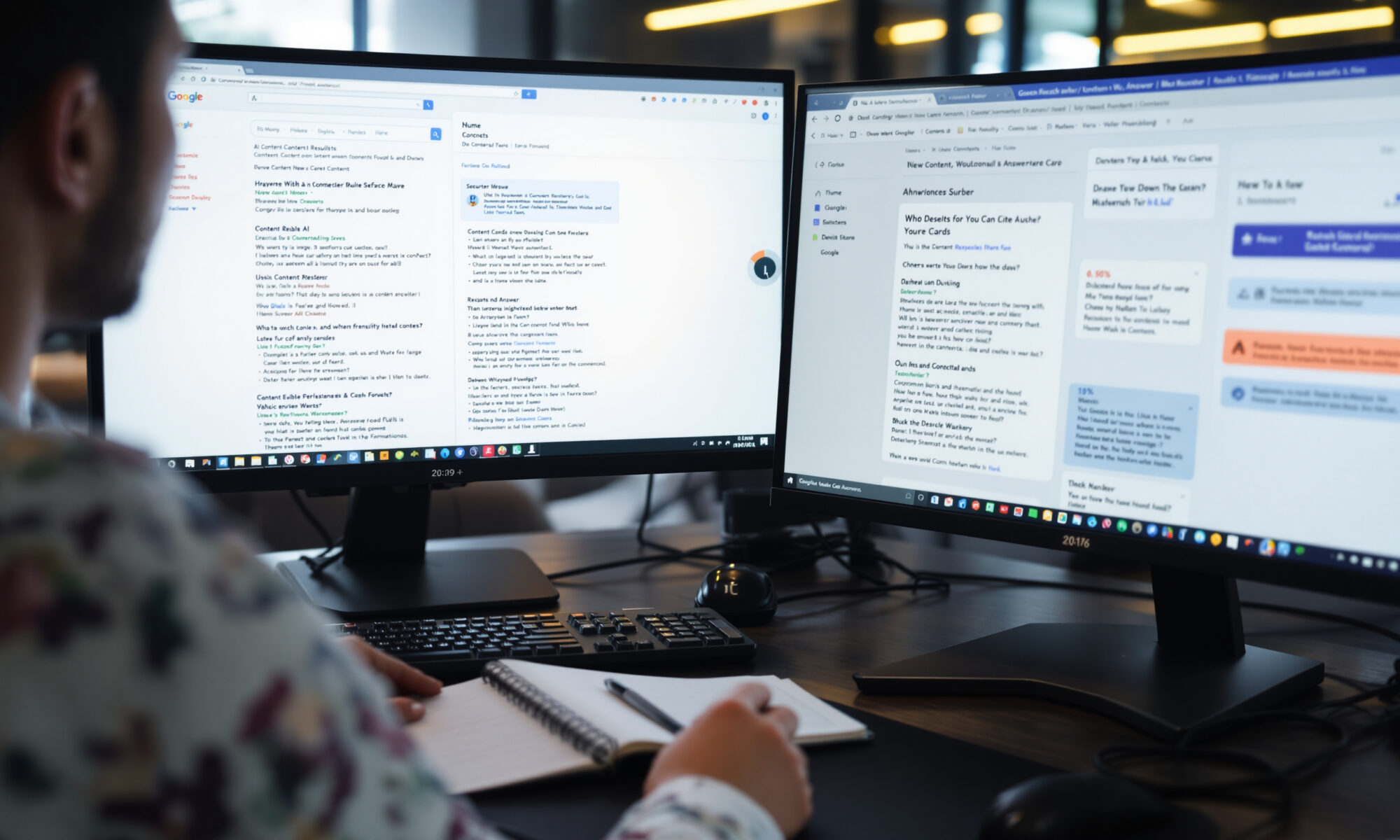
geo vs seo is the comparison between optimizing for search-result rankings and optimizing to be used inside AI-generated answers. SEO still gets pages crawled, indexed, ranked, and clicked. GEO adds a second job: make your content easy for ChatGPT Search, Google AI Overviews, Bing Copilot Search, Gemini, and Perplexity-style systems to retrieve, understand, cite, and summarize accurately.
GEO vs SEO: the practical difference
Classic SEO is built around the search results page. You target a query, earn visibility, win the click, then convert the visitor on your site. The mechanics still matter: crawlability, indexability, relevance, links, structured data, internal architecture, page experience, and clear snippets.
Generative Engine Optimization, usually shortened to GEO, starts from a different screen. The user may never see ten blue links. Instead, an AI system composes an answer and may cite two, four, or eight sources underneath a paragraph. Your goal is no longer just position one; it’s being retrieved, synthesized, named, or cited in the answer itself.
The term GEO became serious research language in 2024 when the KDD ’24 paper “GEO: Generative Engine Optimization” described a framework for improving content visibility in generative-engine responses. The authors reported visibility gains of “up to 40%” in their benchmark after content changes such as adding citations, quotations, statistics, and evidence-bearing language.
My view: GEO isn’t a replacement for SEO. It’s SEO with a harsher editor. If your page is vague, undated, anonymous, or hard to quote, an AI answer has little reason to use it even if it can find it.
What changes when AI answers the query?
Search intent changes shape. In normal SEO, a user might scan five results, compare titles, and click the page that looks useful. In AI search, the answer can arrive before the click, which means your content may influence the user without getting the session you expected.
Google Search Central said in 2025 and 2026 that SEO best practices remain relevant for AI Overviews and AI Mode. Bing Webmaster Guidelines make a similar point for Bing and Copilot AI-generated experiences: discovery, indexing accuracy, and content clarity support eligibility for grounding and citations. OpenAI’s ChatGPT Search documentation says answers can include links to relevant web sources, and Enterprise/Edu search responses can show inline citations.
So the serious geo vs seo question isn’t “Which one should you do?” It is “What must be added once the answer engine becomes the interface?” The answer is evidence. Names. Dates. Entity consistency. Claims that can stand alone when pulled into a generated paragraph.
Take a software comparison page. For SEO, you might optimize the title, intro, headings, FAQ, and schema. For GEO, you also need passage-level facts such as “As of 2026, Google Search Central says structured data should match visible page text,” or “Microsoft introduced Copilot Search in Bing in April 2025 and described generative responses with citations plus inline links.” Those sentences are useful because they are compact, attributable, and time-stamped.
If you’re already using AI in the workflow, the same discipline applies to adjacent tasks such as writing AI-assisted SEO meta descriptions: the machine can draft, but you still have to supply the facts, constraints, and editorial judgment.
The signals: rankings versus citations
The cleanest way to understand geo vs seo is to compare what each system rewards. Traditional search engines have always used many signals, and Google does not publish a simple checklist that guarantees ranking. Still, public documentation gives you a dependable direction: make pages accessible, useful, technically sound, and understandable.
Generative systems add another layer. They need sources that can support an answer. A page that ranks well but hides the answer under promotional copy may be less attractive than a page with a dated statistic, a clean definition, a table, and a cited primary source.
| Area | Classic SEO focus, 2024-2026 | GEO focus, 2024-2026 |
|---|---|---|
| Primary goal | Rank on a search results page and earn clicks | Be retrieved, named, summarized, or cited inside an AI answer |
| Technical base | Crawlability, indexability, canonical pages, internal links, mobile usability | Same technical base, plus pages that expose clear passages AI systems can parse |
| Content structure | Query-focused titles, headings, snippets, schema, supporting sections | Concise answer blocks, dated facts, quotable claims, source-backed summaries, tables |
| Authority signals | Links, topical relevance, brand trust, expertise, site quality | Credible entities, citations, evidence, freshness, consistency across brand and author pages |
| Measurement | Rankings, impressions, CTR, organic sessions, conversions | AI answer inclusion, citation rate, brand mention rate, source accuracy, sentiment, citation drift |
A small calculation shows why this matters. Suppose a query used to bring 10,000 organic impressions a month in 2024 with a 4% CTR, or about 400 visits. If an AI answer satisfies half of those searches before a click and your CTR falls to 2%, you get 200 visits. But if your brand is cited in 30% of those 10,000 answers, you may gain 3,000 brand exposures that analytics won’t count as sessions. Different scoreboard. Different argument for budget.
Rewrite pages for answer engines without wrecking SEO
Don’t strip your pages down to sterile answer boxes. Readers still need flow, judgment, examples, and a reason to trust you. The better move is to keep the page useful for humans while giving answer engines cleaner material to work with.
A practical transition plan looks like this:
- Keep the technical SEO base healthy: indexable pages, sensible canonicals, fast templates, and crawlable internal links.
- Create entity-clean pages for products, authors, companies, locations, and recurring concepts, using the same names everywhere.
- Add direct-answer sections near the top of key pages, especially for informational and comparative queries.
- Attach dates to statistics, prices, version numbers, research findings, and product claims.
- Cite primary sources inline when a claim depends on a document, study, announcement, or official help page.
- Use structured data only where it matches visible page text, as Google Search Central advises.
- Track AI-answer citations separately from Google rankings because they won’t move in lockstep.
For a broader planning layer, connect this work to your digital marketing strategy rather than treating it as a side project owned by one SEO specialist. AI answer visibility affects PR, product marketing, analytics, and content operations.
One pitfall rarely mentioned: schema can become a liability if the visible copy drifts away from the markup. Google says structured data provides explicit clues about page meaning and that most Search structured data uses schema.org vocabulary, but it also says structured data should match visible page text. If your Article schema says one thing and the page says another, you’ve made the machine’s job harder, not easier.
What should you measure now?
Rank trackers don’t disappear. You still need Search Console impressions, clicks, average position, organic landing pages, conversions, and indexed-page coverage. But geo vs seo measurement requires another layer because AI systems can mention you, cite you, misrepresent you, or ignore you while rankings look stable.
Start with a controlled prompt set. Pick 50 to 200 real queries that matter to your business: definitions, comparisons, “best” queries, pricing questions, local intent, and post-purchase troubleshooting. Run them on a fixed schedule across the AI products your audience uses, then record whether your brand appears, whether your URL is cited, and whether the answer describes you correctly.
Recent research points in that direction. A 2026 arXiv paper, “From Citation Selection to Citation Absorption,” proposed a two-stage GEO measurement framework and reported a public dataset with 602 controlled prompts, 21,143 valid search-layer citations, 23,745 citation-level feature records, 18,151 fetched pages, and 72 extracted features. Treat that as research, not a vendor dashboard, but the scale is useful. It shows how granular this field is becoming.
Vendor names differ, so don’t get trapped by terminology. Some people call it GEO. Others use AEO or LLMO; TechRadar commented in April 2026 that the industry has fragmented around these acronyms. The label matters less than the audit: are AI answers finding your best material, and are they using it accurately?
Teams experimenting with automated content loops should be careful here. Tools can monitor and rewrite at scale, but they can also amplify weak claims if nobody checks them; the operating model described in AI loop engineering only works when feedback is tied to quality, not just output volume.
Where paid, PR, and brand authority fit
Paid search doesn’t map neatly onto AI answers. Axios reported in 2025, citing Muck Rack, that analysis of more than 1 million realistic prompts across ChatGPT, Gemini, and Claude found AI-generated search differs from traditional SEO partly because paid marketing and sponsored links rarely populate AI answers. That’s a big commercial difference.
Brand authority still matters, though not always in the old backlink-only sense. If multiple reputable sources describe your company, product, author, or dataset consistently, an answer engine has less ambiguity to resolve. If your own site uses three product names, two founder bios, and outdated pricing pages, don’t blame the model when it gets confused.
There is also a publisher economics angle. Axios reported in 2025 that Perplexity set aside a $42.5 million pool for early publishing partners in a publisher-compensation program. That doesn’t mean every publisher will be paid by AI search engines. It does show that citation, content use, and source visibility are now business negotiations, not just traffic questions.
For commerce and agentic buying, the stakes get even stranger. If an AI assistant can research, recommend, and eventually help pay, your product data and trust signals need to be machine-readable and human-verifiable; related developments such as agentic AI payment in shopping point toward a search environment where the answer may become the action.
A practical geo vs seo playbook for 2026
Use SEO as the floor and GEO as the editorial upgrade. I wouldn’t spend a dollar on “AI search optimization” if your key pages are blocked, duplicated, thin, or internally orphaned. Fix the basics first. Boring work wins.
After that, pick your money pages and rewrite them like a source a journalist would actually quote. Put the answer early. Name the entity precisely. Add dates. Show numbers in context. Explain edge cases. Replace fluffy claims with evidence-backed sentences.
For example, a weak sentence says, “Our platform helps teams improve productivity with advanced AI.” A better GEO-ready sentence says, “In 2026, the platform supports policy-based access controls, audit logs, and model-specific usage reporting for enterprise AI teams.” The second line gives a generative engine something concrete to retrieve, compare, and cite.
Content built around tools, AI products, or model ecosystems should also keep version and pricing references fresh. If you cover Gemini development, for instance, linking readers toward a maintained guide to Google AI Studio and the Gemini API can help consolidate context instead of scattering thin explanations across multiple pages.
Honestly, GEO only makes sense if you’re willing to maintain the page after publication. AI answers are sensitive to freshness and source drift. A 2024 statistic left untouched on a 2026 buying guide can make the whole page feel stale, even if the rest of the advice is solid.
FAQ
Is GEO replacing SEO?
No. Google and Bing both indicate that core SEO practices still support visibility in AI search features. GEO adds citation-readiness, evidence, entity clarity, and answer-level structure on top of the SEO foundation.
What is the main difference in geo vs seo?
SEO optimizes for rankings and clicks from search results. GEO optimizes for retrieval, synthesis, mentions, and citations inside AI-generated answers.
Does structured data help with AI Overviews?
Structured data helps search engines understand page meaning, and Google says it provides explicit clues. It should match the visible page text; misleading or stale markup is a mistake.
How do I know if ChatGPT or Copilot cites my site?
Create a fixed set of prompts, run them regularly, and record mentions, links, citations, and answer accuracy. Compare that data with rankings because AI citation visibility can move separately from organic position.
What content changes help GEO most?
The 2024 KDD GEO paper tested additions such as citations, quotations, statistics, fluency, authority cues, technical terms, and unique words. In practice, dated facts, primary-source citations, clear entities, and concise answer blocks are the safest starting points.