

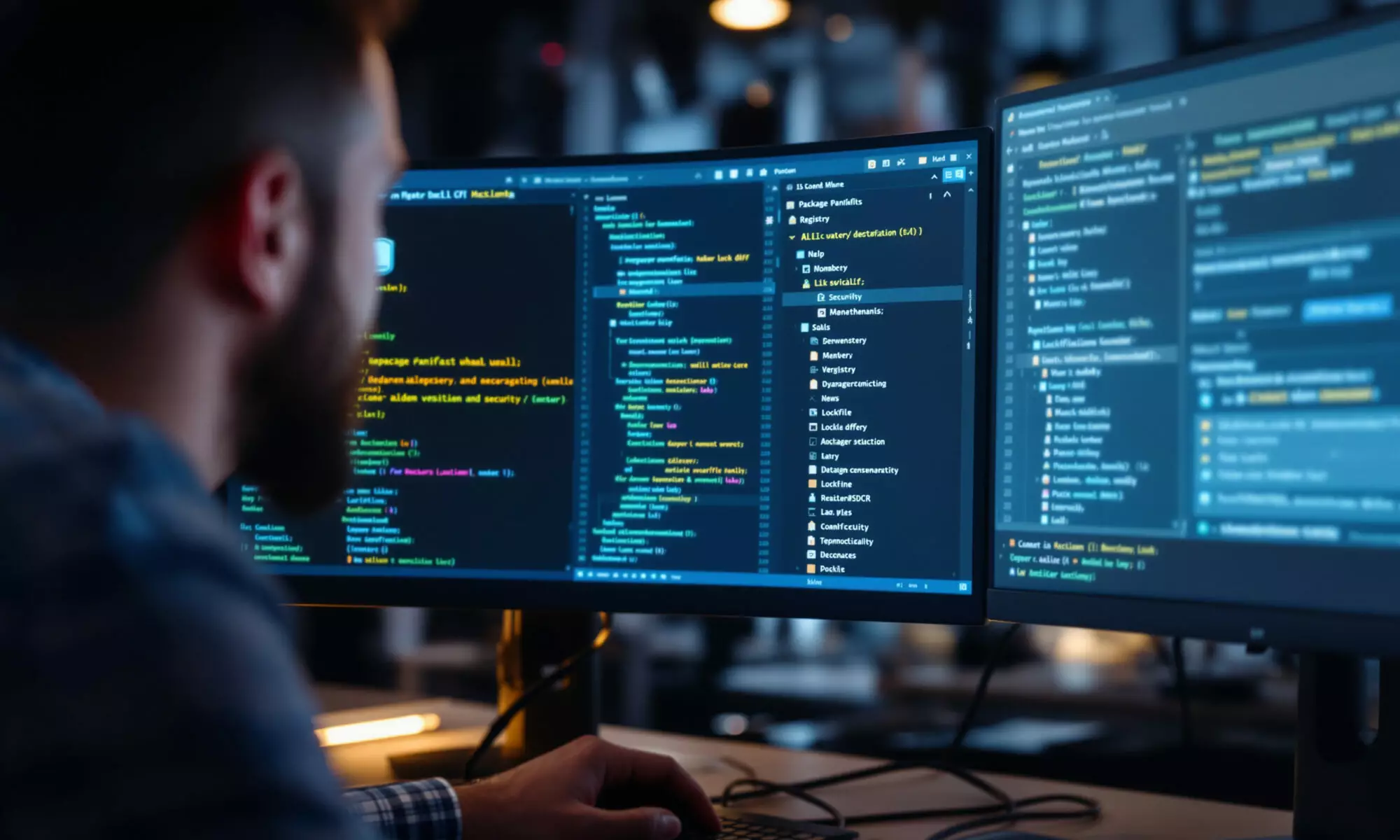
AI coding dependency security requires treating every agent-proposed package as untrusted until policy and a human reviewer approve it. Coding agents can choose dependencies, run package managers and reach registries, so a plausible but nonexistent package can become executable code within minutes. AI coding dependency security is the discipline that controls how AI-generated dependencies enter, change and leave a software build.
Why are AI coding agents creating a dependency problem?
AI coding agents create dependency risk because they can recommend packages, edit manifests, execute installation commands and access public registries faster than reviewers can validate each change. VentureBeat reported on September 24, 2026, that assistants were adding packages, libraries and container images while enterprise approval cycles still took days.
Speed changes the nature of the problem. A developer might add a few dependencies during a feature sprint, while an autonomous agent can repeatedly try libraries, discard approaches and leave indirect packages buried in a lockfile. Each addition expands the set of maintainers, release systems and registry accounts your application trusts.
The risk isn’t limited to malicious code. Abandoned libraries, unexpected licenses, compromised publishers, typo-squatted names and incompatible versions can all reach a build through a suggestion that looks reasonable in a pull request. Teams already concerned about malicious repositories hijacking coding agents should apply the same skepticism to package registries.
Traditional review also has a visibility problem. A one-line addition to package.json can pull dozens or hundreds of transitive components, depending on the package, version and ecosystem in 2026. Reviewing the direct package without inspecting the resolved tree is therefore an incomplete security decision.
How do hallucinated packages become supply-chain attacks?
Hallucinated packages become attack opportunities when an AI model repeatedly suggests a plausible name that does not exist, allowing an attacker to register that name and publish hostile code. A 2025 academic study of 16 models and 576,000 generated samples measured an average package-hallucination rate of approximately 19.6%.
The study, published through USENIX in 2025, shows why a failed installation isn’t harmless noise. Repeated names provide an attacker with a ready-made distribution channel: register the missing name, wait for generated code to request it, and rely on normal package-manager behavior to retrieve it.
Sonatype reported a related version problem in 2026 after analyzing 36,870 agent-generated upgrade recommendations. According to Sonatype, 27.76% referenced nonexistent versions, including more than 10,000 hallucinated releases. A real package name doesn’t make a fabricated version safe; it can trigger failed builds, unsafe substitutions or pressure to bypass controls.
Propagation can happen before anyone publishes malware. The Cloud Security Alliance described the hallucinated name react-codeshift spreading through 237 forked repositories before a researcher defensively registered it in January 2026. Forks can preserve a bad dependency reference long after the original output disappears.
OWASP’s Secure Coding with AI Cheat Sheet, accessed October 1, 2026, recommends checking each suggested package in its actual registry and reviewing its creation date, download activity and maintainer history. OWASP treats packages younger than 30 days with particular suspicion. In my view, installation failure should be logged as a security signal, not dismissed as an agent making another typo.
What should an AI dependency approval policy require?
An AI dependency approval policy should require the agent to identify the dependency’s purpose, exact package and version, registry, maintenance status and rejected alternatives before installation. AI coding dependency security must then enforce the decision outside the model through continuous-integration rules, approved registries and human authorization for sensitive changes.
A model’s explanation is evidence, not enforcement. Prompt instructions can be ignored, misunderstood or displaced by hostile repository content. The safer pattern is simple: the agent may propose a dependency, but a separate control decides whether that package can enter the build.
The following checklist covers the minimum review path for every new or changed dependency:
- Confirm that the exact package and version exist in the intended registry, and reject silent substitutions.
- Record the package’s purpose, publisher, creation date, release activity, license and maintenance history.
- Compare at least one no-dependency or already-approved alternative, including the cost of writing the required function locally.
- Restrict downloads to approved internal or public registries through network allowlists and repository policy.
- Require reviewed manifest and lockfile changes, integrity values, a dependency diff and a software bill of materials.
- Scan direct and transitive dependencies before merge, then fail continuous integration at the organization’s defined severity threshold.
- Send installation, registry-policy and high-impact exceptions to a human approval gate that the agent cannot approve itself.
This approach also prevents dependency sprawl. If a package saves 20 lines of code but introduces 40 transitive components, the review should measure the added trust rather than admiring the shorter source file. Honestly, a small local function often makes more sense when the alternative creates a large, weakly maintained dependency tree.
NIST Special Publication 800-204D recommended trusted-source allowlists, signature verification, vulnerability scanning, update checks and software bills of materials in 2024. NIST also recommended beginning dependency scanning at the first commit, rather than postponing it until release. Those controls fit naturally beside broader third-party supply-chain vetting.
How should CI verify AI-generated dependency changes?
Continuous integration should reject AI-generated dependency changes unless the manifest, reviewed lockfile, integrity data, dependency diff, vulnerability results and software bill of materials agree. For npm projects in 2026, deterministic installation and committed package-lock.json files give reviewers a defined dependency tree instead of a moving version range.
According to npm documentation accessed October 1, 2026, package-lock.json records resolved artifacts and SHA-512 or SHA-1 integrity values. The standard npm audit workflow normally requires a lockfile because an audit needs a defined tree. A manifest-only pull request should fail automatically.
| Control | Evidence reviewed | Failure condition |
|---|---|---|
| Registry verification | Exact package, version, publisher and approved registry | Name or version is missing, substituted or fetched from an unapproved source |
| Deterministic install | Committed package-lock.json and resolved artifacts |
Manifest changes without corresponding reviewed lockfile changes |
| Integrity and provenance | Integrity hashes, registry signatures and available attestations | Artifact differs from locked data or required verification fails |
| Vulnerability scan | Direct and transitive dependency findings | A finding meets the organization’s documented rejection threshold |
| SBOM comparison | SPDX or CycloneDX inventory against the previous approved build | Unexpected component, version, source or transitive dependency appears |
npm documentation accessed in 2026 states that npm audit signatures checks registry signatures and provenance attestations. Provenance verification requires npm CLI 9.5.0 or later. Signatures don’t prove that a package is benign, but they can establish whether the artifact and publisher evidence match what the registry presents.
Generate a software bill of materials for every build, not just a major release. npm can produce SPDX or CycloneDX output, while NIST and the Cybersecurity and Infrastructure Security Agency describe SBOMs as machine-readable software inventories. Comparing successive inventories exposes the hidden cost of a tiny manifest edit.
Scanning alone is too narrow. A vulnerability database may have no entry for a newly created malicious package, so AI coding dependency security must also evaluate package age, registry, publisher and provenance. Similar reasoning applies when teams use AI agents during code review: automated findings support judgment rather than replacing it.
Which permissions should coding agents receive?
Coding agents should receive separate identities, short-lived credentials and only the shell, filesystem, package-manager and network permissions required for the assigned repository. GitHub’s 2026 guidance recommends restricted tools and human approval for sensitive operations, while agent-authored commits and session logs preserve attribution after an incident.
Registry access should be explicit. GitHub’s cloud-agent firewall supports organization-level and repository-level domain or URL rules, according to documentation accessed October 1, 2026, although GitHub warns that the firewall isn’t comprehensive. Network filtering belongs beside package policy, not in place of it.
The identity gap remains substantial. VentureBeat Pulse reported on August 12, 2026, that 65% of surveyed enterprises enforced scoped agent permissions, but only 18% isolated their highest-risk agents and 53% had experienced an agent-related security incident or near-miss. A separate VentureBeat report put the share combining runtime enforcement with high-risk isolation at only 8% in 2026.
Here is the overlooked calculation: 65% enforcement minus 8% combining enforcement with isolation leaves a 57-percentage-point gap between basic permission control and the stronger paired control in that 2026 survey. Permissions help, but shared infrastructure and credentials can still turn one compromised agent into a wider incident.
Shared credentials weaken attribution too. On September 30, 2026, VentureBeat reported that 22 of 37 surveyed organizations running production agents with enforced permissions still allowed some or most agents to share credentials. A log showing “automation account” isn’t enough when several agents can use the same secret.
Keep approval outside the agent’s reach. An August 26, 2026, prompt-injection demonstration reported by VentureBeat showed an agent using existing credentials to make an unauthorized DNS change. The recommended pattern allows an agent to propose a high-impact action but prevents it from approving that action, a useful model for package installation and registry exceptions as well as infrastructure changes. Teams should also account for the broader ways coding agents choose and invoke tools.
Frequently asked questions
Can a lockfile stop a malicious npm package?
A lockfile cannot determine whether an npm package is malicious. A reviewed package-lock.json fixes the resolved tree and records integrity data in 2026, helping continuous integration detect unexpected artifacts or dependency changes.
Is npm audit enough for AI coding dependency security?
npm audit is not enough for AI coding dependency security because vulnerability scanning may miss new, hallucinated or deliberately malicious packages. Registry identity, package age, publisher history, signatures, provenance and SBOM differences require separate checks in 2026.
Should coding agents be allowed to install packages?
Coding agents may install packages inside an isolated environment when registry allowlists, scoped credentials, deterministic builds and external approval gates constrain the action. Production builds should reject unreviewed manifest or lockfile changes in 2026.
What should an agent explain before adding a dependency?
An AI coding agent should state the dependency’s purpose, exact package and version, source registry, maintenance status and rejected alternatives. Continuous-integration policy and a human reviewer should verify that explanation before the dependency enters a 2026 build.