

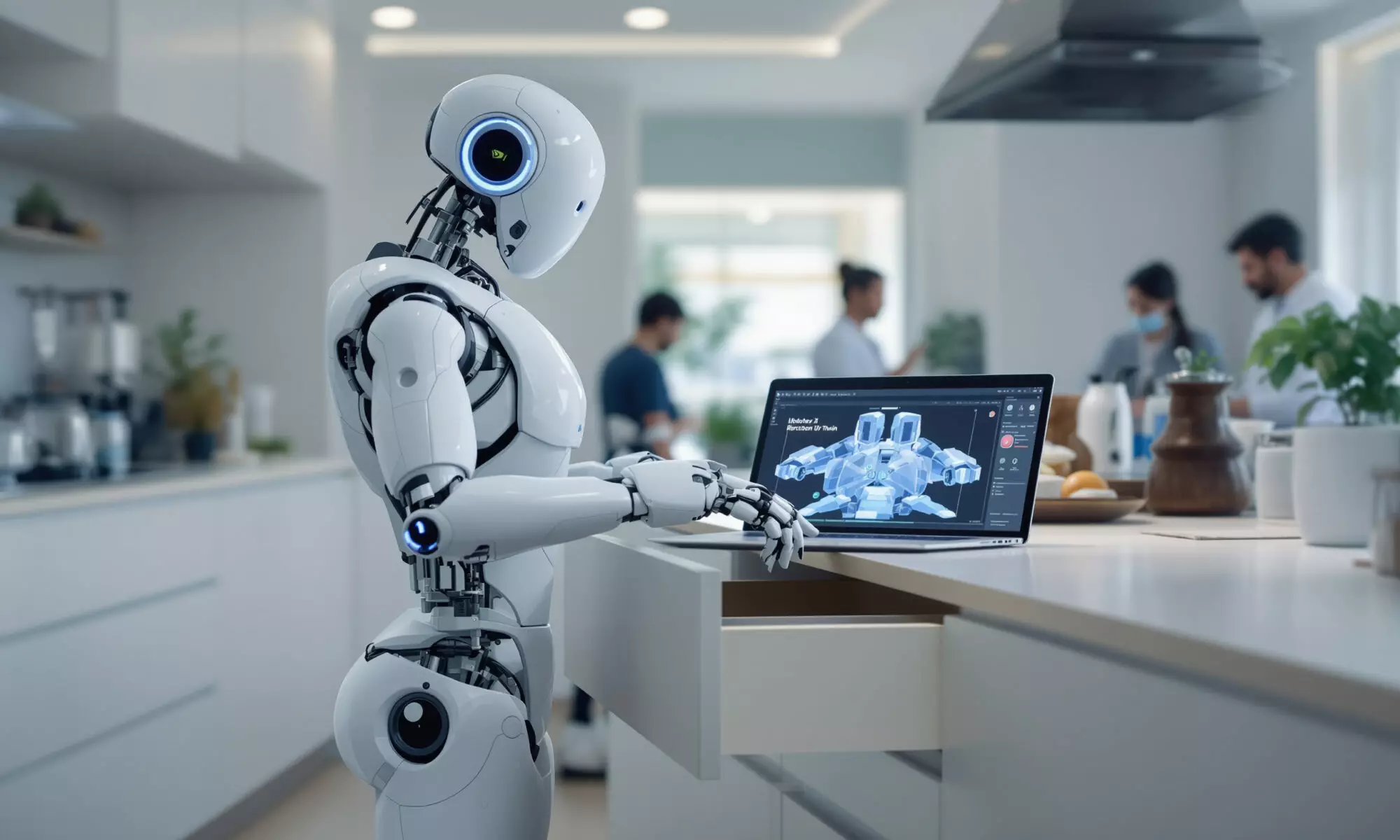
GPT-6 Astra robotics can control high-level humanoid tasks without an environment-specific trained policy. Stanford and Caltech’s September 2026 HomeBody system let GPT-6 Astra direct a Unitree G1 through an unfamiliar kitchen by calling reusable skills for navigation and object handling. The model didn’t generate motor commands itself; persistent spatial memory, an Nvidia Isaac Sim digital twin and lower-level controllers handled execution.
How does GPT-6 Astra robotics control a humanoid?
GPT-6 Astra robotics uses the HomeBody architecture to select targets and issue structured tool calls to reusable robot skills. Introduced by Stanford and Caltech researchers in September 2026, HomeBody replaces a conventional vision-language-model-to-action pipeline with a swappable vision-language model that orchestrates skills while dedicated controllers execute physical movement.
HomeBody is a modular robot architecture that lets a vision-language model plan tasks and call embodied skills through a common interface. Its September 2026 demonstration ran on a Unitree G1 humanoid and used GPT-6 Astra remotely for high-level decisions.
The distinction matters. Astra could request “pick” or “open drawer,” but it wasn’t calculating every joint position or actuator update. Arm and hand commands ran at 250 Hz in the 2026 system, while the pretrained AMO lower-body policy updated at 50 Hz. Those real-time loops stayed beneath the language model.
The demonstrated library contained five skills in September 2026: pick, place, open drawer, pick from drawer and navigate. Developers can add learned policies, classical algorithms or other controllers behind the same interface. That resembles the way AI coding agents select specialized tools, except a bad call can move kilograms of hardware rather than corrupt a file.
“Without a trained policy” therefore needs qualification. HomeBody did not require a new task-specific policy or environment-specific training data for the kitchen, but pretrained and engineered controllers still powered its reusable skills. The advance is orchestration without retraining, not a robot operating without control software.
What did HomeBody accomplish in the unfamiliar kitchen?
HomeBody explored a previously unseen kitchen, cleaned up multiple objects and retrieved medicine from a remembered drawer in September 2026. Stanford and Caltech reported that the Unitree G1 completed those demonstrations without environment-specific training data or additional policy learning, although the project published no aggregate completion rate or duration benchmark.
The system’s spatial memory combined camera observations, LiDAR and simultaneous localization and mapping geometry, joint poses and waypoints. Astra also built an Nvidia Isaac Sim digital twin, allowing the planner to reason about objects beyond the robot’s current camera view.
HomeBody aligned the robot’s map with the simulation reconstruction using Super Odometry and iterative closest point registration in 2026. This Real2Sim approach adds setup time and API expense, but gives the model a more persistent representation than a stream of disconnected camera frames. For broader context, simulation already supports testing and operational planning well beyond humanoid robots.
The published videos need careful reading. According to the HomeBody project, most 2026 skill previews were accelerated, and the drawer-opening and drawer-grasping clips included recorded reattempts. They demonstrate behavior, not real-time task duration or statistically established reliability.
How does GPT-6 Astra recover from robot errors?
GPT-6 Astra robotics divides error recovery between bounded local retries and high-level replanning. In HomeBody’s September 2026 design, visual servoing corrects alignment without making another model call; if the allowed retries fail, the skill returns a specific failure reason to GPT-6 Astra so the model can choose another plan.
That split keeps minor corrections close to the hardware. A gripper that’s slightly misaligned shouldn’t wait for a remote language model to inspect the entire situation, generate a response and issue another command.
The recovery path follows four defined stages:
- Astra selects a target and calls a named skill through structured arguments.
- The skill’s controller executes motion and uses local perception for alignment.
- Visual servoing makes bounded retries when the first physical attempt misses.
- After retries are exhausted, the skill reports the failure reason and Astra replans.
In my view, this separation is the most useful part of HomeBody for developers. It keeps fast, repeatable control inside tested components while reserving the general model for semantic decisions. Related work on evolving AI training environments addresses a different problem: improving agents through generated practice rather than composing existing physical skills at runtime.
How fast and expensive is GPT-6 Astra robotics?
GPT-6 Astra robotics had no published total kitchen-trial bill or end-to-end latency distribution as of September 2026. OpenAI priced the Standard API at $10 per million input tokens, $1 per million cached-input tokens and $50 per million output tokens, while HomeBody reported noticeable pauses between remotely generated skill calls.
| Item | 2026 figure | What it measures |
|---|---|---|
| Standard input | $10 per 1 million tokens | Uncached API input |
| Standard cached input | $1 per 1 million tokens | Reused API input |
| Standard output | $50 per 1 million tokens | Generated API output |
| Arm and hand control | 250 Hz | Low-level command rate |
| AMO lower-body policy | 50 Hz | Pretrained locomotion update rate |
A concrete calculation shows why output length matters. At OpenAI’s September 2026 Standard rates, a hypothetical robot decision using 20,000 uncached input tokens and 2,000 output tokens would cost $0.20 plus $0.10, or $0.30. One hundred such decisions would cost $30. This is an illustration, not HomeBody’s reported usage.
Local perception, planning and skill execution ran on one Razer Blade laptop with an Nvidia RTX 4090 in September 2026. GPT-6 Astra ran remotely, creating pauses between skills rather than inside the 250 Hz control loop. OpenAI added an Ultrafast processing mode on September 29, 2026, offering developers lower model latency at higher inference cost.
Compute isn’t the only constraint. HomeBody reported in 2026 that heavier perception models could require more local hardware, Real2Sim reconstruction imposed setup and API costs, and finger-servo overheating limited extended operation. Honestly, remote orchestration makes the most sense when tasks tolerate pauses between self-contained skills.
Is GPT-6 Astra robotics safe and reliable?
GPT-6 Astra robotics has promising demonstrations but no evidence of general real-world reliability as of September 2026. HomeBody added swept-arm collision checking and bounded retries, yet separate GPT-6 Astra hardware testing stopped after physically unreasonable or unsafe commands damaged equipment; the researchers reported that no person was injured.
A separate RoboDojo preprint dated September 21, 2026, reported an average success rate of 22.48% across 42 simulated tasks and 2,100 trials. RoboDojo found strong relative performance, but precision, dynamic control and complex bimanual coordination remained weak. Its retained real-robot trials did not establish broad hardware reliability.
Those figures are a useful counterweight to polished kitchen footage. A system may clean several objects in a filmed demonstration while still failing most tasks in a broad simulation suite; the evaluations test different conditions, so neither result directly predicts performance in a home.
Developers should treat the skill boundary as a safety boundary. Collision checking, argument validation, force and speed limits, bounded retries, emergency stops and human exclusion zones belong below the language model. The practical lesson echoes real-site camera detection deployments: a convincing model output doesn’t remove the need for operational safeguards and measured field performance.
FAQ about HomeBody and GPT-6 Astra
Who created HomeBody?
HomeBody was introduced in September 2026 by Stanford and Caltech researchers Gio Huh, Cayden Gu, Takara E. Truong, C. Karen Liu and Guy Tevet. The project used GPT-6 Astra with a Unitree G1 humanoid.
Does GPT-6 Astra send commands directly to robot motors?
GPT-6 Astra does not generate every actuator command in HomeBody. In the 2026 implementation, the model called skills at a high level, while arm and hand control ran at 250 Hz and the AMO lower-body policy ran at 50 Hz.
Does HomeBody require any trained robot policies?
HomeBody avoids a newly trained, environment-specific task policy, but it can use pretrained policies inside reusable skills. The 2026 Unitree G1 implementation included a pretrained AMO lower-body policy for locomotion.
Can developers replace GPT-6 Astra in HomeBody?
HomeBody was designed around a swappable vision-language model in September 2026. A replacement model would need to interpret the scene, use spatial memory and produce valid structured calls for the available skill interface.
When was GPT-6 Astra released?
OpenAI released GPT-6 Astra through its API on September 3, 2026, and began a phased ChatGPT rollout on the same date. OpenAI added Ultrafast API processing on September 29, 2026.