
The Apple AI health study is a free, U.S.-only research project examining how adults understand, trust and act on conversational health-AI answers. Launched November 15, 2026, with OpenEvidence, the study accepts up to 200,000 people aged 21 or older who have an Apple Intelligence-enabled iPhone 15 Pro or later running iOS 26 or newer.
What is the Apple AI health study?
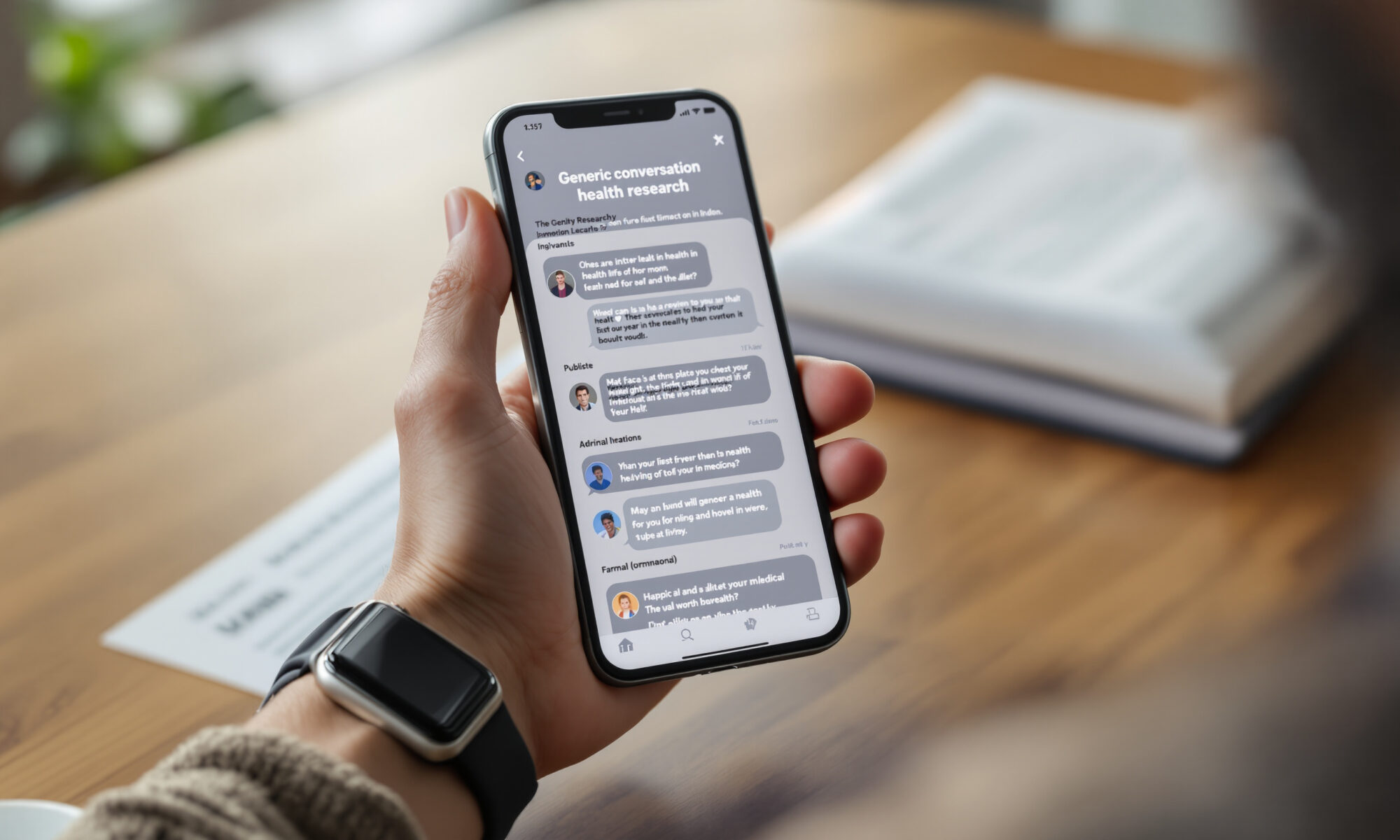
The Apple AI health study is a virtual research project that measures trust, comprehension, answer quality and subsequent actions when people use conversational AI for health questions. Apple released a dedicated iPhone app on November 15, 2026, and says the project studies health-AI use rather than launching a general medical chatbot.
OpenEvidence supplies plain-language responses grounded in established medical publications, including The New England Journal of Medicine, JAMA and Nature. Participants can inspect linked peer-reviewed citations instead of receiving an unsupported block of chatbot prose.
That distinction matters. Health answers can sound confident even when their evidence is weak, a broader issue examined in our guide to AI hallucinations and unreliable outputs. Citations don’t guarantee that an answer fits your case, but they give you and your clinician something concrete to check.
The app can help explain symptoms or conditions, put personal health measurements into context and prepare questions for a medical appointment. Apple explicitly says the app isn’t intended to diagnose or treat disease, and it doesn’t replace a healthcare professional.
Who can join the Apple AI health study?
Enrollment in the Apple AI health study is limited to U.S. residents aged 21 or older, with a maximum of 200,000 participants in 2026. Apple requires an Apple Intelligence-enabled iPhone 15 Pro or later running iOS 26 or later, while TechCrunch reports that Apple Intelligence must also be switched on.
The phrase “iPhone 15 or later” can be misleading. The standard iPhone 15 and iPhone 15 Plus don’t support Apple Intelligence, so neither meets the study requirement; the iPhone 15 Pro and iPhone 15 Pro Max do. That’s an easy eligibility trap when model names differ by only one word.
The App Store lists the English-language application as free, iPhone-only and developed by Apple Inc. If you’re following operating-system changes before enrolling, our coverage of iOS 26.5 beta features provides related software context, although Apple’s stated minimum for the study is iOS 26.0.
Before downloading, check these enrollment requirements:
- You must live in the United States and be at least 21 years old in 2026.
- You need an iPhone 15 Pro, iPhone 15 Pro Max or a later Apple Intelligence-compatible iPhone.
- The iPhone must run iOS 26.0 or later, and Apple Intelligence must be enabled.
- You must use the English-language study app and provide informed consent.
- Enrollment must remain open because the study is capped at 200,000 participants.
What health information can participants share?
Participants in the Apple AI health study may optionally share HealthKit information such as resting heart rate, activity, sleep and laboratory results. Apple is testing whether personal context makes OpenEvidence responses more relevant and understandable, while participants retain control over sharing HealthKit measurements and survey responses throughout the 2026 research project.
Personal context could change the usefulness of a response. A generic question about fatigue is different from one considered alongside sleep duration, activity patterns or laboratory values. Still, a correlation in HealthKit data isn’t a diagnosis, and consumer measurements can contain gaps or device-related errors.
Sleep is a good example. Wearables infer sleep from signals rather than observing it directly, so trends may be more useful than a single score; our report on Fitbit’s sleep-scoring approach shows how consumer platforms combine multiple measurements into one simplified result.
Apple says safety guardrails are designed to identify certain concerning questions and direct users toward a healthcare provider or another appropriate resource. In my view, that escalation path is more meaningful than a polished conversational tone. The app should help you prepare for care, not persuade you that care is unnecessary.
How private is the Apple Health AI Study App?
Apple says data from the Apple Health AI Study App won’t be used to train AI models, and HealthKit sharing is optional. Apple’s 2026 research policy says contact details are separated from study data and replaced with a random code before coded information reaches Apple systems, but the App Store privacy label still warrants careful reading.
The App Store label says user IDs may be collected and linked to identity for app functionality or analytics. Diagnostics may be collected without being linked to identity. Those disclosures don’t automatically conflict with coded research data; they describe different data categories and processing purposes.
Fierce Healthcare reported on November 15, 2026, that queries are processed on the device to remove identifying information, separated from participant IDs and screened in a contractor-managed study environment before reaching OpenEvidence. TechCrunch separately reported that anonymized questions move through a secure third-party cloud provider.
According to TechCrunch’s November 2026 reporting, OpenEvidence deletes query-and-response data after 24 hours. Apple’s launch announcement doesn’t state that deletion window, so the 24-hour figure should be treated as a reported operational detail rather than a term independently documented in Apple’s public announcement.
How does Apple’s study compare with ChatGPT Health and Claude?
Apple’s 2026 project differs from ChatGPT Health and Claude personal-health features because Apple is running a capped research study rather than offering a broad consumer assistant. ChatGPT Health serves eligible U.S. adults through web and iOS, while Anthropic’s health integrations are primarily available to U.S. Claude Pro and Max subscribers.
| Category | Apple Health AI Study App | ChatGPT Health | Claude personal-health features |
|---|---|---|---|
| Answer sources | OpenEvidence responses with linked citations, including NEJM, JAMA and Nature | ChatGPT health models, web capabilities and connected personal records | Claude models with connected records and health services; healthcare connectors include CMS sources |
| Personalization | Optional heart rate, sleep, activity and laboratory data | Optional Apple Health, medical records, medications, labs, visits, sleep and activity | Optional records, labs, Apple Health, Android Health Connect and third-party connectors |
| Training policy | Apple says study data doesn’t train AI models | OpenAI says connected health data and related conversations don’t train foundation models | Anthropic says connected health data doesn’t train models |
| 2026 availability | Free U.S. study; age 21+; up to 200,000 people; compatible iPhone required | Eligible U.S. users age 18+; supported ChatGPT plans; web and iOS | Primarily U.S. Claude Pro and Max subscribers |
| Product status | Research study | Consumer health experience | Consumer integrations and enterprise healthcare products |
Demand is already vast. OpenAI said on July 23, 2026, that more than 300 million people each week use ChatGPT for health-related questions. Apple’s cap equals roughly 0.067% of that weekly audience: 200,000 divided by 300 million, multiplied by 100.
The comparison highlights Apple’s research-first bet. Rather than immediately placing health conversations inside Siri or the Health app, Apple is measuring comprehension, trust and behavior in a controlled cohort. Honestly, the slower approach makes sense for medical information, although it leaves Apple with a much smaller initial reach than OpenAI.
OpenAI also expanded its provider-facing ChatGPT for Healthcare offering on November 16, 2026, adding computer-use agents, improved clinical search and more than 20 healthcare plugins. Apple’s project remains consumer research, so those enterprise features aren’t direct equivalents.
How long does the study last, and what remains unknown?
Each Apple Health AI Usage Study participant may remain enrolled for up to 12 months, according to 2026 launch reporting, while TechCrunch says the overall research project is intended to run for more than 12 months. Apple hasn’t published a study protocol, results schedule or confirmed publication date as of November 17, 2026.
TechCrunch reports that participants will rate answers and receive monthly surveys. Fierce Healthcare independently confirms baseline and monthly surveys, supporting the recurring-survey detail but not fully documenting the same answer-rating process.
The biggest unresolved product question is where the research leads. Apple hasn’t committed to bringing OpenEvidence-powered conversations to Siri or the Health app, and no such integration had been confirmed by November 17, 2026. Research participation is therefore not early access to a promised consumer feature.
Results will also need careful interpretation. A U.S.-only group that owns a recent Pro-class or newer iPhone won’t perfectly represent older adults with basic phones, Android users or people without access to connected health records. A 200,000-person ceiling is large, but sample size can’t erase selection bias.
Frequently asked questions
Is the Apple Health AI Study App free?
The Apple Health AI Study App is free in the U.S. App Store as of November 2026. Enrollment remains subject to age, device, software and participant-cap requirements.
Can the Apple health AI app diagnose a medical condition?
The Apple Health AI Study App isn’t intended to diagnose or treat medical conditions. Apple positions the 2026 app as a research and information tool that can help participants understand health topics and prepare for clinician visits.
Does Apple use study conversations to train AI?
Apple says data from the Apple Health AI Usage Study won’t be used to train AI models. Participants separately control optional HealthKit and survey sharing.
Does the study work on a standard iPhone 15?
The standard iPhone 15 isn’t eligible because Apple requires an Apple Intelligence-enabled iPhone 15 Pro or later. The compatible phone must run iOS 26.0 or newer, and TechCrunch reports that Apple Intelligence must be enabled.
Will OpenEvidence answers come to Siri or Apple Health?
Apple had announced no plan to add OpenEvidence health answers to Siri or the Health app as of November 17, 2026. The dedicated app is a research project, not confirmation of a future Apple product integration.