
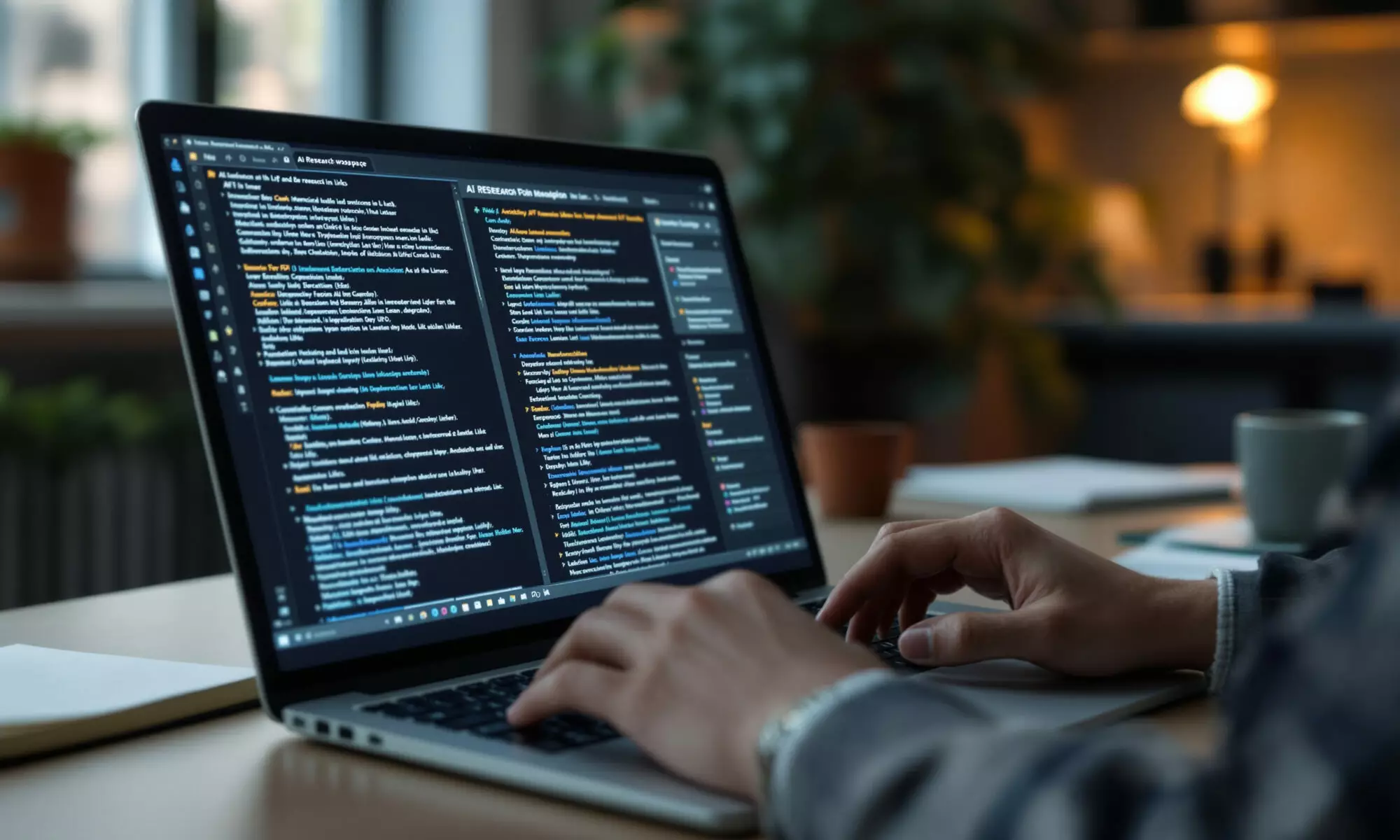
Unriddle AI became Anara in March 2025, but its core purpose remains the same: helping you search, question, summarize, and cite source material. The 2026 service handles documents and multimedia, links answers to source passages, and starts free. It’s strongest as a research workspace, not as a complete academic writing or fact-checking system.
An AI research workspace is software that organizes source material and uses language models to retrieve, explain, compare, and cite information from that material. Anara fits that definition, although independent testing of its latest features remains limited.
What happened to Unriddle AI?
Unriddle AI was renamed Anara on March 23–24, 2025, according to the company’s renaming announcement. Existing subscriptions transferred automatically, and the primary domain moved to anara.com. The change was a rebrand rather than a shutdown, so former Unriddle accounts and workflows continued under the Anara name.
The old name still appears in searches, reviews, and bookmarks, which can make the product look discontinued. It isn’t. If you search for an Unriddle login or pricing page in 2026, you should expect to land on Anara’s website.
The newer identity also reflects a broader product. Early coverage focused heavily on chatting with PDFs, while the 2026 platform combines source search, document analysis, writing, citations, data extraction, and integrations. Our earlier guide to Unriddle AI for content creation provides historical context, but its product name and plan details should be read as a snapshot of 2025.
What can Unriddle AI do in 2026?
Unriddle AI, now Anara, can search, summarize, compare, and answer questions about research papers, webpages, presentations, audio, video, images, and spreadsheets in 2026. Answers can link back to supporting passages, while newer workflows include cited multi-document extraction, spreadsheet analysis, research agents, notes, and citation formatting.
The source links are the central attraction. A useful research assistant shouldn’t merely produce fluent prose; it should help you locate the evidence behind each claim. Anara’s cited answers reduce the time spent hunting through long PDFs, though you still need to open the passage and confirm that the wording supports the generated answer.
Several substantial additions arrived during 2026. Anara added Excel and CSV editing on July 22, expanded citation formatting from 12 styles to more than 10,000, and launched Views for cited multi-document extraction on July 30. On September 18, its updated chat agent gained parallel research tasks, mid-response steering, and simultaneous lines of inquiry, according to the company’s product update log.
A sensible source-review workflow looks like this:
- Upload or connect the original material rather than relying on a generated summary from another service.
- Ask a narrow question that specifies the document, date range, metric, or population you care about.
- Open every cited passage and check the surrounding paragraphs for qualifications or conflicting evidence.
- Compare important claims across multiple sources using Views or separate document questions.
- Export the notes or draft only after checking quotations, citations, figures, and bibliography formatting.
That verification step matters in fields such as medicine. Anara added PubMed and ClinicalTrials.gov access to its Plus plan by 2026, but retrieval isn’t clinical validation. For a practical look at adjacent workflows, see our coverage of AI-assisted healthcare document extraction.
How much does Unriddle AI cost in 2026?
Unriddle AI pricing under the Anara brand ranges from $0 to $200 per seat each month in 2026. Monthly plans cost $10 for Plus, $20 for Pro, $100 for Max 5x, and $200 for Max 20x. Annual billing lowers the effective monthly rates to $8, $16, $80, and $160.
| Plan | Monthly billing | Annual effective rate | Maximum upload per file | Selected integrations |
|---|---|---|---|---|
| Free | $0/month | $0/month | 20 MB or 120 pages | Zotero, Mendeley |
| Plus | $10/month | $8/month | 100 MB or 600 pages | PubMed, ClinicalTrials.gov |
| Pro | $20/month | $16/month | 300 MB or 10,000 pages | Google Drive, Notion, OneDrive |
| Max 5x | $100/month | $80/month | No stated size or page limit | Higher-capacity plan |
| Max 20x | $200/month | $160/month | No stated size or page limit | Highest listed capacity |
The annual discount equals 20% at every paid tier in 2026. Plus costs $96 per year instead of $120, saving $24; Pro costs $192 instead of $240, saving $48. At the top end, Max 20x costs $1,920 rather than $2,400, a $480 annual difference per seat.
Upload limits may decide the plan before model access does. A 150-page report exceeds the Free plan’s 120-page ceiling even when its file size is below 20 MB, because the published limit is expressed as 20 MB or 120 pages. Plus accommodates that report, while a dense archive approaching 700 pages requires Pro unless you split it into separate files.
Anara changed usage accounting on August 17, 2026. Free usage refreshes daily, paid allowances refresh weekly, and paid subscribers can buy extra credits. The pricing page doesn’t turn those allowances into a universal number of questions because consumption can vary by task and model, so heavy users should test a realistic workload before committing annually.
How reliable is Unriddle AI for serious research?
Unriddle AI improves research traceability by attaching answers to source passages, but the 2026 service should not be treated as an authority that verifies its own output. Anara advertises 97% answer correctness and access to more than 300 million academic papers, yet no independent reproduction of those company claims was located.
Citations make mistakes easier to catch; they don’t make mistakes impossible. A linked passage may be real while the generated sentence overstates causation, ignores a limitation, or merges findings from different populations. You remain responsible for checking the original source, especially before publishing medical, legal, scientific, or financial claims.
Independent evidence is thin. A 2025 Dual Media News reviewer reported that the service broke a 28-page healthcare white paper into takeaways, quotations, topics, bullet summaries, and suggested questions. The same review flagged lost formatting, trouble with footnotes, image-heavy slides, and restrictive free access. Those findings describe the former version and shouldn’t automatically be assigned to Anara’s rebuilt 2026 reader.
A separate Reddit reviewer gave the old service 3.2 out of 5 in 2025, praising contextual document questions and citation-preserving exports while criticizing the lack of plagiarism, grammar, and outline tools. That’s one user report, not a controlled benchmark. Honestly, the product makes more sense as a source-grounded reading desk than as an all-purpose writing suite.
There’s also a less obvious pitfall: source-linked AI can create false confidence. When every paragraph carries a citation, a draft looks finished sooner than it is. The broader risks resemble those facing search publishers, where generated synthesis can obscure provenance; our analysis of AI’s effect on search and source visibility explains why direct source checking remains necessary.
Who should use Unriddle AI?
Unriddle AI suits students, researchers, analysts, clinicians, and writers who regularly question large source collections and need passage-level citations. The 2026 Free plan is adequate for short trials, Plus fits moderate academic reading, and Pro is the practical tier for larger files or workflows involving Google Drive, Notion, and OneDrive.
Device support is broad but uneven. Anara runs on the web, macOS, iPhone, and iPad, and it offers a Chrome extension plus a Microsoft Word add-in. There is no Windows desktop application in 2026, although Windows users can still use the web service and Word integration.
The iPhone and iPad companion launched on September 11, 2026, and requires iOS or iPadOS 26 or later. A September 18 update added 31 languages to the mobile apps, offline access to saved chats and PDFs, and searchable offline titles. Across the platform, Anara supports 32 interface and response languages in 2026.
Choose the free tier if you’re evaluating answer quality with ordinary papers below 120 pages. Plus is the better fit when PubMed or ClinicalTrials.gov matters, while Pro earns its price when cloud storage connections and files above 600 pages are part of your routine. Max is difficult to justify unless weekly usage limits are a proven bottleneck rather than a hypothetical concern.
My view is simple: at $16 per month with annual billing in 2026, Pro is the most balanced plan for active research teams and solo professionals. Casual users should resist paying for capacity they haven’t measured. Run the same representative document set for several days, inspect the citations, and record how often you need to correct the output.
Frequently asked questions about Unriddle AI
Is Unriddle AI now called Anara?
Unriddle AI officially became Anara on March 23–24, 2025. Existing subscriptions transferred automatically, and the service moved to anara.com.
Does Unriddle AI have a free plan?
Unriddle AI offers a $0 Free plan in 2026 with uploads capped at 20 MB or 120 pages per file. Free usage refreshes daily, according to Anara’s August 2026 update.
Can Unriddle AI read PDFs and spreadsheets?
Unriddle AI can analyze PDFs and other research material in 2026, while Anara’s July 2026 update added Excel and CSV editing and analysis. Supported sources also include webpages, presentations, audio, video, and images.
Does Unriddle AI work on Windows?
Unriddle AI works through a web browser and Microsoft Word on Windows in 2026, but Anara does not offer a dedicated Windows desktop application. A native desktop app is available for macOS.
Can Unriddle AI replace a reference manager?
Unriddle AI complements reference managers rather than fully replacing them. Anara integrates with Zotero and Mendeley in 2026, adds citation formatting and source-grounded notes, but you should still verify metadata and bibliography output before submission.