

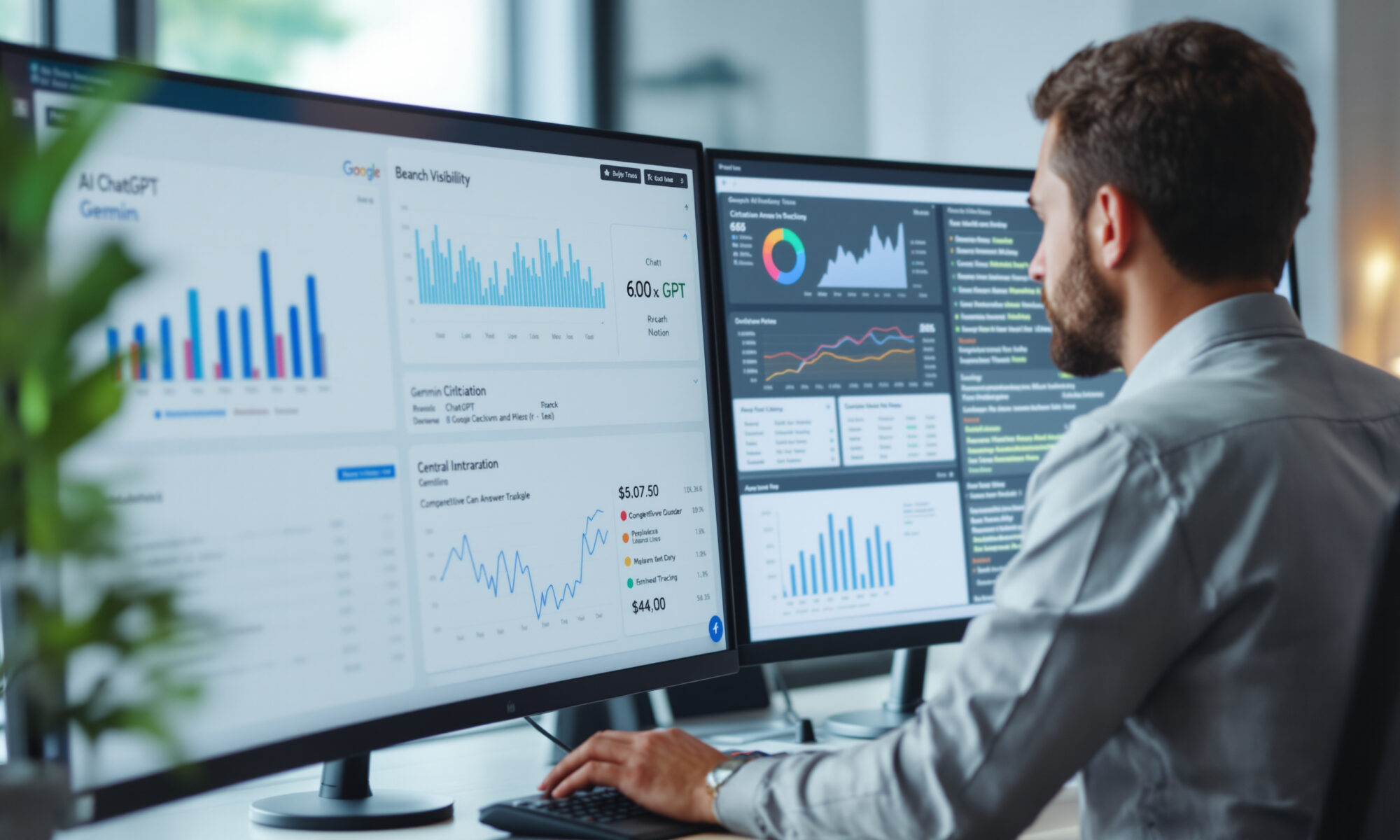
The best AI search visibility tools for brands in 2026 are Ahrefs Brand Radar, Semrush AI Visibility Toolkit, Peec AI, OtterlyAI and Scrunch. Each tracks mentions or citations across major answer engines, but pricing, prompt coverage and methodology differ sharply. AI search visibility is a measurement category that monitors how brands appear in answers generated by AI platforms.
Which AI search visibility tools are best for brands?
Five AI search visibility tools stand out in 2026: Ahrefs Brand Radar for large-scale research, Semrush AI Visibility Toolkit for established SEO teams, Peec AI for daily brand analysis, OtterlyAI for accessible prompt tracking and Scrunch for broad platform coverage. The right choice depends on your prompt volume, markets and reporting needs.
Ahrefs Brand Radar takes the broadest research-oriented approach. According to Ahrefs documentation dated September 3, 2026, its index covered more than 405 million search-backed prompts derived from the Ahrefs keyword database and Google People Also Ask questions. Large chatbot indexes refresh monthly, while custom prompts can run daily, weekly or monthly.
Semrush AI Visibility Toolkit fits naturally into a marketing department already using Semrush for search research. Its 2026 Base plan tracks 25 custom prompts and reports brand mentions across ChatGPT, Google AI experiences, Gemini and Perplexity.
Peec AI focuses on recurring monitoring and straightforward competitive reporting. The company said on October 3, 2026 that visibility equals the percentage of analyzed AI responses mentioning the tracked brand. Peec AI also tracks answer position, sentiment, cited sources, competitor benchmarks and ChatGPT shopping recommendations.
OtterlyAI is the easiest low-cost entry among tools with publicly documented prices. Its October 2026 product added Brand Profiling, sentiment, average brand position and chart annotations, while its August 2026 Agent Analytics release extended measurement into server logs for AI crawlers and on-demand fetchers.
Scrunch deserves attention when platform breadth matters. Its September 2026 documentation listed nine monitored services: ChatGPT, Perplexity, Google AI Overviews, Google AI Mode, Gemini, Claude, Copilot, Grok and Meta AI. Scrunch also said its methodology combines clean sessions, consented consumer panels, citations, agent traffic and downstream referral validation.
How much do GEO tracking tools cost in 2026?
Published 2026 prices range from $29 per month for OtterlyAI with 15 prompts to $699 per month for all-platform Ahrefs Brand Radar access. Semrush AI Visibility Base costs $99 per month per domain with annual billing. Peec AI and Scrunch prices should be confirmed directly because the supplied 2026 research does not establish comparable rates.
| Tool | Published price | Included scale | Coverage detail |
|---|---|---|---|
| OtterlyAI | $29, $189 or $489 monthly | 15, 100 or 400 prompts | Base plans cover ChatGPT, Google AI Overviews, Perplexity and Copilot; selected platforms cost extra |
| Semrush AI Visibility Toolkit | $99 monthly per domain, billed annually | 25 custom prompts | ChatGPT, Google AI, Gemini and Perplexity |
| Ahrefs Brand Radar | $199 per platform index or $699 for all platforms monthly | Large indexes; custom tracking sold separately | Custom packages start at $50 for 2,500 checks |
| Peec AI | Verify with vendor | Not established by supplied research | Daily model testing documented in 2026 |
| Scrunch | Verify with vendor | Not established by supplied research | Nine monitored platforms documented in September 2026 |
Prompt counts need careful reading. Ahrefs defines one check as one prompt execution on one large language model in one location. A $50 package containing 2,500 checks therefore supports 100 prompts across five platforms for five collection runs: 100 × 5 × 5 equals 2,500.
Location can multiply costs too. OtterlyAI said in July 2026 that each country consumes a separate prompt slot. Tracking 15 commercial questions in the United States, Canada and the United Kingdom therefore requires 45 country-specific prompt slots rather than 15.
Honestly, the cheapest plan only makes sense when a compact prompt set represents your customers well. A serious comparison should calculate prompts multiplied by platforms, countries and collection frequency before judging price. That expense belongs beside the other software in a practical 2026 campaign stack, not in an isolated SEO budget.
What do AI visibility trackers actually measure?
AI visibility trackers measure how frequently a brand appears, which pages receive citations, where the brand sits within answers, how sentiment is classified and what share of voice competitors earn. These metrics describe exposure inside a sampled set of prompts. They do not directly measure clicks, qualified leads, sales or total consumer demand.
Definitions vary. According to Ahrefs documentation published September 3, 2026, its metrics include mentions, citations, modeled impressions and AI share of voice. Ahrefs estimates AI impressions using Google search volume associated with a People Also Ask prompt, so that number models possible search exposure rather than measuring an AI assistant’s actual audience.
Peec AI uses a simpler visibility calculation: responses mentioning your brand divided by all responses analyzed. If a campaign checks 60 responses and your company appears in 18, visibility is 30%. That calculation is clear, but a 30% Peec AI score cannot be treated as equivalent to a vendor’s modeled impression or weighted share-of-voice figure.
Visibility also isn’t attribution. Someone may read an answer, remember a brand and visit later through search, a bookmark or a retailer. Teams that need commercial evidence should connect trend data to branded search, direct traffic, assisted conversions and a broader multi-touch attribution model.
How accurate are AI search visibility tools?
AI search visibility tools provide a standardized directional baseline, not a complete record of customer activity. Accuracy depends on prompt selection, platform, model, country, collection frequency and session method. Because generative answers are non-deterministic, repeated observations and multiweek trends are more defensible than a single rank, citation or screenshot.
No tracker receives a complete first-party feed of real prompt demand from every AI platform. Scrunch warned in September 2026 that prompt-volume estimates are probabilistic and fragile. Clean-session testing also cannot reproduce each user’s account history, personalization, settings or previous conversation context.
Collection method creates another quiet pitfall. Ahrefs says Brand Radar queries public web versions without stored context, while OtterlyAI says it uses public web interfaces except for Claude. Output collected through an application programming interface may differ from what a customer sees in the consumer interface.
Volatility is substantial. OtterlyAI reported that its September 2026 sample contained 46,009 distinct cited URLs over 30 days; 48% appeared once, while the leading 1% generated 44% of all citations. A citation appearing on Tuesday and disappearing on Wednesday may reflect normal answer variation rather than a failed optimization.
Coverage can change without warning. Ahrefs reported on October 27, 2026 that policy changes had temporarily stopped new Grok collection, and Claude was restricted to custom prompts consuming eight checks per execution. Scrunch reported in September 2026 that Grok presence, ranking and sentiment remained trackable, but Grok citations were unavailable.
How should you choose and use a GEO tracking platform?
Choose a GEO tracking platform by matching its collection method, supported countries, model coverage, refresh rate and export options to a defined business question. Begin with a stable prompt set covering discovery, comparison and purchase intent. Run the baseline repeatedly, then evaluate trends by platform rather than collapsing every result into one score.
A useful selection process has five steps:
- Define the decisions the data must support, such as competitor comparison, citation research or reputation monitoring.
- Build prompts from real sales questions, customer interviews, search queries and support records rather than vendor-generated suggestions alone.
- Calculate total executions across prompts, platforms, countries and monthly runs before choosing a plan.
- Review mentions and cited URLs separately because a brand can appear without receiving a source citation.
- Connect visibility changes to analytics, branded demand, leads and revenue while preserving the original baseline prompts.
For broad market discovery, Ahrefs Brand Radar has a compelling scale advantage. For teams centered on conventional search workflows, Semrush reduces tool switching. OtterlyAI is attractive for controlled pilots, while Peec AI offers an especially readable visibility formula. Scrunch is the stronger candidate when nine-platform monitoring and mixed measurement signals are priorities.
Don’t rewrite the complete prompt set whenever results disappoint you. Prompt drift destroys comparability. Add a separate experimental group, annotate changes and keep a fixed control set, just as you would preserve baselines in a disciplined digital marketing strategy.
The strongest operating model pairs prompt tracking with citation analysis. Find domains repeatedly cited for high-intent questions, inspect why those pages are useful, and improve your own source material without copying it. Published specifications, transparent methodology, original datasets and clear entity descriptions give answer engines material they can cite.
FAQ about AI search visibility tools
What does GEO mean in marketing?
Generative engine optimization, or GEO, is the practice of improving how a brand, product or source appears in answers generated by platforms such as ChatGPT, Gemini, Perplexity and Google AI Overviews.
Can AI visibility software show every prompt people use?
AI visibility software cannot show every real prompt because AI platforms do not provide trackers with a complete first-party demand feed in 2026. Vendors measure selected, generated or modeled prompt samples.
Is an AI citation the same as a website visit?
An AI citation is not the same as a website visit. A cited URL may create awareness without a click, while later direct visits, branded searches or purchases can be difficult to attribute to the original AI answer.
How often should brands track AI answers?
Brands should use a consistent schedule that matches answer volatility and budget, with daily collection suited to active campaigns and weekly collection often sufficient for directional monitoring. Monthly-only data can conceal short-term changes, although large Ahrefs chatbot indexes refreshed monthly in September 2026.
Why does ChatGPT show a different answer from a tracking report?
ChatGPT can show a different answer because generative output varies by run, location, model version, account settings and conversation history. Most trackers use standardized clean sessions, which provide comparability rather than a replica of every individual user session.