

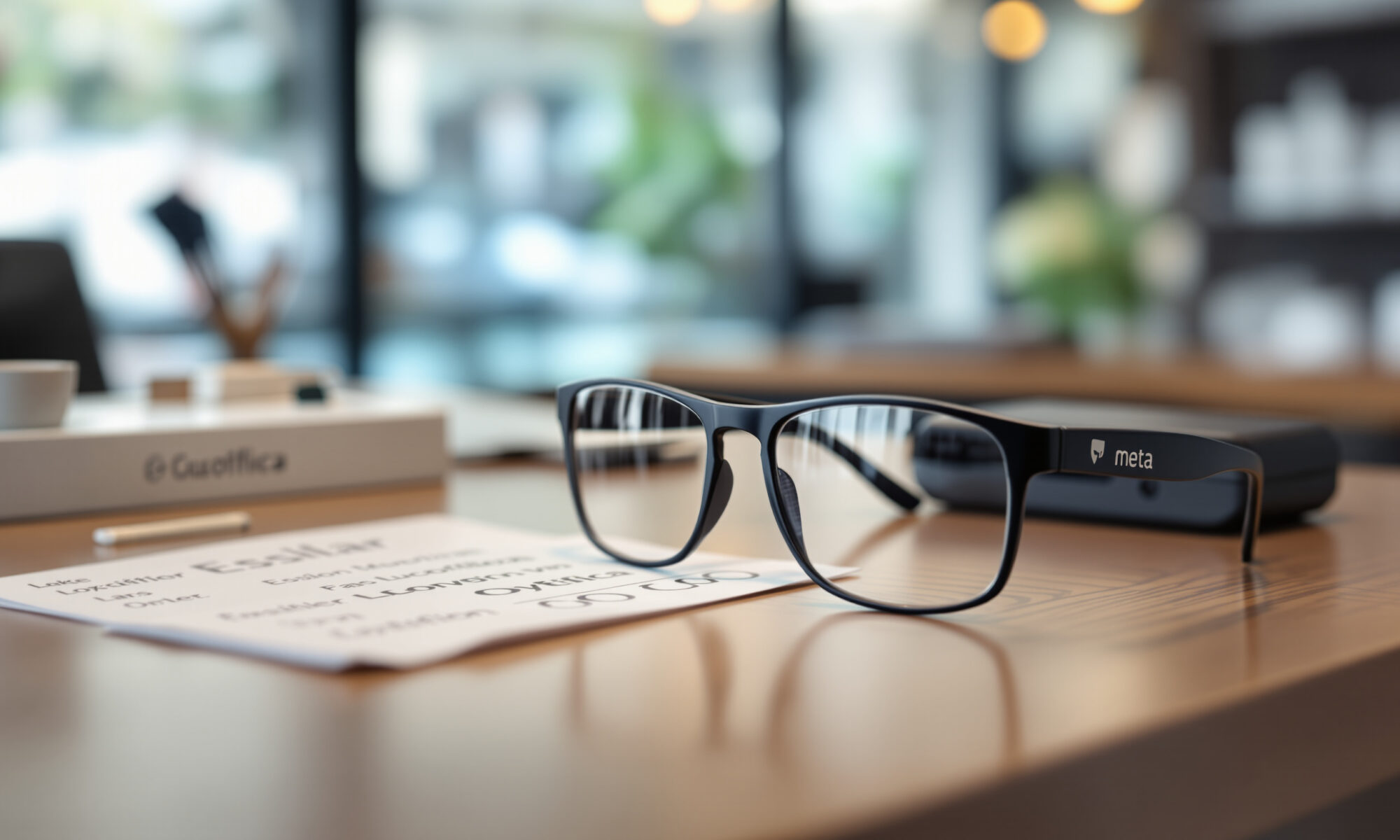
Meta partners with EssilorLuxottica on Meta Glasses, a $299 AI-eyewear line announced on June 23, 2026, with 26 style combinations, prescription support, open-ear audio, hands-free capture, Meta AI and more than eight hours of battery life. The short version: Meta is moving smart glasses beyond Ray-Ban and Oakley, while EssilorLuxottica gives the product fashion retail reach and prescription credibility.
Meta partners with EssilorLuxottica on a cheaper AI glasses bet
The launch matters because it lowers the entry price for Meta’s wearable AI push. Ray-Ban Meta made the category visible, Oakley Meta gave it a sportier angle, and now Meta Glasses puts the Meta name directly on the frame at a starting price of $299 in 2026.
That price is the signal. CNN and KESQ reported on June 23, 2026, that Meta CTO Andrew Bosworth described the lower price point as important for reaching more consumers. I think he’s right: smart glasses won’t become ordinary if they remain a luxury novelty sitting next to $800 phones and $1,000 laptops.
Meta said the collection starts with three frame families: Meta Adventurer, Meta Fury and Meta Glasses by Kylie. Across colors, lenses and frames, the launch covers 26 styles. EssilorLuxottica said three Rx-able shapes are included: rectangle, square and oval.
Meta partners with EssilorLuxottica under a broader agreement announced on September 17, 2024, to work “into the next decade” on multi-generational smart eyewear. So this isn’t a one-off product drop. It’s the next step in a category plan that already includes Ray-Ban Meta, Oakley Meta and optical-first Ray-Ban Meta styles for prescription wearers.
What do Meta Glasses actually do?
Meta Glasses are displayless AI glasses, not full augmented-reality glasses. There’s no confirmed built-in screen in the June 2026 launch information, which matters because many buyers hear “smart glasses” and expect floating apps in front of their eyes.
Instead, the feature set is closer to a wearable camera, headset and AI assistant built into ordinary-looking eyewear. Meta said the glasses include Meta AI, open-ear speakers, a multi-mic array, hands-free photo and video capture, more than eight hours of battery life, and a charging case that provides up to 40 additional hours.
The company also said Meta Glasses are its first AI glasses to launch with Meta AI powered by Muse Spark from day one. Live translation is adding 14 new languages, including Japanese, Chinese/Mandarin, Hindi and Korean, according to Meta’s June 23, 2026 announcement. Pedestrian navigation is described as “coming soon” for displayless glasses, so you shouldn’t buy the first batch assuming that feature is already finished.
The most practical use cases are simple. You can take a photo without pulling out a phone, record a short clip while your hands are busy, listen to audio without blocking your ears, or ask the assistant a question while you’re walking. If you’re interested in how AI systems are increasingly split across devices and services, the shift also rhymes with broader work on multi-agent AI systems, where different tools handle different parts of a task.
| Product line | Announced | Positioning | Known 2026 detail |
|---|---|---|---|
| Ray-Ban Meta | Before 2025 portfolio expansion | Fashion-first smart glasses | Optical-first Ray-Ban Meta styles expanded on March 31, 2026 |
| Oakley Meta | June 20, 2025 | Sport-oriented AI glasses line | Second AI-glasses line after Ray-Ban Meta |
| Meta Glasses | June 23, 2026 | Meta-branded lower-price AI glasses | Starts at $299, 26 style combinations |
Why EssilorLuxottica is the powerful half of the deal
Meta brings AI, cameras, microphones, software distribution and a giant social graph. EssilorLuxottica brings something less flashy but harder to copy: eyewear manufacturing, lens know-how, frame design, retail outlets and relationships with prescription customers.
The company owns or licenses major eyewear brands and operates retail banners including LensCrafters and Sunglass Hut. For Meta Glasses, availability includes Meta.com in the US, Canada, UK, France, Italy, Germany, Spain and other European countries, plus LensCrafters and Sunglass Hut in the US, according to EssilorLuxottica’s June 23, 2026 release.
MacRumors reported the same day that EssilorLuxottica is manufacturing the glasses and that the company’s logo appears on the temple arms and packaging alongside Meta’s. That branding choice is revealing. Meta wants technology credibility, but it also needs the product to feel like eyewear, not a face computer that escaped a developer conference.
EssilorLuxottica has also been preparing the supply side. On June 9, 2026, it announced its first wearable production lines in Italy, beginning from the second half of 2026, with operations expected by early 2027. A week later, on June 16, 2026, it announced a long-term joint development agreement with Applied Materials for next-generation AR optics platforms for smart glasses.
Fashion matters here more than many technology writers admit. People reject wearables for reasons that have nothing to do with processor speed. If the frame shape looks wrong on your face, the product fails before the AI assistant says a word. For a broader view of how accessories can shift from niche to desirable, see this analysis of AI and fashion accessory trends.
The $299 calculation buyers should make
The headline price is appealing, but the real cost depends on lenses, insurance and how often you replace prescription eyewear. Meta said Meta Glasses start at $299 in 2026; prescription lens pricing can vary by lens type, coatings, retailer, region and vision plan.
Here’s the practical calculation. If you wear prescription glasses every day and keep a pair for two years, a $299 frame-only starting price works out to about $12.46 per month before Rx lens costs. Add, say, a few hundred dollars for prescription lenses depending on your needs, and the monthly equivalent still may be lower than a mobile data plan.
But there’s a pitfall almost nobody mentions: battery aging and prescription timing can get out of sync. A normal pair of glasses may remain useful as long as your prescription and frame condition hold up. Smart glasses add a battery that will degrade over charge cycles, so the electronics may feel old before the lenses do.
You should also think about the charging case. Meta claims up to 40 additional hours from the case, which sounds generous, but case battery health becomes part of ownership. Lose the case, forget it during a trip, or let it age badly, and your glasses become ordinary frames with dead electronics for part of the day.
The upgrade decision is similar to other workplace and consumer hardware choices: the sticker price is only the start. Dualmedia’s guide to the hidden price of upgrading tech is aimed at companies, but the same logic applies to wearables. Accessories, support, replacement cycles and training time all count.
How to decide if Meta Glasses fit you
Meta partners with EssilorLuxottica to make these glasses feel more mainstream, but that doesn’t mean everyone should buy the first generation. Honestly, this option only makes sense if you already know what job you want the glasses to do.
Use this quick filter before you spend the money:
- Buy if you want hands-free photos, short video capture, open-ear audio and AI queries in a frame you can wear outside without feeling ridiculous.
- Pause if you expect full AR overlays, apps floating in your view or all-day navigation at launch.
- Check prescription availability if you need Rx lenses, especially for progressive, high-index or specialty lens requirements.
- Ask about returns, warranty handling and lens replacement before ordering, because smart eyewear is harder to resell than ordinary sunglasses.
- Consider privacy etiquette if you’ll wear them at work, in schools, around children or in places where cameras are unwelcome.
The privacy issue is not theoretical. A camera on your face changes the social contract in small rooms. Even if the device has capture indicators and even if you use it responsibly, other people may not know when recording is possible or what Meta AI can infer from what you see.
For creators, the glasses could be useful in narrow situations: cooking, travel, sports sidelines, events, behind-the-scenes clips. For most office workers, the value is less obvious unless audio, calls and quick visual capture already fit your day. People building social audiences should also remember that better capture tools don’t replace distribution strategy; a guide to building a more visible Instagram presence covers that side of the equation.
What this says about Meta’s wearable AI strategy
Meta partners with EssilorLuxottica because the company appears to be choosing a patient route into AI hardware. Instead of asking consumers to strap on a bulky headset for daily use, it’s putting microphones, cameras and AI into an object people already buy.
The sequence is telling. The September 2024 long-term agreement set the frame. Oakley Meta arrived on June 20, 2025. Ray-Ban Meta optical-first styles for prescription wearers were announced on March 31, 2026. Meta Glasses followed on June 23, 2026, with a lower starting price and Meta’s own brand on the product.
EssilorLuxottica said in June 2026 that “millions of consumers” are wearing AI glasses from the Meta/EssilorLuxottica portfolio. That’s a company-reported figure rather than audited category data, so treat it as directional. Still, it suggests the partnership has moved beyond experimental volumes.
There’s a counter-argument worth taking seriously: phones are still better for many tasks. They have bigger batteries, screens, editing tools, stronger cameras and fewer social awkwardness problems. Smart glasses win only when being hands-free beats everything a phone does better.
That’s why the $299 starting price matters. At $299, these aren’t cheap in an absolute sense, but they’re close enough to premium eyewear pricing that buyers can justify them as glasses with extras rather than a separate gadget. Meta partners with EssilorLuxottica to make that mental shift easier.
The company’s longer-term work on AR optics with EssilorLuxottica and Applied Materials also hints at where this could go. Displayless AI glasses are probably a bridge, not the final destination. For now, though, the bridge is the product you can actually buy.
FAQ
When did Meta partners with EssilorLuxottica launch Meta Glasses?
Meta and EssilorLuxottica announced Meta Glasses on June 23, 2026. The companies described them as a new AI-glasses collection developed through their existing partnership.
How much do Meta Glasses cost?
Meta said Meta Glasses start at $299 in 2026. Prescription lenses, coatings and retailer-specific options can increase the final price.
Do Meta Glasses support prescription lenses?
Yes. EssilorLuxottica said the collection includes three Rx-able shapes: rectangle, square and oval. You should still verify your specific prescription and lens requirements before ordering.
Are Meta Glasses the same as AR glasses?
No, based on the June 2026 launch details, they are displayless AI glasses. They include audio, microphones, camera capture and Meta AI, but no announced built-in visual display.
Where are Meta Glasses available?
EssilorLuxottica said they are available on Meta.com in the US, Canada, UK, France, Italy, Germany, Spain and other European countries, and at LensCrafters and Sunglass Hut in the US.