

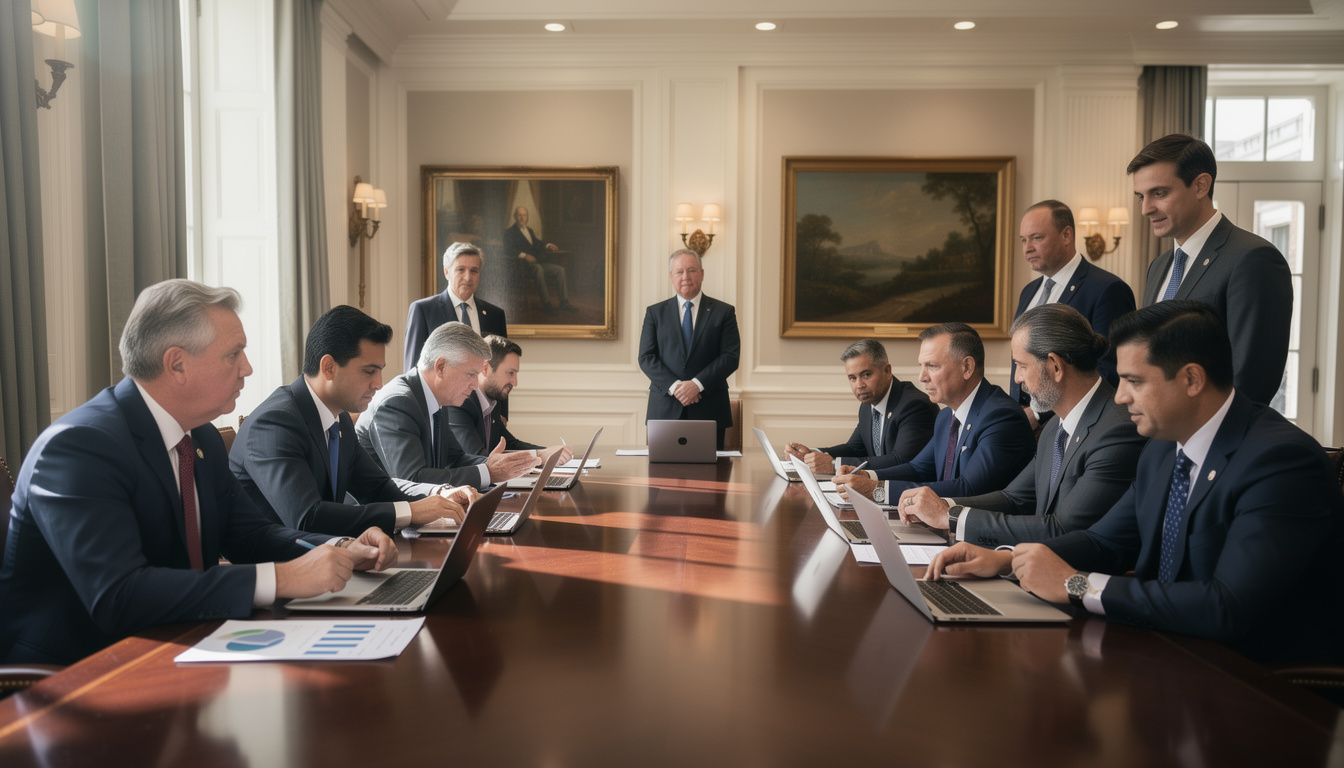
Exclusive reporting indicates the White House is preparing a closed-door session that puts banks and crypto firms in the same room to restart stalled legislative talks on digital-asset rules. The meeting is framed as a policy reset: market-structure guardrails, stablecoin expectations, and supervision boundaries that work for traditional finance and cryptocurrency platforms without leaving gaps criminals exploit. The timing matters. After earlier momentum in the Senate faded and industry groups hardened their positions, the administration appears to be testing whether a narrow, enforceable package can move faster than a sweeping rewrite. For compliance teams, this is less about headlines and more about operational deadlines, audit trails, and vendor risk. For exchanges and issuers, it is about whether regulation lands as a clear rulebook or a patchwork of enforcement actions. One compliance officer at a mid-sized U.S. bank described the mood as “prepare for a single standard, but expect hard questions.” The next weeks will signal whether Washington wants a negotiated baseline or another cycle of delays, and the market will price that signal quickly.
White House legislative talks: what the closed-door format signals
A private roundtable at the White House changes incentives. Banks arrive with mature compliance programs and a bias toward predictable supervision, while crypto firms arrive with faster release cycles and a bias toward flexibility.
When legislative talks happen in this setting, the goal is often alignment on a few measurable requirements rather than broad statements. Expect discussion around custody, disclosures, and the limits of bank partnerships with digital-asset platforms, because those are the friction points that break deals.
Exclusive stakeholder map: who has leverage and why
The White House controls agenda setting, but banks control access to payment rails and deposit infrastructure. Crypto firms control product innovation and user demand, especially around 24-7 markets and tokenized settlement.
The leverage point is risk transfer. If policymakers want safer cryptocurrency markets without pushing activity offshore, regulation has to define who carries liability for custody loss, market manipulation controls, and reserve attestations.
For a running example, consider a hypothetical fintech, HarborLink, seeking to offer instant stablecoin settlement to small exporters. HarborLink needs bank sponsorship for fiat on-ramps and needs crypto firms for liquidity, so its business model lives or dies on the rules negotiated now.
The practical takeaway: a narrow compromise tends to be enforceable, and enforceable policy is what vendors and auditors will demand next.
For background on the legislative backlog and the sections most likely to be revived, see this crypto legislation update.
White House, banks, and crypto firms: the technical issues on the table
Markets hear “groundbreaking” and think price action. Compliance teams hear “groundbreaking” and think scope, definitions, and reporting cadence.
In most drafts, the fight is not about whether regulation is needed, but about definitions: what counts as a commodity-like token versus a security-like instrument, and where stablecoins fit when used for payments.
Groundbreaking policy topics: custody, stablecoins, and market structure
Custody standards will be central because banks want qualified custodian requirements while crypto firms push for modern controls that fit hot-warm-cold key management. Expect debate on segregation of client assets, key recovery procedures, and incident reporting windows.
Stablecoins will raise reserve quality, attestation frequency, and redemption rights. A workable rule set needs to specify who validates reserves, how often, and what happens when a redemption request hits stress conditions.
Market-structure rules will focus on conflicts of interest: exchanges acting as broker, custodian, and venue in one stack. Separation rules, surveillance obligations, and best-execution principles are likely to be framed in language banks already follow in traditional finance.
A useful reference on active proposals is this overview of crypto regulation bills in Congress, which tracks how competing drafts handle these definitions.
White House regulation strategy: security, fraud, and cyber controls
Any durable policy package has to survive the first major breach after it passes. That is why the White House focus is expected to include operational resilience, not only investor protection language.
Banks will push for controls they already run: vendor due diligence, segmentation, privileged access management, and mandatory incident response drills. Crypto firms will counter with verifiable cryptography-based controls: proof-of-reserves patterns, on-chain monitoring, and automated withdrawal throttles under anomaly detection.
Practical checklist for banks and crypto firms entering legislative talks
The quickest way to lose credibility in legislative talks is to promise controls without evidence. Teams preparing for the White House meeting are expected to arrive with artifacts: audit reports, incident timelines, and quantified loss scenarios.
- Define custody responsibilities in plain terms: who controls keys, who signs transactions, and who bears loss if access fails.
- Document stablecoin redemption workflows: cutoffs, liquidity sources, and dispute handling.
- Align transaction monitoring to both fiat and on-chain signals: sanctions screening, mixer exposure, and rapid chain hops.
- Set incident reporting windows and thresholds: what triggers notice, and who receives it first.
- Propose measurable controls: key rotation intervals, separation of duties, and penetration test frequency.
The insight: when regulation is written with measurable controls, both finance incumbents and cryptocurrency operators get fewer gray zones to fight over later.
White House legislative talks: scenario table for business impact
Policy outcomes rarely land in a single stroke. They emerge as sequencing: an initial market-structure bill, a stablecoin framework, then technical rulemaking.
The table below outlines common negotiation paths and what they mean for banks, crypto firms, and end users like HarborLink’s small-business customers.
| Legislative talks outcome | Likely regulation result | Impact on banks | Impact on crypto firms | User impact (payments and trading) |
|---|---|---|---|---|
| Narrow compromise | Clear definitions, custody baseline, stablecoin reserves standard | Faster partner approvals, clearer examiner expectations | Higher compliance load, improved access to banking services | More reliable redemptions, fewer sudden delistings |
| Partial deal then delay | Stablecoins move first, market structure postponed | Reduced payment risk, ongoing trading exposure concerns | Payment products benefit, exchange rules stay uncertain | Better payment rails, inconsistent trading protections |
| No alignment | Patchwork enforcement and state-level divergence | Higher legal risk for partnerships, conservative de-risking | More offshore routing, slower U.S. product launches | More friction, higher fees, less transparency |
The key insight: the most “groundbreaking” result is not the biggest bill, it is the one that reduces ambiguity for audits and enforcement.
Our opinion
The White House bringing banks and crypto firms into the same legislative talks is a strong signal that Washington wants a negotiated baseline for regulation rather than a slow grind of case-by-case actions. The exclusive angle is not the guest list, it is the direction: custody, stablecoin reserves, and market structure are being treated as infrastructure policy for finance and cryptocurrency, not a niche debate.
If the administration delivers a short list of measurable obligations, the market will adapt fast and compliance will get simpler to verify. If the session produces only broad principles, the next quarter will look like the last one, with delays, uneven enforcement, and higher cyber and fraud exposure. This topic is worth sharing because it affects how people store value, move money, and assess risk in everyday digital finance.