

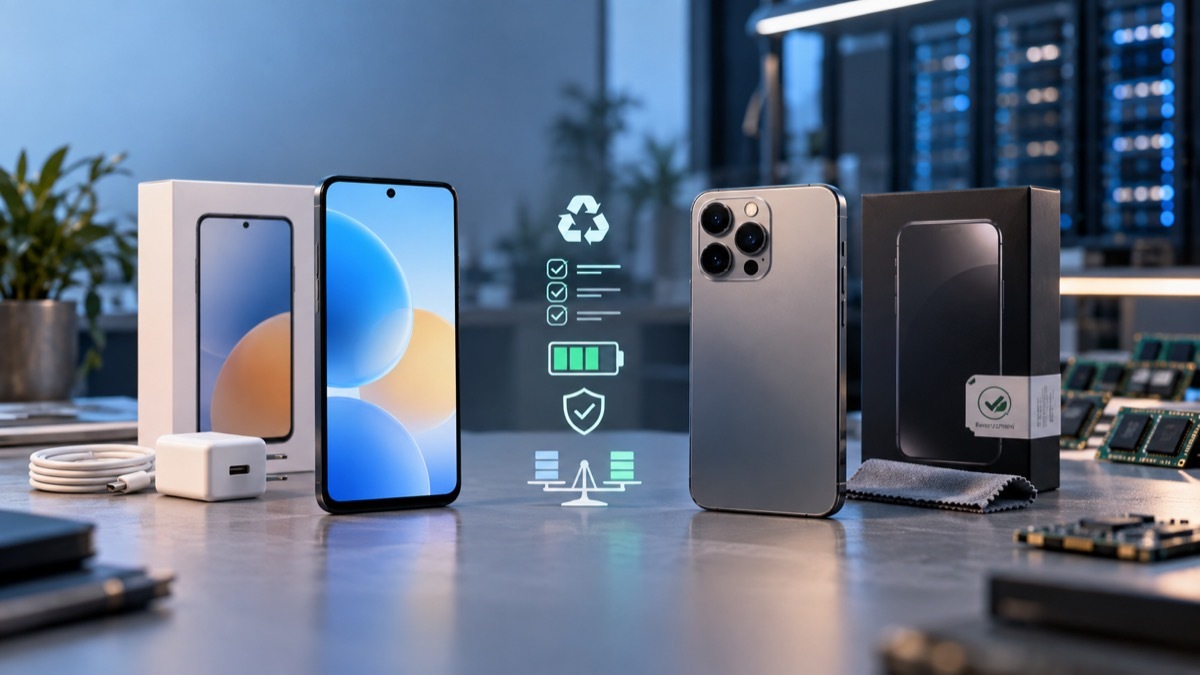
Budget smartphones in 2026 are not the bargain they were two years ago. A global memory shortage has pushed entry-level prices up, trimmed specifications on cheaper Android models, and made the sub-A$300 phone that does everything much harder to find. The buying decision has quietly flipped as a result: for many people, a refurbished flagship now beats a brand-new budget handset on almost every measure that matters.
This guide compares both paths at current prices, explains why the maths changed, and closes with a buying checklist. The refurbished side has matured quickly, too: Phonebot’s refurbished phones, for example, are tested across 72 diagnostic points, list their battery health up front, and come with a 12-month warranty and 30-day returns.
Why cheap phones got expensive in 2026
The problem starts in the data centre. Memory makers have shifted wafer capacity to high-bandwidth chips for AI servers, starving smartphones of DRAM and NAND. In a December 2025 analysis, IDC described the shortage as unprecedented and warned it could persist into 2027. Memory can represent 15 to 20 percent of a mid-range phone’s bill of materials, and IDC expects price rises to be significantly steeper at the low end, where thin margins leave manufacturers no room to absorb the cost.
Counterpoint Research reached a similar conclusion. Its forecast, reported by CNBC on December 16, 2025, called for a 6.9 percent jump in average smartphone selling prices this year alongside a 2.1 percent decline in shipments. Volume brands such as Xiaomi and Realme are the most exposed, while Apple and Samsung secured memory supply 12 to 24 months ahead and are largely insulated.
That is why some entry-level models now cost more than last year’s versions while shipping with the same, or less, memory. The trickle-down of flagship features has gone into reverse.
The best new budget phones right now
New is not dead. A handful of 2026 models still justify their price, mainly because they arrive with long software support.
The Google Pixel 10a, A$849 RRP, remains the consensus pick, topping Tom’s Guide’s tested list of the best cheap phones thanks to its 120Hz OLED display, strong cameras and seven years of updates. Apple’s iPhone 17e sits at A$999 with 256GB of storage and the A19 chip, the cheapest route into a current-generation iPhone.
Below A$500, though, the compromises stack up quickly: slower processors, 60Hz screens, weaker cameras and shorter update windows. That is where refurbished becomes interesting.
What refurbished buys you instead
Refurbished phones are professionally tested, repaired where necessary, graded and resold with a warranty, so they are not private-sale gambles. Counterpoint’s April 2026 data shows the segment typically saves buyers 30 to 50 percent against a new device, and Apple now accounts for 58 percent of global refurbished sales as people chase premium hardware at mid-range money.
Refurbished sales grew 5 percent globally in 2024 against 3 percent for new phones, and Counterpoint’s H1 2025 report found refurbished prices moving closer to new-device prices as buyers pay up for quality iPhones and Galaxy S models. The arithmetic explains why: a Grade A Galaxy S24 starts from around A$550 and an iPhone 16 Pro from roughly A$1,050 at a reputable refurbisher, the same money as a new mid-range Android, yet both ship with a flagship processor, better cameras and a brighter display.
The caveat is the seller. A refurbished phone is only a bargain if the testing, grading and warranty are real.
New vs refurbished: the honest trade-offs
Neither option wins outright. Here is how they compare.
- Price: a new budget phone runs A$450 to A$1,000, while a refurbished flagship from one or two generations back sits at A$550 to A$1,250.
- Hardware: refurbished wins on processor, cameras and display, because you are buying last year’s flagship, not this year’s compromise.
- Software support: new wins. A Pixel 10a will receive updates until 2033, while a refurbished iPhone 15 will likely stop around 2029 or 2030.
- Battery and condition: new ships at 100 percent and pristine. Refurbished is usually 80 to 95 percent and cosmetically graded, from Like New down to Grade B.
- Warranty: manufacturers cover new phones for 12 to 24 months. Refurbished cover ranges from 3 to 12 months depending on the seller.
- Resale value: a new phone loses value fastest in year one. A refurbished flagship has already absorbed that drop.
If you keep phones for six years, the support gap matters. If you upgrade every two or three years, it barely registers.
Five checks before you buy refurbished
- Battery health. Ask for the exact percentage. Apple’s own battery guidance uses 80 percent of original capacity as the benchmark, so anything lower should mean a replacement or a discount.
- Certification and parts. Consumer Reports advises checking whether a refurbisher is certified, because certified sellers replace faulty components with new parts while others may fit used ones or cheap third-party batteries.
- Warranty length. Manufacturer programs such as Apple Certified Refurbished and Samsung Certified Re-Newed offer a full year, while some marketplaces offer only 30 to 90 days.
- Grading transparency. Grades are not standardised across the industry, so read the seller’s own definitions rather than assuming Grade A means the same everywhere.
- Network and activation status. Confirm the phone is unlocked and not reported lost or blocked. Reputable stores check this before listing.
The verdict
Buy new if you want maximum software life and the Pixel 10a or iPhone 17e fits your budget. Buy refurbished if you want flagship performance for mid-range money, or if your budget sits below A$600, where the memory squeeze has compromised new phones. In 2026, refurbished is no longer the fallback option. For most buyers, it is the smarter first choice.