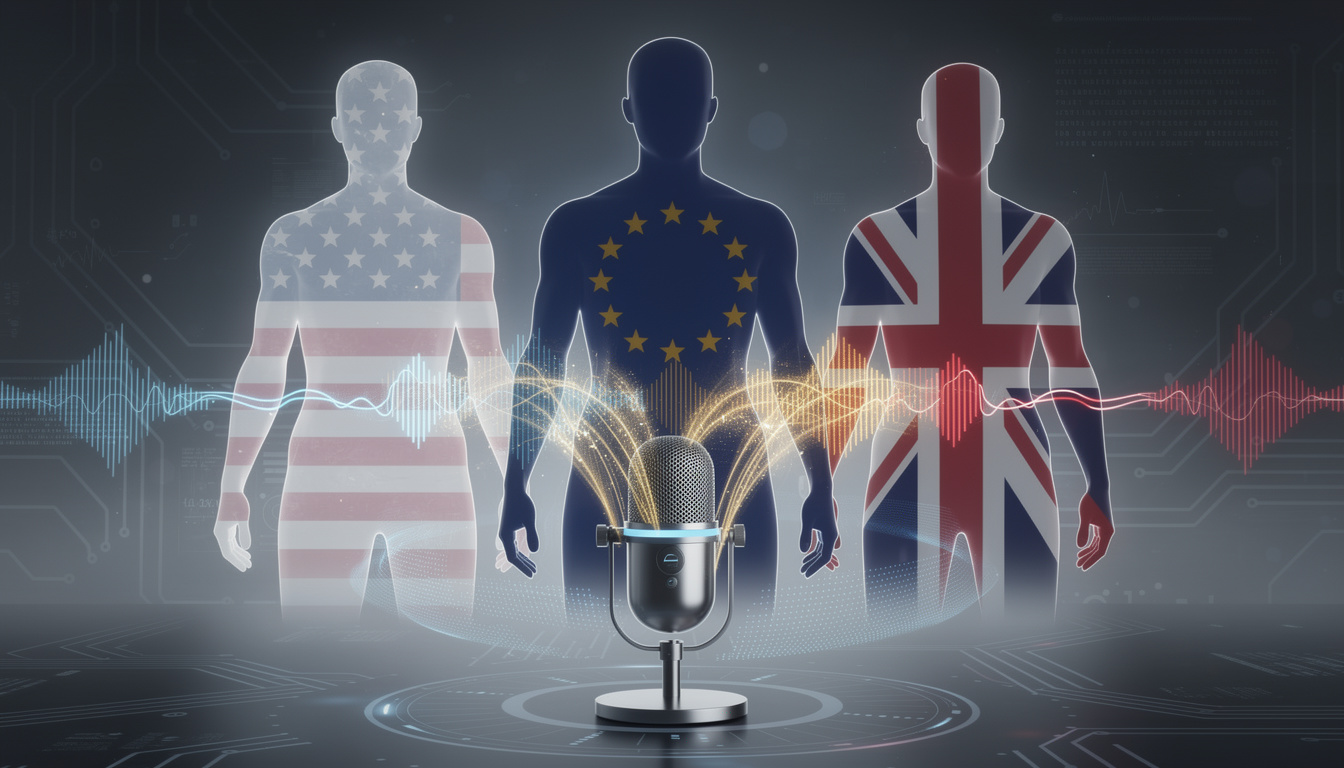
AI voice cloning is legal in some cases, risky in many others. Here’s where US, EU, and UK rules draw the line, and why consent now matters more than ever.
A founder records a quick product demo, then swaps in a synthetic voice that sounds uncannily like a famous actor. The audio is polished, the workflow is cheap, and the temptation is obvious. But with AI voice cloning, the legal line can move fast, especially if that voice belongs to someone else.
That matters now because regulators, courts, and platforms are no longer treating synthetic audio as a novelty. In the US, states such as Tennessee and California already protect voice rights in different ways. In Europe, the GDPR and the EU AI Act shape how voice data can be collected and used. In the UK, privacy, data protection, passing off, and fraud laws all come into play. If your team uses cloned speech for content, ads, dubbing, customer service, or entertainment, the safest question is no longer “Can this be done?” but “Who agreed to it, and how?”
AI voice cloning is usually legal when consent is clear
The shortest practical answer is simple. Cloning your own voice is generally lawful. Cloning another person’s voice with informed permission is also often lawful, provided the use matches the consent and does not mislead the public.
That does not mean every use is automatically safe. Commercial terms matter, platform rules matter, and disclosure may matter too, especially in advertising, politics, and customer interactions. A paid tool’s license can still limit business use even when the underlying voice belongs to you.
The core rule across most jurisdictions is consistent: consent lowers risk, deception raises it. That is not a slogan, it is the working pattern visible across privacy law, publicity rights, consumer protection, and anti-fraud enforcement.
What the US says about AI voice cloning
The United States still lacks one single federal statute that comprehensively governs AI voice cloning. Instead, the legal picture is split across state publicity laws, privacy doctrines, unfair competition, copyright disputes, and federal action against deception. That patchwork is why one campaign can look acceptable in one state and much riskier in another.
Tennessee’s ELVIS Act, signed in 2024 after passing in 2023, is one of the clearest recent examples. It expanded voice and likeness protections to address AI-generated imitation, a direct response to concerns from the music industry in Nashville. California and New York have also long treated voice and likeness as identity-linked interests under right of publicity and related laws.
At the federal level, the Federal Trade Commission has not created a full AI voice code, but it has repeatedly signaled that deceptive synthetic media can trigger enforcement under existing consumer protection rules. Based on that enforcement direction and past FTC practice, using a cloned voice to trick customers, voters, or employees is where legal exposure escalates fastest.
A simple way to read the US market is this: if a synthetic voice sounds like endorsement, impersonation, or fraud, expect scrutiny. If it is your own voice, or clearly licensed talent used within a written contract, the path is much cleaner.
There is also a copyright layer that many teams overlook. If a model is trained on copyrighted recordings, fair use remains unsettled for narrow imitation tools. In Thomson Reuters v. Ross Intelligence, a US court rejected a fair use defense in an AI training dispute, and while that case was not about music or voice cloning specifically, it showed courts are not automatically accepting broad AI fair use arguments.
This is an inference based on current legal reasoning: voice cloning tools may face a harder fair use case than general-purpose LLM systems because they are built to imitate a specific person, from a smaller and more identifiable pool of source material. That makes licensing and market substitution easier for a court to examine.
| Key detail | Why it matters |
|---|---|
| Own voice clone | Usually lawful, subject to platform and commercial licensing terms |
| Someone else’s voice with written consent | Often lawful if the use matches the permission granted |
| Someone else’s voice without consent | High legal risk under publicity, privacy, fraud, and deception rules |
| Training on copyrighted audio | Fair use is unsettled, licensing may be needed |
| Misleading political or commercial audio | Could trigger regulator action, platform penalties, and civil claims |
How the EU and UK treat voice data and synthetic speech
In Europe, voice is not just content, it can also be personal data. Under the GDPR, voice recordings may qualify as biometric data when used to identify a person, which pushes the consent bar much higher. Explicit permission, clear purpose limitation, and secure processing become central, not optional.
The EU AI Act adds another layer. Some voice-related systems can fall into transparency or higher-risk categories depending on the use case, especially where identity, employment, access decisions, or public-facing manipulation concerns appear. Based on the reported design direction of the law, teams using cloned voices in sensitive workflows should expect documentation and governance duties, not just a quick product launch.
The UK now sits outside the EU framework, but the result is not a free pass. UK GDPR, data protection rules, passing off, misuse of private information, defamation, and fraud law can all apply depending on the facts. If a cloned voice falsely suggests celebrity endorsement or impersonates a company executive, that can create both civil and criminal exposure.
The practical distinction is useful. In the EU, compliance often starts with data handling and lawful basis. In the UK, the analysis often broadens quickly into deception, brand damage, and reputational harm. For businesses, the safe baseline is nearly identical in both places: get consent, document scope, secure the recordings, and avoid misleading listeners.
Where copyright fights begin in AI voice cloning
The most visible public debate is often about impersonation, but copyright can be just as important. The first issue is the input stage, whether audio recordings used to train a voice model were licensed. The second is the output stage, whether the resulting audio copies too much of a protected performance or competes with it.
Legal scholars have argued that training on copyrighted material may be fair use in some general AI contexts, especially where datasets are vast and the outputs are multifunctional. Voice cloning is different. Its purpose is much narrower, to reproduce a recognizable vocal identity, which can make licensing markets easier to define and market harm easier to argue.
That distinction matters for music. An AI cover that swaps Artist A’s vocal timbre for Artist B’s voice may sound novel to listeners, but copyright law asks a tougher question: what original expression was really added? Some legal analysis now suggests many AI covers may be too close to the source recording to qualify as protectable derivative works.
The analogy often used comes from older copyright cases about minor alterations to existing works. A small change in surface appearance is not always enough. In audio, changing the singer’s timbre while preserving most of the underlying performance may look more like imitation than new authorship.
For creators and startups, the lesson is blunt. A license for the voice is not always a license for the recording, and a clever output is not automatically a new copyrighted work. That is where many synthetic media projects drift into legal trouble.
What responsible use looks like in practice
Legal compliance is the floor, not the full standard. A team can stay out of court and still damage trust if users feel tricked. That is why the most credible companies now treat voice consent, disclosure, and data security as product features rather than legal afterthoughts.
Consider a dubbing studio replacing a child actor’s earlier performance after their voice changes with age. If the studio has written approval, defines the scope of use, secures the training files, and labels the synthetic process where needed, the project sits on much firmer ground. Replace one of those safeguards with assumption, and the risk profile changes quickly.
The same applies to enterprise use. A sales team may want a cloned executive voice for global training, or a creator may want multilingual narration without endless re-recording. Those can be sensible deployments, but only if the person behind the voice agreed to the use and can limit or revoke it where the contract allows.
Here are the habits that matter most:
- Get written consent before cloning anyone else’s voice
- Define the use case, including geography, duration, platforms, and commercial rights
- Disclose synthetic audio when listeners could reasonably be misled
- Protect voice recordings like sensitive personal data
- Avoid impersonation in ads, politics, customer support, and financial workflows
If a project would look troubling on a courtroom screen or in a regulator’s press release, it probably needs a different design. That is the easiest internal test to remember.
Frequently asked questions
Is AI voice cloning legal if someone agrees to it?
Usually, yes. In the US, EU, and UK, consent is the strongest starting point, but the permission should be informed, documented, and limited to clear uses such as ads, dubbing, podcasts, or internal training.
Can a business clone a CEO voice for customer service?
It can be lawful if the CEO clearly agreed and the deployment is not misleading. The bigger risk appears when customers think they are hearing a live human or when the audio is used in sensitive financial or support interactions.
Does GDPR treat a voice recording as biometric data?
It can, especially when the recording is processed to identify a person. That means consent, purpose limitation, and security controls become more important for EU-facing products and services.
Are AI song covers using a cloned singer voice legal?
They can raise two separate issues, training on copyrighted audio and releasing outputs that closely mimic protected performances. Based on current legal analysis, many AI covers sit in a gray zone or carry meaningful risk unless permissions are secured.
What is the safest rule for AI voice cloning?
Use your own voice, or use someone else’s only with written consent and a clear contract. Then add disclosure where needed and avoid any use that suggests false endorsement, impersonation, or fraud.
What to watch next
The next phase of AI voice cloning law will likely come from three places at once: more state laws in the US, tougher enforcement against deceptive synthetic audio, and clearer case law around training data and music outputs. That matters because the technology is moving into mainstream business tools faster than legal systems usually move.
For now, the pattern is clear enough to act on. Your own voice is the simplest case. Another person’s voice without consent is the danger zone. Everything in between depends on contracts, context, and whether listeners are being misled.
That leaves businesses with a practical standard rather than a philosophical one. If consent is explicit, data handling is disciplined, and the use is honest, the risk becomes manageable. If not, the legal system is getting less patient.
Want more tech and innovation coverage like this? DualMedia Innovation News tracks the technology shifts that actually matter, from AI to foldable hardware to the next wave of consumer products.
 EN
EN  FR
FR  ES
ES