

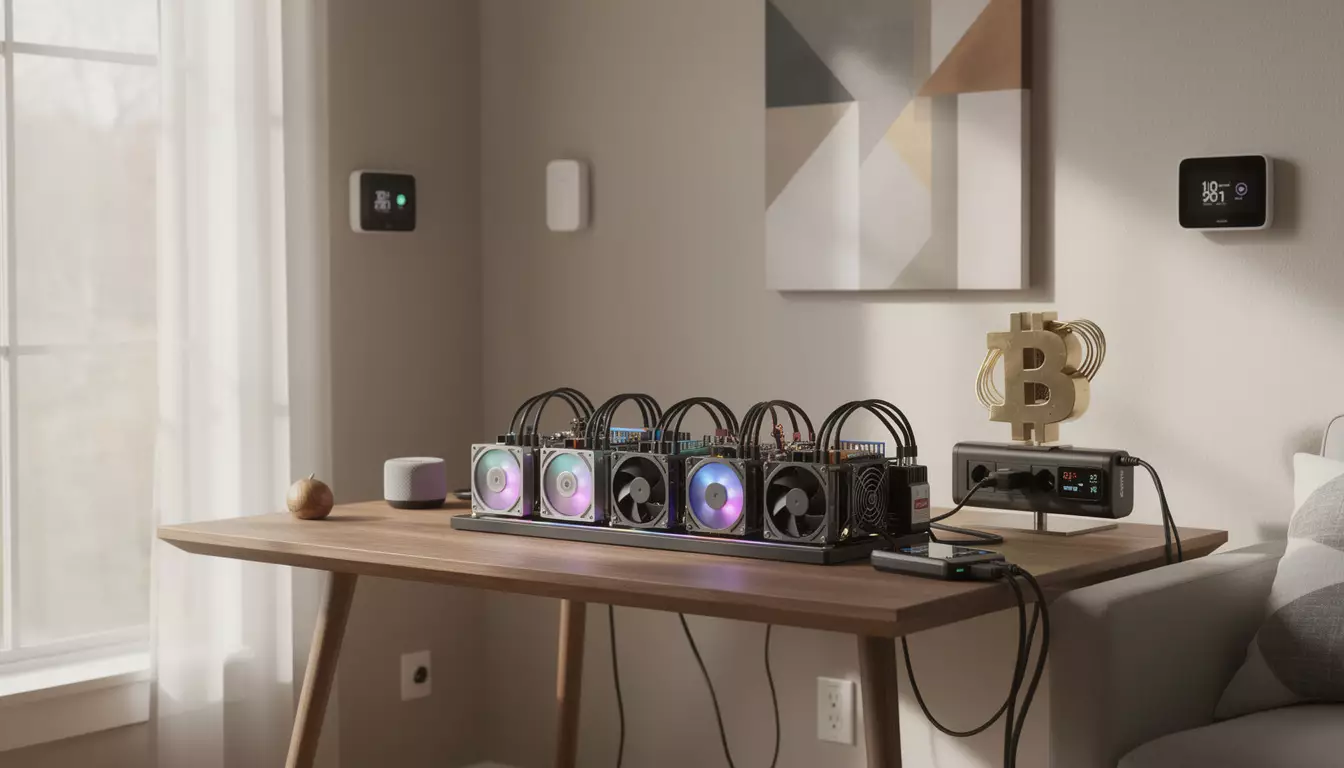
Bitcoin mining at home in 2026, real costs, power rates, and ASIC efficiency decide whether your setup earns a profit or quietly burns cash.
At 2 a.m., the sound is impossible to ignore. A home ASIC miner does not hum like a laptop, it roars like a compact vacuum that never takes a break. For some people, that noise still signals opportunity. Bitcoin mining at home in 2026 remains possible, but the math has become far less forgiving after the 2024 halving cut the block subsidy to 3.125 BTC per block.
If you are thinking about running a miner from a garage, spare room, or basement, the real question is simple: can revenue outrun electricity, hardware depreciation, cooling, and pool fees? Recent profitability trackers such as CoinWarz and miner spec sheets from Bitmain and MicroBT suggest the answer depends heavily on your power price and machine efficiency. That is where the numbers start to matter more than the hype.
Bitcoin mining at home in 2026 starts with one harsh variable
The biggest factor is still electricity. A modern ASIC may draw roughly 3,000 to 3,500 watts continuously, which means a machine running 24 hours a day can consume more power than many household appliances combined. At $0.08 per kWh, that load may remain workable. At $0.15 or $0.20, margins can disappear quickly.
That gap is why home mining looks very different from industrial mining farms in Texas, the UAE, or parts of Canada. Public miners can negotiate energy contracts and infrastructure at a scale that households cannot match. For a home user, the utility bill is often the whole story.
This is also why some readers drift toward hosted or app-based options, though those come with their own risks and tradeoffs. Anyone comparing paths should also read recent coverage on cloud mining apps, especially because outsourced mining can hide fees that are less obvious than a monthly home power bill.
Real numbers: what a home ASIC miner can actually earn
Take a current-generation ASIC in the range of 180 to 220 TH/s, with efficiency near 16 to 20 J/TH. Depending on network difficulty, Bitcoin price, and pool luck, gross daily revenue can swing widely. In practical terms, many home miners are not chasing huge income, they are trying to stay above breakeven after power costs.
Using a simple example, a 3.5 kW machine consumes about 84 kWh per day. At $0.10 per kWh, that is $8.40 a day in electricity alone, before pool fees or cooling. If gross mining revenue lands near $10 to $14 a day, which can happen during stronger market periods, the margin exists but stays thin.
When Bitcoin pulls back sharply, the picture changes fast. That dynamic has been visible across the broader market, including during periods covered in reports about Bitcoin dropping below $80K and later rebounds. Home mining lives and dies on volatility, not only on machine specs.
| Key detail | Why it matters |
|---|---|
| ASIC power draw: about 3.0 to 3.5 kW | Sets the baseline daily electricity cost |
| Electricity rate below $0.10 per kWh | Often the threshold for viable home margins |
| Block reward: 3.125 BTC since 2024 halving | Lower rewards tightened profitability |
| Pool fees: commonly 1% to 3% | Small percentage, but material over time |
| Heat and noise management | Adds hidden cost and limits where you can mine |
A realistic breakeven model should include more than the miner and the plug. It should also include shipping, customs in some regions, replacement fans, possible downtime, and the fact that ASIC resale values can fall quickly when newer machines arrive.
Hardware efficiency matters more than hash rate alone
It is easy to fixate on terahashes per second, but efficiency is the more important metric for a home setup. A stronger machine that burns too much power can underperform a slightly smaller ASIC with better joules per terahash. This is where spec sheets from manufacturers like Bitmain and MicroBT become more useful than social media posts.
There is also the issue of operating conditions. Manufacturers usually publish performance under controlled environments, not in a hot attic during summer. Based on the reported design direction of current ASICs and past field behavior, thermal throttling and poor ventilation can reduce actual output at home.
The practical checklist is not glamorous, but it is decisive.
- Power rate under local residential billing
- ASIC efficiency in J/TH, not only raw hash rate
- Cooling and airflow for stable output
- Noise tolerance inside or near living space
- Pool selection and payout structure
Taxes, regulation, and security can erase your gains
Mining profit is never just a hardware question. In the USA, tax treatment can depend on whether mined coins are treated as income at receipt and how later capital gains are calculated when sold. Rules differ by country, and in some places the compliance burden is enough to change the economics.
Policy risk also remains real. Regulatory shifts continue to reshape the sector, as seen in ongoing reporting around the US crypto regulation gap and country-by-country legal changes. A home miner who ignores regulation is not reducing cost, only postponing it.
Then there is wallet security. If you mine directly to a poorly protected wallet, one breach can wipe out months of slim returns. That is why security habits matter as much as hashrate, a point reinforced by recent analysis of crypto wallet security breaches.
When home Bitcoin mining still makes sense
There are still situations where the setup works. A household with solar overproduction, time-of-use pricing, or access to unusually cheap electricity can create room for profit. The same goes for technically skilled users who can handle ventilation, maintenance, firmware tuning, and downtime without paying outside help.
There is also a non-financial case. Some people mine because they want direct exposure to Bitcoin infrastructure, not because they expect fast ROI. That approach is valid, but it should be framed honestly, as participation or accumulation strategy, not as easy passive income.
For beginners, a softer entry can make more sense than buying a loud, power-hungry machine on day one. Services discussed in pieces like this look at simplified Bitcoin mining access show why many newcomers test the waters before committing to a full home rig.
Frequently asked questions
Is Bitcoin mining at home in 2026 profitable for most people?
For most households, profitability is tight and depends mainly on electricity cost, ASIC efficiency, and Bitcoin price. If power is above roughly $0.10 to $0.12 per kWh, many setups struggle to stay meaningfully profitable.
How much electricity does a home Bitcoin miner use?
A modern ASIC often uses around 3 to 3.5 kW continuously. Over a full day, that can add up to roughly 72 to 84 kWh, which is substantial on a residential bill.
Is solo mining at home realistic now?
For most individuals, solo mining is closer to a lottery than a business model because network difficulty is so high. Pool mining is usually the more practical route because it smooths income and reduces variance.
What is the hidden cost many beginners miss?
Cooling, noise control, and downtime are frequently underestimated. Hardware wear, fan replacements, and reduced output from poor ventilation can quietly damage ROI.
Should mined Bitcoin be held or sold immediately?
That depends on cash flow, tax treatment, and risk tolerance. Holding can improve returns if price rises later, but it also adds market risk on top of already thin mining margins.
The bottom line
Bitcoin mining at home in 2026 is still possible, but it is no longer forgiving. The winning setups tend to share the same traits: cheap electricity, efficient ASIC hardware, disciplined operating costs, and realistic expectations about payback time.
For everyone else, the spreadsheet may tell a blunt story. Based on post-halving economics, current ASIC power demands, and the uneven path of Bitcoin prices, home mining works best as a specialized project, not a guaranteed income stream. If the numbers do not hold before purchase, they rarely improve after the machine arrives.
Want more tech and innovation coverage like this? DualMedia Innovation News tracks the technology shifts that actually matter, from AI to foldable hardware to the next wave of consumer products.