

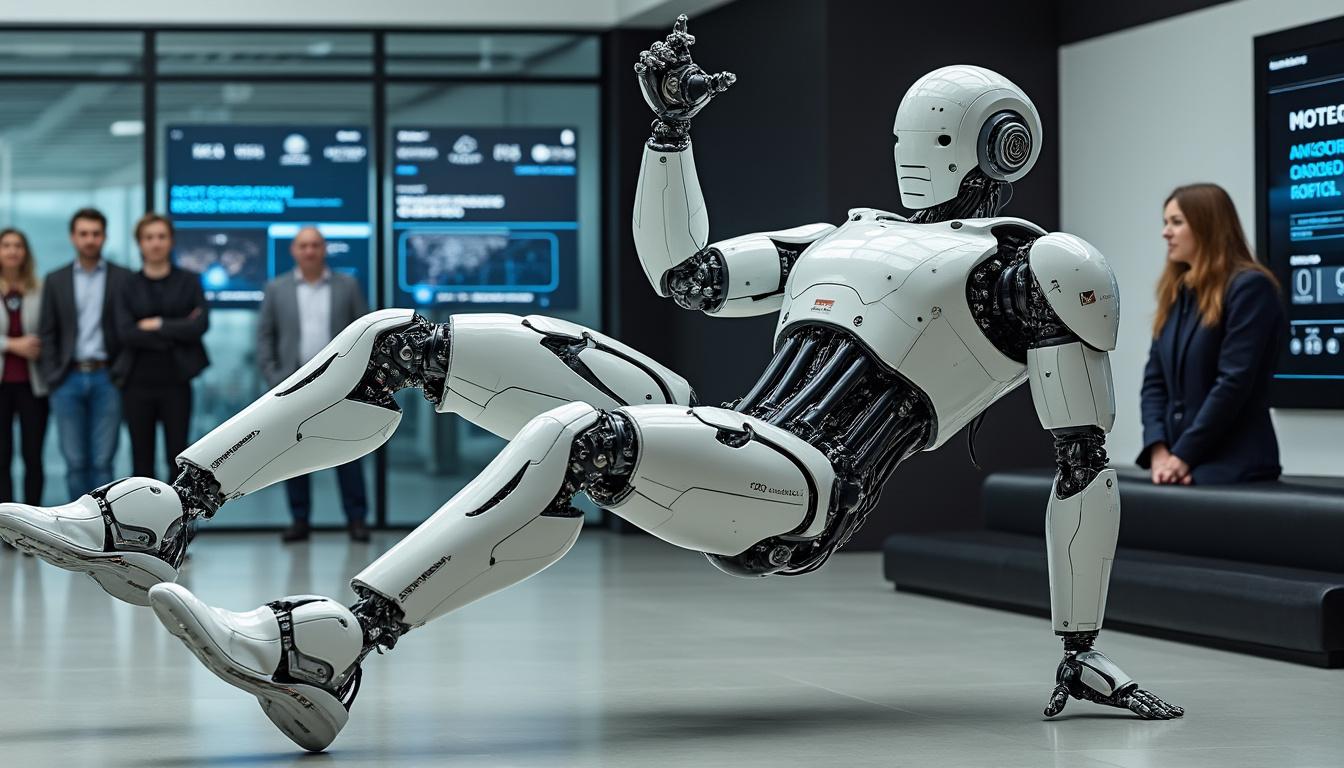
The AI Robot moment in Moscow went viral within hours. Video shows Russia’s first anthropomorphic model losing balance seconds after its unveiling at a technology forum. The machine moved onstage to a Rocky soundtrack, then toppled forward while engineers scrambled to cover the unit with a cloth, which tangled during the effort. Witnesses filmed the scene, and mainstream outlets replayed the footage for commentary and technical analysis.
The incident raises hard questions. The AI Robot fall exposed risks in hardware tuning, motion planning, and event staging. Engineers must rethink safety checks for public demos, network latency in remote control, and sensor fusion under bright stage lights. Coverage from major outlets highlights the public reaction and technical gaps, and provides primary footage for forensic review.
Expect quick follow ups in lab reports and press statements. The AI Robot case will influence funding for robotics research, procurement rules in event production, and policy on AI-driven humanoid deployment. Readers interested in the original clips and deeper reporting can compare multiple sources for a fuller picture of the malfunction and the response from teams involved.
AI Robot Topples During Unveiling: Watch the Viral Clip
Footage shows the fall seconds after the AI Robot walk onto stage. Assistants rushed to help, then draped a cloth over the unit while cameras kept rolling. The public reaction ranged from laughter to concern, with commentators linking the event to broader questions in robotics and automation.
- Source videos provide frame by frame evidence for failure analysis.
- Event staging and audio cues may influence robot balance during demos.
- Immediate scene handling revealed weaknesses in contingency planning.
| Element | Observed issue | Immediate effect |
|---|---|---|
| Balance control | Stumble on flat stage | Robot toppled forward |
| Sensors | Possible glare interference | Delayed correction |
| Onstage support | Assistants tripped in cover attempt | Cloth tangled with limbs |
Primary coverage offers direct clips and commentary for viewers. Watch the BBC clip for a concise replay, consult the New York Times video for slow motion analysis, and view extended footage on YouTube for alternate angles.
BBC video of the fall,
New York Times slow motion,
YouTube full clip
Immediate cause and malfunction analysis
Engineers reviewing footage highlight motion plan timing as the most likely cause. Stage lighting and soundtracks may have introduced unexpected signals for on-board systems. A rapid review of logs will reveal whether the malfunction came from firmware, motors, or sensor input fusion.
- Check motor torque response during the first steps.
- Review sensor logs for saturation from stage lights.
- Validate software state machines used for demo routines.
| Test | Focus | Expected outcome |
|---|---|---|
| Gait stability | Motor control loop | Smooth corrective action |
| Sensor robustness | Light and audio noise | No false triggers |
| Fail-safe | Emergency stop | Safe collapse without damage |
For context, read the initial reports from NDTV and PrimeTimer for timeline and naming details. Technical readers will find extra analysis at Interesting Engineering and Geo News useful for cross checks.
NDTV report on the fall,
PrimeTimer overview,
Interesting Engineering analysis,
Geo News coverage,
Newsweek report
AI Robot Failures and Lessons for Technology and Robotics
The episode provides a case study on public demos in robotics. Teams must balance showmanship with rigorous testing. Event planners must include extra safety margins when an AI Robot performs in uncontrolled environments. Policy makers will use this case when drafting guidance on human-robot interactions in public spaces.
- Strengthen pre-demo checklists for hardware and software.
- Run dry runs under full stage lighting and audio playbacks.
- Include redundant sensors for balance correction.
| Stakeholder | Action | Benefit |
|---|---|---|
| Engineers | Simulate stage conditions | Fewer surprises |
| Event teams | Maintain clear safety zones | Faster response |
| Regulators | Issue demo standards | Public safety |
Case studies and expert commentary provide pathways to reduce malfunction risk. DualMedia offers technical briefs on managing AI workflows and comparative analyses of robotics technologies. Practitioners should consult these resources when updating validation plans.
Managing AI workflows and risk,
Comparative analysis of AI technologies,
Experts opinions on AI developments in robotics
Practical steps to reduce public demo failures
Teams should apply staged integration testing before live shows. Remote control fallbacks must operate under high latency. Redundant balance controllers will limit damage during a collapse.
- Schedule rehearsals with full audiovisual load.
- Activate passive support rigs for human crowds.
- Record synchronized telemetry for post-incident review.
| Step | Tool | Outcome |
|---|---|---|
| Rehearsal | Full AV playback | Identifies environmental triggers |
| Telemetry | Time-synced logs | Speeds forensic analysis |
| Fallback | Remote kill switch | Limits damage |
Further reading on automation in logistics and manufacturing shows where AI Robot reliability matters most. Use real-world case studies to adjust risk models for deployment.
AI in logistics automation,
Real-world applications in manufacturing
AI Robot Innovation, Automation and Future Predictions
Public failures do not end progress. Innovators will use lessons from this AI Robot incident to improve hardware, software, and demo practices. Investment flows will shift toward robustness and explainability in automation systems. Project teams must justify trade offs between aesthetics and reliability when designing humanoid units for public roles.
- Invest in robust actuation and sensor suites.
- Prioritize explainable control logic for safety audits.
- Publish detailed test procedures for peer review.
| Area | Focus | Impact |
|---|---|---|
| Hardware | Redundant actuators | Higher uptime |
| Software | Deterministic failover | Predictable recovery |
| Testing | Real world stress tests | Reduced demo incidents |
DualMedia forecasts highlight trends for 2025 and beyond. Teams should consult future predictions for AI-powered robotics to align roadmaps with investor expectations and regulatory direction.
Future predictions for AI powered robotic technology,
Impact of AI on robotic intelligence enhancement,
Latest innovations in AI powered robotic automation
Examples and industry anecdotes
A European logistics firm improved uptime after adding redundant balance controllers to warehouse robots. A hospital pilot added passive support rigs for humanoid assistants during patient transfer. These cases show measurable drops in incident rates after modest design changes.
- Warehouse robots saw 30 percent fewer falls after redundancy upgrades.
- Medical pilots reported smoother handoffs with passive supports.
- Public demos accepted slower, safer walk routines for audience safety.
| Case | Change | Result |
|---|---|---|
| Logistics firm | Redundant controllers | 30% fewer failures |
| Hospital pilot | Support rigs | Smoother transfers |
| Tech demos | Slower routines | Fewer accidents |
For targeted tools and playbooks, review DualMedia resources on AI discovery and case studies in healthcare robotics. These guides help teams prepare for public rollouts with pragmatic steps.
AI discovery app launch,
Case studies on AI powered robotics in healthcare,
Top 10 AI tools for 2025
Our opinion
The AI Robot fall is a public reminder. Public demos require conservative risk profiles, clear abort procedures, and robust hardware redundancy. Teams that adopt these rules will reduce malfunction exposure and preserve public trust in robotics and automation.
- Adopt stricter pre-demo validation checks.
- Document telemetry for rapid root cause analysis.
- Communicate openly with the public after incidents.
| Recommendation | Priority | Expected benefit |
|---|---|---|
| Pre-demo validation | High | Fewer public failures |
| Telemetry logging | Medium | Faster fixes |
| Public transparency | Medium | Maintained trust |
Readers seeking deeper reporting should compare multiple angles from news outlets and technical briefs. The incident will influence robotics best practices for years, and teams should act now to improve reliability across the industry.
The Outpost summary,
DNA India viral clip report,
AI insights innovative solutions