

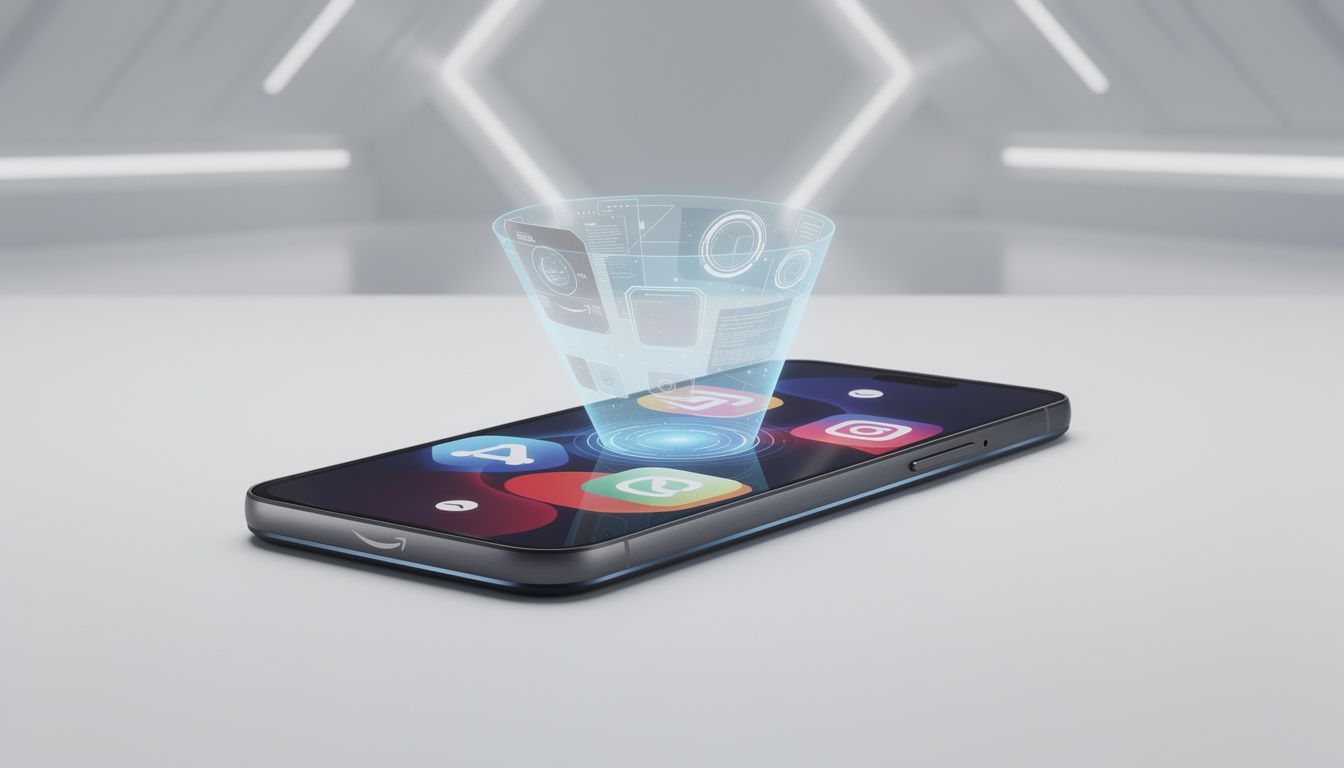
Amazon returns to the smartphone game with a groundbreaking device, and the reported plan points to an Alexa-centered phone built for AI tasks, daily personalization, and tighter links between shopping, media, and mobile life.
Amazon Returns to the Smartphone Game With a Groundbreaking Device, but This Time the Bet Looks Different
On a crowded train, one person opens three apps to order dinner, check a package, and switch music. Another asks a voice assistant for the same set of tasks in one sentence. That contrast explains why Amazon returns to the smartphone game with a groundbreaking device matters right now. The company appears ready to test whether people still want a phone built around icons and app stores, or whether they want a device that responds to intent first.
Amazon returns to the smartphone game with a groundbreaking device after the Fire Phone collapsed more than a decade ago. That failure was costly and public. Reports tied the damage to roughly $170 million, a sharp lesson in what happens when hardware arrives without a strong reason to switch. This new effort appears shaped by that history, not trapped by it.
The reported internal codename is Transformer. The project sits inside Amazon’s devices and services group, with a specialist team called ZeroOne. Leadership matters here. J Allard, known for key work at Microsoft on Xbox and Zune, is said to be involved under Panos Panay’s broader devices operation. That detail signals discipline. It suggests Amazon is treating mobile as a long-term systems project, not as a rushed vanity play.
Amazon returns to the smartphone game with a groundbreaking device with a sharper thesis than before. The pitch no longer centers on gimmicks like 3D effects. The focus appears to be AI over apps. In plain terms, a user might ask the phone to reorder groceries, resume a Prime series, book food delivery, surface a route, and summarize messages, all without opening separate services one by one.
This idea fits a wider shift across the industry. Google, Apple, Samsung, and smaller AI hardware startups are all trying to make phones more assistant-led. Readers who track how AI is transforming mobile apps have seen this coming for months. The difference with Amazon is ecosystem depth. The company already owns retail, media, smart home access, cloud infrastructure, and a voice assistant used in millions of homes.
There is also a practical consumer angle. If the phone acts as a mobile bridge to Alexa, the company gains more context across the day. Home speakers know routines in the kitchen and living room. A handset fills the gap outdoors, in stores, in cars, and at work. That makes the mobile layer strategically valuable in a way the old Fire Phone never managed to prove. The core insight is simple: this comeback only works if Amazon sells convenience, not hardware ego.
Why an AI-First Amazon Phone Could Appeal to Frustrated Users
Amazon returns to the smartphone game with a groundbreaking device at a moment when many people feel tired of app overload. Phones have become cluttered. Notifications pile up. Routine actions take too many taps. If Amazon strips away some of that friction, the argument for a second look becomes stronger than critics expect.
Reports suggest the company is testing more than one form factor. One path points to a standard handset. Another points to a simpler model inspired by minimalist phones, built for users who want fewer distractions. That split matters. It means Amazon is not chasing one generic buyer. It is studying two distinct habits, heavy smartphone dependence and intentional digital restraint.
Amazon returns to the smartphone game with a groundbreaking device because behavior has shifted since 2014. A phone is no longer only a screen for apps. It is a wallet, remote control, travel pass, shopping terminal, and media hub. A strong assistant layer matters more now because the device sits in the middle of all those tasks. Readers comparing the broader market already see movement in smartphone future innovations and new interface ideas.
What would an AI-first phone need on day one? The answer is not hard to outline.
- Fast voice handling for messages, search, reminders, and purchases
- Context awareness based on time, location, and routine
- Tight media links across Prime Video, Music, and Kindle services
- Low-friction commerce for Amazon orders and partner services such as food delivery
- Simple privacy controls that show what data the assistant uses
The strongest case for this device is not raw hardware dominance. Apple and Samsung still lead there, and together they held about 40 percent of global smartphone sales in the latest cited market data. Amazon needs a sharper argument. That argument is convenience through orchestration. If one request replaces five app sessions, users notice. If the phone still forces old habits, interest fades fast.
There is a second reason this timing is notable. The mobile market in 2026 faces price pressure from memory costs and weaker shipment trends. Reports point to a steep annual shipment decline, with IDC projecting a severe drop. Readers following the AI memory price surge know why prices across electronics have become harder to manage. That environment punishes weak ideas and rewards devices with a clear identity.
For Amazon, the identity looks straightforward. Alexa becomes the service layer. The phone becomes the daily access point. The mini thesis behind the project is bold but logical: fewer apps, more outcomes. That is the part worth watching.
A quick comparison helps frame the challenge.
| Factor | Fire Phone era | Reported Transformer direction |
|---|---|---|
| Main hook | 3D effects and shopping features | AI assistance and personalization |
| User flow | Traditional app behavior | Intent-led tasks through Alexa |
| Device role | Standalone smartphone attempt | Bridge across home, media, and commerce |
| Market context | Early voice era | Assistant-led mobile race |
The table shows why the new plan feels less random. Amazon is not retrying the same pitch. It is chasing a new user problem, digital friction.
Amazon Returns to the Smartphone Game With a Groundbreaking Device, but the Hard Part Starts After Launch
Amazon returns to the smartphone game with a groundbreaking device into a market with little patience for weak ecosystems. This is where the optimism needs discipline. Consumers do not switch phones for curiosity alone. They switch when life gets easier, when battery life holds up, when photos look good, and when old habits still work on day one.
The app question sits at the center of the debate. Reports suggest Amazon wants a future where AI reduces dependence on app stores. The logic is sound. Many users do not care which app completes a task. They care about the task finishing fast. Yet habits built over fifteen years are hard to dislodge. Banking, messaging, work tools, travel, maps, social platforms, and health services still rely on mature app ecosystems. Amazon needs compatibility, not ideology.
Battery and hardware basics also matter more than the AI narrative. If the phone ships with weak endurance, warm thermals, or uneven cameras, the software story loses force. Buyers have become ruthless on these points. Rankings of the best smartphone batteries in 2025 drew attention for a reason. Daily reliability still beats futuristic messaging.
There is also a trust issue. Amazon wants more of the user’s day, including location habits, shopping intent, and media behavior. That creates convenience, but it also raises obvious concerns. The company will need clear controls, visible permissions, and language people understand. If the interface feels opaque, the comeback stalls. If privacy settings feel concrete, resistance drops.
One plausible launch scenario stands out. Amazon starts with a modest release, likely in selected markets, tied to Prime benefits and Alexa features people already know. The company then tests whether users accept AI-led actions in place of old app routines. If adoption rises among Prime-heavy households, Amazon gains a foothold no rival can copy easily. If adoption stays shallow, the device risks becoming another niche experiment.
The strategic upside is larger than phone sales alone. A successful handset strengthens subscriptions, streaming, retail frequency, and smart home engagement. A failed one drains money and weakens Amazon’s hardware credibility again. ZeroOne’s work on an Android-based tablet near the $400 mark shows the company is thinking across connected devices, not on a single product. That broader plan gives the phone context.
So the argument is clear. Amazon returns to the smartphone game with a groundbreaking device only if the company solves everyday friction better than entrenched rivals. If the reported Transformer phone turns Alexa into a reliable layer across shopping, media, communication, and movement, people will pay attention. If not, history will not be kind twice.
Would you switch to an Amazon phone built around AI tasks instead of traditional apps? Share your take and send this article to someone who still remembers the Fire Phone.
What is Amazon’s Transformer phone?
Reports describe Transformer as an internal Amazon smartphone project focused on AI, personalization, and deep Alexa integration. The device appears designed to connect retail, streaming, and daily mobile tasks in one system.
Will the new Amazon phone replace apps with AI?
The reported direction points to fewer traditional app steps for common tasks. Full app replacement looks unlikely at first, since buyers still depend on banking, work, travel, and messaging services with mature mobile ecosystems.
Why did the Fire Phone fail?
The Fire Phone lacked a strong reason for people to leave Apple or Samsung, and its signature features did not solve a pressing user problem. Pricing, weak differentiation, and limited ecosystem appeal all hurt adoption.
When will Amazon release the new phone?
No official release date, price, or final hardware details have been confirmed. Current reporting places the project in development inside Amazon’s devices and services division.