

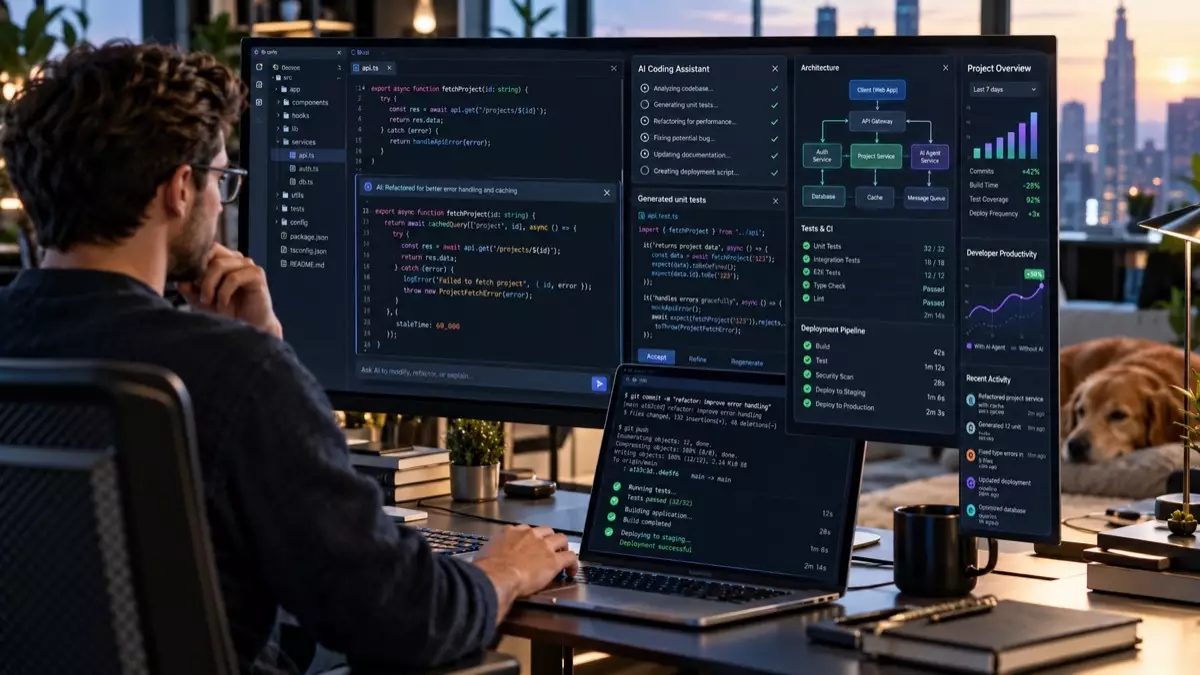
The software development workflow that dominated for the past two decades is undergoing a fundamental shift. AI coding agents have moved from experimental tools to production infrastructure at companies ranging from solo developer shops to enterprise engineering teams. By early 2026, the question is no longer whether these systems work, but how teams should reorganize around them. The transition is messier than the vendor pitches suggest, but the underlying change is real. Developers are writing less boilerplate, spending more time on architecture decisions, and watching AI handle the repetitive tasks that used to consume entire afternoons. The shift is visible in commit logs, sprint velocity, and the way junior engineers onboard. Industries beyond traditional software are noticing. Even sectors like online entertainment and gaming have begun integrating AI-assisted development workflows, with crypto casinos adopting automated testing and deployment pipelines that rely on AI-generated code to handle complex blockchain integrations and real-time transaction processing. The tooling has matured faster than most infrastructure changes, and the implications are starting to show up in hiring patterns and project timelines.
What AI Coding Agents Actually Do
AI coding agents are not glorified autocomplete systems. They parse codebases, generate entire functions from natural language prompts, refactor legacy code, write unit tests, and flag security vulnerabilities in real time. Tools like GitHub Copilot, Cursor, and Replit’s Ghostwriter operate inside the IDE and respond to developer intent with context-aware suggestions. The difference between these systems and earlier code completion tools is the depth of contextual understanding. An AI agent can read a project’s architecture, infer dependencies, and propose solutions that align with existing patterns. That contextual awareness makes them useful beyond trivial tasks. Developers describe the experience as having a junior engineer who never gets tired and responds instantly, though one who occasionally needs correction.
Speed Gains and Workflow Compression
The measurable benefits are starting to accumulate. Research on the impact on developer productivity shows that generative AI tools can cut coding time by 35 to 45 percent for specific tasks like writing new functions or debugging isolated modules. Those gains compress timelines in ways that affect project planning. A feature that once required three weeks of implementation can now ship in ten days, assuming the team has adapted its review process to account for AI-generated code. The speed increase is not uniform across all tasks. Architectural decisions, system design, and complex debugging still require human judgment. But the grunt work of translating logic into syntax has accelerated sharply. Teams that have integrated AI agents report spending more time on design reviews and less time writing repetitive CRUD operations.
The Shift in What Developers Actually Do
The role of the software engineer is changing in subtle but significant ways. Junior developers who once spent months writing basic functions now start by reviewing and refining AI-generated code. That shifts the learning curve. Instead of building muscle memory through repetition, new engineers learn by evaluating code quality, identifying edge cases, and understanding why certain patterns work better than others. Senior engineers report spending more time on high-level architecture and less time on implementation details. The change is not universally welcomed. Some developers feel the work has become less tactile, more abstract. Others appreciate the reduction in tedious tasks and the ability to focus on problems that require creativity. The adjustment period varies, but the trend is consistent. Writing code from scratch is becoming a smaller part of the job.
What Comes Next
The integration of AI coding agents is still in its early phase. The tools will improve, the workflows will stabilize, and the industry will figure out what this means for team structure and compensation. The transition is uneven, and not every organization will benefit equally. But the direction is clear. Software development is becoming faster, more abstract, and more dependent on AI assistance. The engineers who adapt will find themselves working at a different layer of the stack, focused less on syntax and more on intent.