

AI in industrial automation is a $20B market — but 80% of projects fail to scale. Discover the real ROI, the 7 biggest mistakes, and what successful companies do differently.
The market is booming, but most AI projects in manufacturing still fail to scale. Here’s what the ROI really looks like — and the mistakes companies keep making.
Artificial intelligence in industrial automation is no longer experimental. The market was valued at $20.2 billion in 2024 and is projected to reach $111.8 billion by 2034, growing at 18.8% annually. Factories are deploying predictive maintenance, computer vision for quality control, autonomous robots, and AI-driven supply chain optimization at an accelerating pace.
But here’s what the hype rarely tells you: most industrial AI initiatives don’t make it past the pilot stage. According to industry research, up to 80% of AI projects in manufacturing stall before reaching full-scale deployment. The technology works. The problem lies in data readiness, organizational alignment, and unrealistic expectations about return on investment.
This article cuts through the noise. We’ll examine the real ROI of AI in industrial automation, break down the most common challenges, and explain what separates companies that succeed from those that burn budget on failed pilots.
The Real ROI of AI in Industrial Automation
Let’s start with the numbers that matter. When properly implemented, AI in manufacturing delivers measurable results across multiple dimensions:
| AI Application | Typical ROI Impact | Payback Period |
|---|---|---|
| Predictive Maintenance | 25-30% reduction in unplanned downtime | 12-18 months |
| Quality Control (Computer Vision) | Up to 90% fewer defects reaching customers | 6-12 months |
| Supply Chain Optimization | 15-20% reduction in inventory costs | 12-24 months |
| Energy Optimization | 10-15% reduction in energy consumption | 8-14 months |
| Process Optimization | 10-25% increase in throughput | 12-18 months |
| Collaborative Robots (Cobots) | 30-50% productivity gain on targeted tasks | 18-36 months |
According to Deloitte’s 2025 Manufacturing Industry Outlook, AI and machine learning have the largest measurable impact on business outcomes among all smart manufacturing technologies. Generative AI in particular is showing high ROI potential, second only to cloud and SaaS solutions in terms of cost-to-value ratio.
The key takeaway: the ROI is real, but it’s not instant. Most successful deployments show meaningful returns within 12 to 24 months — not weeks. Companies expecting overnight transformation are the ones most likely to abandon projects prematurely.
Where the Money Actually Goes: Cost Breakdown
Understanding ROI requires understanding cost structure. Here’s what a typical AI industrial automation project actually costs:
| Cost Category | % of Total Budget | What It Covers |
|---|---|---|
| Data Infrastructure | 25-35% | Sensors, IoT gateways, edge computing, data pipelines, storage |
| Software & AI Models | 20-25% | ML platforms, computer vision, analytics tools, licenses |
| Integration & Deployment | 20-30% | Connecting AI to existing SCADA/PLC/MES systems, API development |
| Training & Change Management | 10-15% | Workforce upskilling, process redesign, operator training |
| Ongoing Maintenance | 10-15% | Model retraining, infrastructure updates, monitoring |
The biggest surprise for most companies? Data infrastructure eats up a third of the budget — and it’s the part most pilots underestimate. You can’t run predictive maintenance models on bad sensor data. You can’t optimize a supply chain if your ERP, MES, and SCADA systems don’t talk to each other.
The 7 Biggest Challenges — and What Companies Get Wrong
The technology behind artificial intelligence in industrial automation is mature enough to deliver real value. The failures are almost always organizational, not technical. Here are the seven most common pitfalls:
1. Poor Data Quality and Fragmented Systems
AI models are only as good as the data they learn from. In most factories, data lives in silos — SCADA systems, PLCs, ERP platforms, spreadsheets, and paper logs that don’t communicate. Cleaning, normalizing, and unifying this data is the unglamorous work that makes or breaks every AI project. Companies that skip this step end up with models that produce unreliable predictions.
2. Pilot Purgatory: Proving Concepts That Never Scale
This is the most widespread failure mode. A team runs a successful proof-of-concept on one production line, gets impressive results, and then the project stalls. Why? Because scaling requires IT/OT convergence, new infrastructure, cross-department buy-in, and budget commitments that pilot teams rarely have the authority to secure. The solution: plan for scale from day one, even if you start small.
3. Lack of Domain Expertise in AI Teams
Data scientists who don’t understand manufacturing processes build models that don’t solve real problems. The best results come from cross-functional teams — data engineers working alongside plant operators, maintenance technicians, and production managers. The people who know the machines need to be part of the AI design process, not just the recipients of its outputs.
4. Underestimating Change Management
A predictive maintenance system that tells operators a machine will fail in 48 hours is useless if the operators don’t trust it, don’t know how to act on it, or see it as a threat to their expertise. Technology adoption is a human problem. Training, communication, and early involvement of frontline workers are as important as the algorithm itself.
5. Expecting AI to Replace Human Judgment
In high-stakes industrial environments — chemical plants, oil refineries, pharmaceutical production — AI should augment human decision-making, not replace it. An AI system can flag anomalies with 95% confidence, but a 5% error rate in a chemical process can be catastrophic. The smartest deployments position AI as an advisory layer: it surfaces insights and recommendations, while experienced operators make the final call.
6. Cybersecurity Blind Spots
Connecting factory equipment to AI platforms means connecting it to networks — and that creates attack surfaces. Industrial control systems (ICS) were designed for reliability, not security. Adding IoT sensors, cloud analytics, and remote access without a robust OT cybersecurity strategy is a recipe for disaster. Ransomware attacks on manufacturing have surged, and connected AI systems can be both targets and vectors.
7. Chasing Hype Instead of Solving Problems
The most expensive mistake of all: deploying AI because competitors are doing it, without a clear problem to solve. Successful industrial AI starts with a specific, measurable pain point — excessive downtime, high defect rates, energy waste — and works backward to the right technology. Companies that start with “we need AI” instead of “we need to reduce downtime by 20%” almost always fail.
What Companies That Succeed Do Differently
The organizations scaling AI in industrial automation successfully share a set of common practices that separate them from the 80% that stall:
-
- Start with the business case, not the technology. Define the problem, quantify the cost of inaction, and set measurable KPIs before writing a single line of code.
-
- Invest in data infrastructure first. Ensure sensors are calibrated, data pipelines are clean, and systems are interoperable before deploying models.
-
- Build cross-functional teams. Pair data scientists with domain experts from the factory floor. The best models come from people who understand both the data and the machines.
-
- Plan for scale from day one. Choose architectures, platforms, and vendors that support multi-site deployment, not just a single-line proof of concept.
-
- Prioritize change management. Train operators early, involve them in design, and demonstrate value through quick wins that build trust.
-
- Iterate, don’t overhaul. Deploy in phases — one production line, one use case, one measurable outcome at a time. Then expand what works.
The Technology Stack Behind Industrial AI
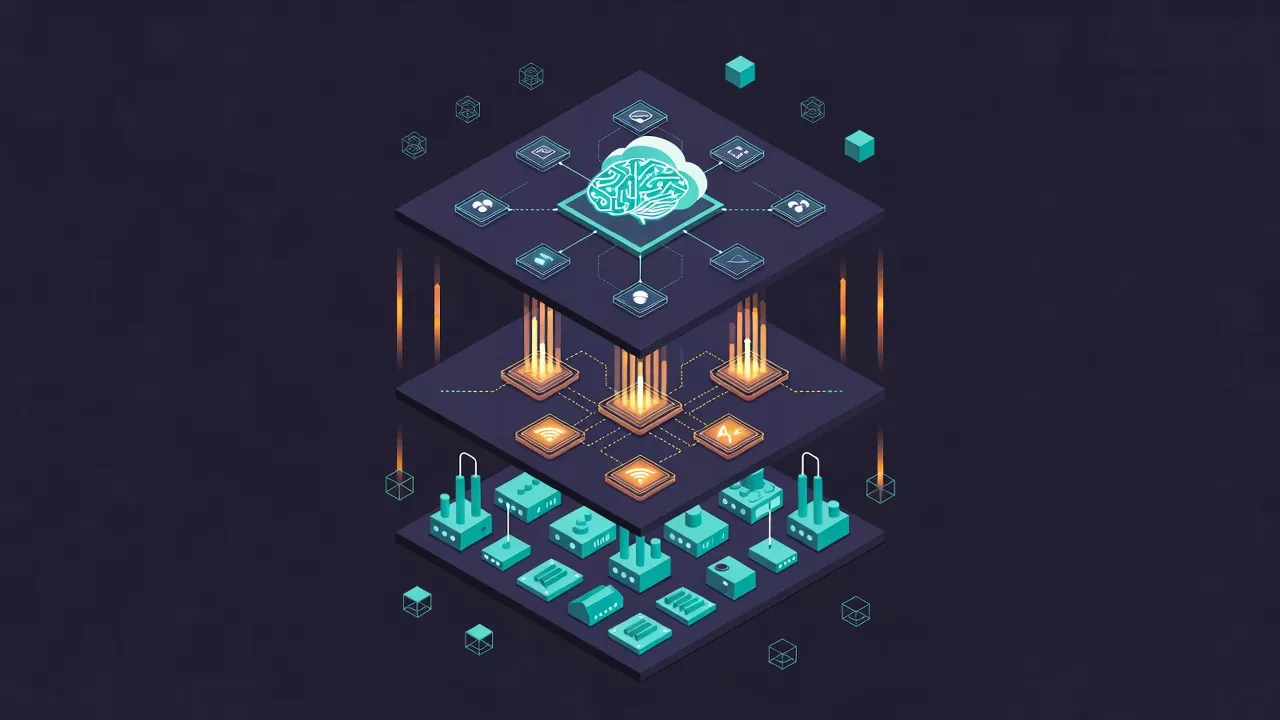
For companies ready to move beyond the hype, here are the key technology layers that power AI in industrial automation:
| Layer | Function | Key Tools / Platforms |
|---|---|---|
| Data Collection | Sensors, IoT gateways, PLC/SCADA integration | Siemens MindSphere, Azure IoT Hub, AWS IoT SiteWise |
| Edge Computing | Low-latency processing at the factory level | NVIDIA Jetson, Azure IoT Edge, AWS Greengrass |
| AI / ML Platform | Model training, deployment, and monitoring | C3 AI, SymphonyAI, Google Vertex AI, Azure ML |
| Computer Vision | Defect detection, quality inspection | Cognex, Landing AI, custom TensorFlow/PyTorch models |
| Digital Twins | Virtual replicas for simulation and optimization | Siemens Xcelerator, Azure Digital Twins, Ansys |
| RPA / Process Automation | Automating repetitive workflows | UiPath, Automation Anywhere, Microsoft Power Automate |
The crucial point: these layers need to work together as an integrated system. A computer vision model running on the edge is only useful if its outputs feed into the MES, trigger alerts in the maintenance system, and log data for continuous model improvement. Integration is where most of the engineering effort — and budget — actually goes.
What’s Next: Trends Shaping 2025-2030
The next five years will see artificial intelligence in industrial automation shift from “early adopter advantage” to “baseline expectation.” Here’s what’s coming:
-
- Generative AI for product design and simulation — By 2028, 50% of large manufacturers are expected to use generative AI for innovation, including evaluating engineering archives and accelerating design cycles.
-
- Physical AI and context-aware robots — Robots that perceive, plan, and adapt using vision-language-action models are moving from labs to production floors.
-
- 5G-connected factories — Ultra-reliable low-latency communication (URLLC) will replace wired connections, enabling more flexible and reconfigurable production lines.
-
- Autonomous process control — AI systems that don’t just advise but actually control production parameters in real time, with human oversight limited to exception handling.
-
- Sustainability-driven AI — Energy optimization, carbon tracking, and waste reduction powered by AI will shift from “nice to have” to regulatory requirement.
Frequently Asked Questions
What is the ROI of AI in industrial automation?
Typical payback periods range from 12 to 24 months. Predictive maintenance can reduce unplanned downtime by 25-30%, computer vision can cut defects by up to 90%, and supply chain optimization can lower inventory costs by 15-20%. The exact ROI depends on scale, data readiness, and integration quality.Why do most industrial AI projects fail?
Up to 80% of AI projects in manufacturing stall before reaching full-scale deployment. The most common reasons are poor data quality, fragmented legacy systems, lack of cross-functional collaboration, underestimated change management, and deploying AI without a clear business problem to solve.How much does AI in manufacturing cost?
Costs vary widely depending on scope. A single-line predictive maintenance pilot can cost $50K-$200K. A full-scale smart factory deployment can reach $1M-$10M+. Data infrastructure typically consumes 25-35% of the total budget, followed by integration and software costs.Will AI replace factory workers?
AI will transform roles, not eliminate them wholesale. Machine operators become robot technicians, maintenance teams shift to predictive analytics, and engineers focus on training and optimizing AI systems. The World Economic Forum projects that intelligent automation will displace some jobs while creating new, higher-skilled ones.What’s the difference between industrial automation and intelligent automation?
Traditional industrial automation follows fixed, pre-programmed rules. Intelligent automation adds AI — machine learning, computer vision, and adaptive algorithms — that enable systems to learn from data, predict outcomes, and adjust in real time without reprogramming.Is AI in industrial automation secure?
Connecting industrial equipment to AI platforms creates new cybersecurity risks. OT systems were designed for reliability, not security. A robust approach includes network segmentation, encrypted data pipelines, regular vulnerability assessments, and OT-specific security solutions alongside traditional IT security measures.Final Thoughts
Artificial intelligence in industrial automation delivers real, measurable ROI — when deployed correctly. The technology is mature. The data is available. The tools exist. What separates success from failure is almost never the algorithm. It’s data readiness, organizational alignment, realistic expectations, and the discipline to scale what works instead of chasing what’s trendy.
The companies that win in the next decade won’t be the ones with the most AI projects. They’ll be the ones that turned a few well-chosen AI applications into sustained operational advantages. Start with a real problem. Build the data foundation. Scale what proves its value. That’s the formula.
Follow DualMedia for in-depth coverage of AI, industrial tech, and digital transformation trends.