

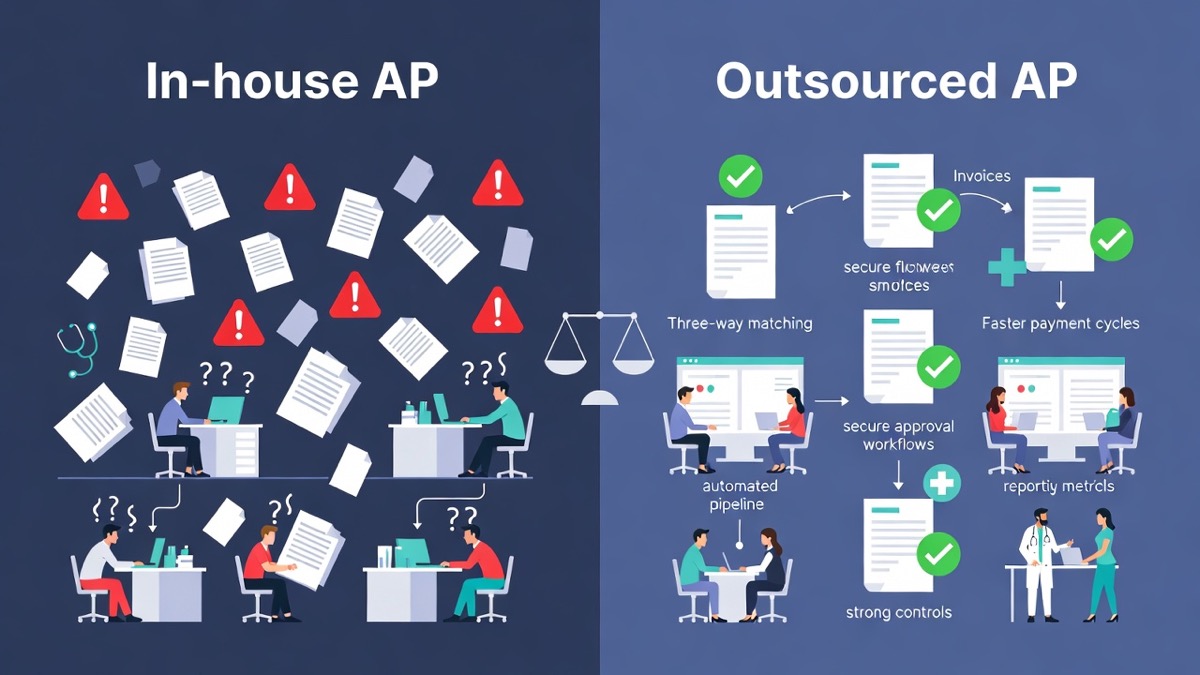
Choosing the wrong AP outsourcing partner costs more than keeping the function in-house ever did. A vendor that processes invoices slowly, misses payment windows, or operates without proper controls creates the same problems you were trying to solve — just with less visibility into what’s going wrong and why. The decision deserves the same structured evaluation you’d apply to any operational change with direct financial consequences. Accounts payable outsourcing services vary significantly in scope, process maturity, and healthcare-specific knowledge. This guide gives you the questions to ask, the boundaries to define, and the onboarding realities to expect before you commit.
What to Outsource vs What to Keep
The first decision isn’t whether to outsource — it’s where to draw the line between what stays internal and what moves to the vendor. Getting this boundary wrong is one of the most common reasons AP outsourcing underdelivers.
Policy and approval authority stay in-house. Your internal team should define which vendors are approved, what the spending thresholds are for each approval level, and what the escalation path is for exceptions. These are governance decisions that require organizational context an outside team doesn’t have and shouldn’t be making. Outsourcing these functions doesn’t save time — it creates misaligned decisions that get corrected later at a higher cost.
Execution moves to the vendor. Invoice intake and logging, three-way matching, GL coding, approval routing within your defined matrix, payment scheduling, and reconciliation — these are rule-based, transactional functions that a specialized team handles more consistently than in-house staff splitting attention across multiple roles. The vendor executes against your policies, not instead of them.
Vendor master maintenance sits at the boundary and requires explicit agreement. Adding new vendors, updating banking details, and changing payment terms are functions with fraud exposure attached to them. Define in writing whether these stay internal or transfer to the vendor — and if they transfer, specify the verification steps required before any changes take effect. An emailed request to change a vendor’s bank account that gets processed without callback verification is a specific fraud vector that catches organizations without a formal policy.
AP outsourcing structured this way — governance internal, execution external — gives you efficiency on the transactional side without surrendering control over the decisions that carry real organizational risk.
Due Diligence Questions to Ask
Vendor selection conversations tend to stay at a surface level until someone asks for specifics. Here are the questions that actually differentiate providers:
- What does your invoice processing SLA look like? You want a specific number of days from receipt to payment-ready status, not a general commitment to “timely processing.” If they can’t give you a number, they’re not measuring it.
- How do you handle exceptions? Ask what percentage of invoices typically require manual intervention and what the resolution workflow looks like. A high exception rate with a slow resolution path means your payment cycle will lag.
- What reporting do clients receive and how often? You should be getting AP aging, invoice cycle time, exception volume, and early payment discount capture rate on a defined schedule. If standard reporting doesn’t include these, ask why.
- How is access to our systems managed? Role-based credentials, MFA, activity logging — these aren’t optional for any vendor handling financial data. Ask for specifics, not assurances.
- What happens during staff turnover on your team? AP knowledge about your vendor mix and approval matrix needs to survive individual staff changes at the vendor. Ask how process documentation is maintained and how transitions are handled.
- What’s your error correction process? Duplicate payments and misapplied transactions happen even in well-run AP operations. How a vendor identifies, documents, and corrects errors tells you more about their operational maturity than their pitch deck does.
- Can we speak with current healthcare clients? References from organizations with similar complexity — not just similar size — are the most reliable signal of actual performance.
Implementation and Onboarding: Typical Steps
AP outsourcing onboarding takes longer than most vendors initially suggest, and practices that don’t plan for it end up with a rocky first 60 days. Here’s what the process actually involves:
System access setup is the first step and often the slowest. Getting vendor staff properly credentialed in your accounting platform, with the right role permissions and logging in place, requires coordination between your IT team and the vendor. Budget two to three weeks for this if your systems have any complexity.
Workflow documentation comes next. Your approval matrix — who approves what, at what dollar threshold, in what sequence — needs to be documented in enough detail that the vendor can route invoices correctly without asking questions on every transaction. If this documentation doesn’t exist internally, building it is the right first step regardless of outsourcing.
Vendor master review is often skipped and consistently causes problems. Before the new team starts processing, audit your active vendor list: remove duplicates, verify banking details are current, flag any vendors whose contract terms don’t match recent invoices. Starting with a clean vendor master prevents a class of errors that would otherwise appear immediately.
A parallel processing period — running the outsourced team alongside your existing process for two to four weeks — lets you validate that invoices are being matched, coded, and routed correctly before going fully live. It adds time upfront but prevents the payment errors that create vendor calls in the first month.
Accounts payable onboarding that skips these steps produces the same outcome every time: a backlog that builds faster than it gets cleared, exceptions that don’t get resolved, and a first-month reconciliation that requires significant manual cleanup. Proper onboarding is where the relationship either establishes a functional pattern or starts generating the problems it was supposed to solve.
The Value of a Healthcare-Focused Partner
Generic AP outsourcing providers can handle invoice processing. What they miss is the context that makes healthcare AP different from other industries — and that gap shows up in specific ways.
Healthcare vendor relationships often involve ongoing service contracts, not one-time purchases. A clinical supply vendor or a maintenance contractor has terms that need to be cross-referenced on every invoice, not just at contract renewal. A provider without healthcare experience treats every invoice as a standalone transaction and misses contract-level discrepancies that a specialist would catch.
Compliance requirements around certain payment categories — physician relationships, referral arrangements, service agreements — carry regulatory sensitivity that general AP teams aren’t oriented toward. A healthcare-focused partner understands which payment types need additional documentation and flags them accordingly.
The coordination between AP and billing also matters in healthcare in a way it doesn’t in most other industries. When collections slow down, AP planning needs to adjust. A partner that handles both functions — or that understands how they interact — prevents the cash flow gaps that result from managing them in complete isolation.
Working with atrusted healthcare partner means the AP function runs with the discipline the revenue side requires — defined processes, documented controls, consistent reporting, and a team that understands the operational context it’s working in.
The right outsourcing decision isn’t just about offloading work. It’s about building a financial operation that runs with fewer errors, better visibility, and controls that hold up when someone looks closely.