

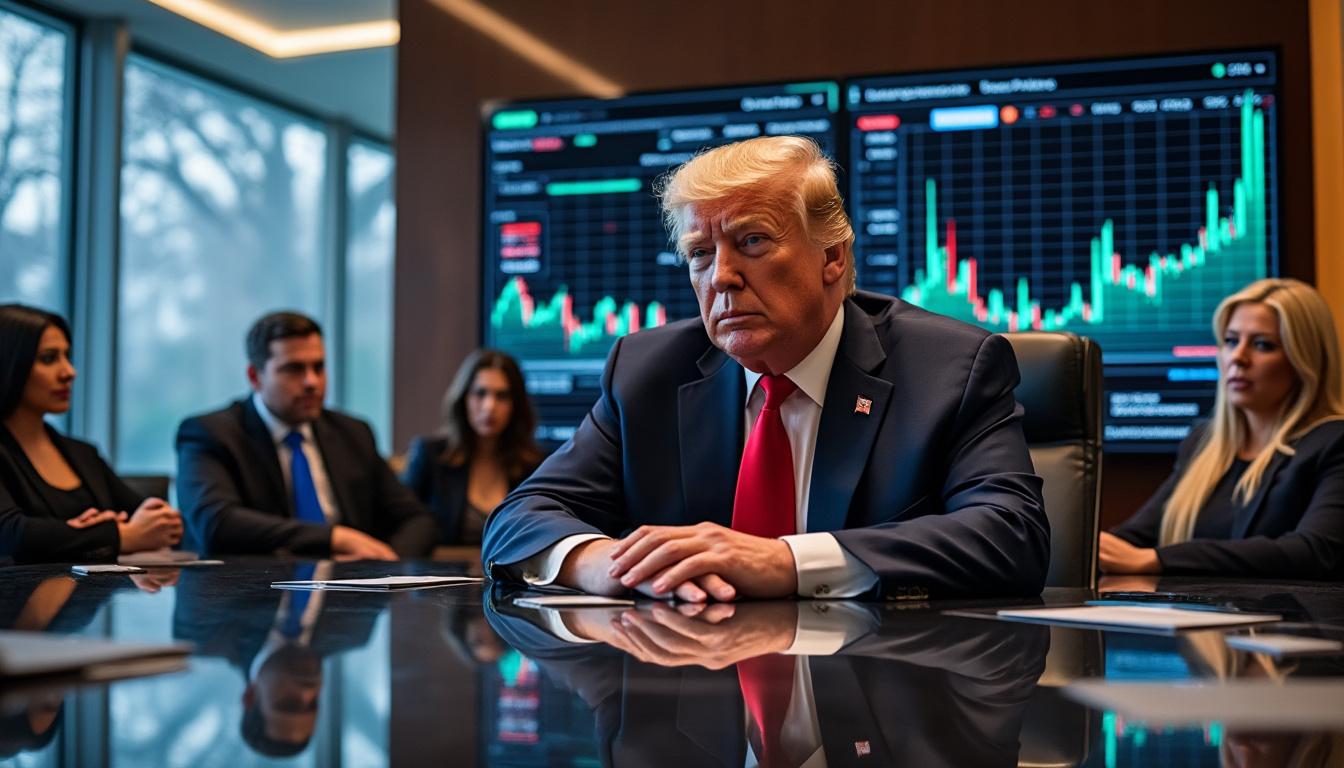
The Trump Family built a $7 billion Crypto Empire around mining firms, DeFi tokens, and a presidential memecoin. Now that empire stands at risk of Collapse as self-dealing accusations and Corruption Allegations spread through Washington and the global markets. A sharp Cryptocurrency downturn has already wiped out roughly a billion dollars, while House Democrats publish reports that frame the president’s digital asset strategy as a Financial Scandal tied to foreign influence and opaque deals.
Behind the headlines, a pattern emerges. A president in office with direct economic exposure to volatile coins. A DeFi platform processing large transactions from politically connected investors. A memecoin promoted from the bully pulpit while Trump-affiliated entities hold the bulk of the supply. Each new allegation adds fresh Legal Issues to a portfolio already shaken by token crashes and equity sell-offs. For traders, compliance officers, and policy analysts, the Trump Family saga reads like a stress test of what happens when high-stakes politics and speculative crypto structures merge in 2025.
Trump Family Crypto Empire under pressure from market and investigators
The Trump Family Crypto Empire grew at speed through aggressive bets on mining, DeFi, and branded tokens. That expansion now collides with a dual threat. Markets punish overleveraged projects, while investigators frame those same ventures as self-dealing machines built around public office. The result is a coordinated pressure on valuations, governance, and reputation.
House Democrats released a report that accuses the president of steering policy and access in ways that support his digital asset holdings. They point to meetings with foreign investors, targeted tax proposals, and the promotion of specific tokens on official channels. At the same time, key Trump-linked stocks and coins trade far below their highs, eroding the claimed $7 billion headline number and raising questions about solvency if the selloff continues.
- American Bitcoin Corp shares down more than 40 percent since early October.
- Trump Media and Technology Group stock down about 33 percent while sitting on a large Bitcoin position.
- World Liberty Financial token falling roughly 50 percent from peak.
- Trump and Melania memecoins shedding 91 percent and 99 percent of value from all-time highs.
- Overall Trump Family net worth sliding to about $6.7 billion, with crypto as a large component.
The same report connects these figures to potential conflicts of interest. If a president gains billions from favorable crypto regulation, every policy move faces scrutiny as possible self-dealing. That perception risk feeds back into market pricing, since institutional players tend to demand strong governance and clean separation between political power and private gain.
| Asset or entity | Crypto role | Recent performance | Key risk for Trump Family |
|---|---|---|---|
| American Bitcoin Corp | Bitcoin mining company linked to Trump sons | Share price down over 40 percent since October | Revenue growth overshadowed by equity Collapse and capital strain |
| Trump Media and Technology Group | Holds around $2 billion in Bitcoin on balance sheet | Stock down about 33 percent in same period | Price exposure to Bitcoin plus Corruption Allegations around governance |
| World Liberty Financial (WLFI) | DeFi platform and token issuer | Token down about 50 percent from all-time high | Foreign influence accusations and regulatory uncertainty |
| Trump presidential memecoin | Branded token launched before inauguration | Down about 91 percent from peak | Self-Dealing concerns due to internal concentration of supply |
| Melania memecoin | Separate family-branded token | Down around 99 percent from peak | Loss of investor trust and reputational damage |
This combination of price erosion and self-dealing narratives pushes the Trump Family Crypto Empire into a fragile state. Each new allegation risks another leg down in liquidity and trust.
Self-dealing and Corruption Allegations around presidential crypto conduct
The core of the Financial Scandal story lies in self-dealing. Critics argue that the Trump Family used public office to pump a private Crypto Empire. They highlight at least three repeated patterns across projects and decisions.
First, the White House narrative claims the president placed assets in a trust managed by his children. Critics respond that he remains the sole trust beneficiary, so every profitable trade or token launch increases personal wealth. Second, political stages and official communications frequently highlight Trump-linked cryptocurrency ventures while Trump-related entities hold large pre-allocated stakes. Third, high-value foreign investors gain unique access through token holdings, dinners, and exclusive events.
- Promotion of a presidential memecoin three days before taking office.
- Public statements praising World Liberty Financial while WLFI tokens circulate among foreign investors.
- Private events at the White House for top token holders, many from abroad.
- Policy moves framed as supportive of specific crypto industries in which the family holds equity.
- Ongoing denial from the administration that any conflict of interest exists.
These behaviors create a pattern that investigators call self-dealing. Whether courts treat those patterns as criminal or merely unethical, the Corruption Allegations alone spread doubt across all Trump-linked coins and shares.
| Alleged self-dealing pattern | Example in Trump Family crypto activity | Potential Legal Issues |
|---|---|---|
| Using office to promote assets | Memecoin launched and advertised close to inauguration | Ethics rules on personal enrichment from public office |
| Concentrated insider holdings | Trump-affiliated firms owning 80 percent of memecoin supply | Securities classification risk and disclosure failures |
| Foreign access via token ownership | Dinners for top token holders including foreign political figures | Foreign influence laws and campaign finance restrictions |
| Policy alignment with private bets | Supportive messaging for mining and DeFi where family holds stakes | Conflict of interest and abuse of office accusations |
As long as these patterns remain at the center of public debate, the Trump Family Crypto Empire carries a permanent governance discount in the eyes of serious capital.
Foreign influence, WLFI tokens, and the global reach of the Crypto Empire
Foreign influence sits at the heart of the harshest Corruption Allegations. World Liberty Financial, marketed as a DeFi hub for stablecoins and lending, attracted hundreds of millions of dollars from overseas. The House report lists multiple investors with links to foreign governments, energy giants, and politically exposed persons.
Names include a UAE-based fund allegedly tied to a manager employed by China National Petroleum Corporation, Russian-linked market maker DWF Labs, and Tron founder Justin Sun. Together, these actors funneled an estimated $550 million into WLFI token sales between October and March. That capital shaped both the valuation of the platform and perceptions around the Trump Family’s independence in foreign policy.
- UAE fund Aqua 1, associated with a Chinese-Brazilian professional connected to a state energy firm.
- DWF Labs, run by Andrei Grachev with a reported history of criminal issues and links to Moscow.
- Justin Sun, buyer of around $75 million worth of WLFI during the token sale window.
- Dozens of anonymous entities registered in permissive jurisdictions.
- Transactions routed through stablecoins and on-chain liquidity pools to WLFI smart contracts.
Regulators worry about a scenario where foreign entities buy Trump-linked tokens to influence policy. The report states that such buyers might see WLFI or the memecoin as a direct channel to curry favor with the administration. Those concerns echo broader global law enforcement actions against crypto-based influence schemes, including high profile fraud cases such as those discussed in analyses of sentencing trends around crypto crimes on sites like this Bitcoin sentencing overview.
| Foreign-linked investor | Associated country | Estimated WLFI exposure | Regulatory concern |
|---|---|---|---|
| Aqua 1 fund | UAE / China | Undisclosed share of $550 million raise | Connection to Chinese state-owned energy firm |
| DWF Labs | Russia-linked | Significant market making and token holdings | Government ties and prior criminal history |
| Justin Sun | China / global | About $75 million WLFI | Existing SEC case around Tron trading volumes |
| Anonymous entities | Offshore centers | Aggregated tens of millions | Sanctions evasion and money laundering risk |
With this type of cap table, every bilateral negotiation with those countries now draws questions about hidden token incentives and quiet backchannels.
Quid pro quo fears and the Binance pardon controversy
The Binance segment of the saga adds another layer of Legal Issues. A televised investigation linked a $2 billion investment deal between Binance and Abu Dhabi’s MGX fund to the presidential pardon of former Binance CEO Changpeng Zhao. The transaction reportedly used USD1, a stablecoin issued on the World Liberty Financial platform, as a key settlement asset.
Critics argue that this sequence looks like a quid pro quo. A favorable pardon, followed by flows into a Trump-linked DeFi stablecoin and associated projects. Binance’s current CEO Richard Teng and Zhao’s legal team deny any connection, stating the investment and pardon followed separate processes. Yet the optics align too closely for many lawmakers.
- $2 billion investment involving Binance and MGX tied to DeFi infrastructure.
- Use of USD1, a World Liberty Financial stablecoin, at the center of the structure.
- Zhao receiving a presidential pardon shortly before or after investment steps.
- House Democrats framing the story as evidence of a broader pattern of Trump Family self-dealing.
- Public trust further damaged among US and European regulators monitoring exchange conduct.
Quid pro quo allegations are difficult to prove but easy to politicize. Each new headline about Binance, stablecoins, or pardons amplifies concerns that the Trump Family Crypto Empire trades regulatory favors for inflows.
| Element | Description | Impact on Trump Crypto Empire |
|---|---|---|
| MGX investment size | About $2 billion | Signals large institutional confidence but invites scrutiny |
| Settlement asset | USD1 stablecoin via World Liberty Financial | Boosts WLFI platform volumes and strategic value |
| Pardon timing | Close to investment deal period | Feeds Financial Scandal narrative and quid pro quo fears |
| Regulatory response | Media investigations and congressional reports | Raises Legal Issues around influence and corruption statutes |
As this thread unfolds, institutions that already faced losses on WLFI tokens and Trump-linked equity must also price in headline and enforcement risk.
Trump memecoin, pay-to-access politics, and direct influence channels
The Trump presidential memecoin sits at the nexus of spectacle and governance risk. Launched three days before the inauguration, the token reached a market value near $8.8 billion before collapsing by about half in little more than a week. Later, the price cratered more than 90 percent from its peak as the broader Cryptocurrency market cracked and Corruption Allegations escalated.
The controversial part is not only the price volatility. It is the structure. According to the token’s own site, two Trump-affiliated companies hold around 80 percent of the supply. That level of concentration, combined with official promotion and exclusive access perks at the White House, created a direct paid channel between crypto wealth and political proximity.
- Token launched in the narrow window between election win and inauguration.
- Rapid rise to multibillion-dollar market cap fueled by social media promotion.
- Trump-related entities controlling about four-fifths of total supply.
- VIP dinner promise for top 220 holders, including special reception for the top 25.
- Significant share of VIP attendees identified as foreign nationals with political roles.
One cited example involves a Chinese political advisor attending the high-tier event as a large token holder. Another comes from a logistics firm, Freight Technologies, that publicly announced a $20 million purchase of the memecoin, presenting it as both a treasury diversification move and a way to advocate for favorable trade policies. These cases tie token ownership to concrete geopolitical and regulatory aims.
| Memecoin feature | Description | Risk exposure |
|---|---|---|
| Supply concentration | 80 percent owned by Trump-affiliated firms | Market manipulation and self-dealing suspicions |
| Launch timing | Three days before taking office | Abuse of office concerns and ethics scrutiny |
| Access perks | Dinners and tours for top token holders | Pay-to-play and foreign influence allegations |
| Corporate buyers | Firms like Freight Technologies buying for policy signaling | Blurring line between lobbying and trading |
| Price path | From $8.8 billion cap to 91 percent drawdown | Investor losses and further Financial Scandal narratives |
For regulators who already track crypto corruption stories from OneCoin to exchange fraud, this memecoin case adds a new data point to debates about pay-to-access politics and tokenized influence, similar to the governance failures seen in other past crypto cases covered in outlets like this report on crypto sentencing.
Market Collapse dynamics across Trump-linked cryptocurrency assets
The Collapse in Trump-linked Cryptocurrency assets follows classic speculative cycle mechanics. Rapid inflows driven by branding, political hype, and influencer campaigns created inflated valuations. When macro conditions turned, liquidity vanished, and market makers stopped aggressively defending price levels. That exposed thin order books and overleveraged traders.
American Bitcoin Corp provides one example. Its mining revenue increased over the last three months, but the share price fell more than 40 percent anyway. Investors now price in higher energy costs, regulatory risk around Bitcoin mining, and reputational damage from the wider Trump Family Financial Scandal. Something similar happened at Trump Media, whose stock lost about a third of its value even as the company tried to present its large Bitcoin holdings as an advantage.
- Speculative bubbles in memecoins unwound once broader risk sentiment turned.
- DeFi tokens like WLFI tracked broader altcoin selloffs, then underperformed as Legal Issues mounted.
- Stocks with concentrated retail bases showed sharp swings around media coverage.
- Institutional buyers pulled back from deals linked to politically exposed persons.
- Corruption Allegations acted as an extra discount factor on all Trump-branded digital assets.
From a risk management perspective, the Trump saga resembles other crypto excess cycles. For example, enforcement against fraudulent projects in earlier years, including high profile scams referenced in analyses on DualMedia’s coverage of the “cryptoqueen” case, showed how quickly sentiment reverses once legal and political clouds gather.
| Asset class | Driver of rise | Trigger of fall | Key ongoing risk |
|---|---|---|---|
| Memecoins | Brand recognition and social media hype | Profit taking and corruption headlines | Low liquidity and regulatory action |
| DeFi tokens (WLFI) | Yield promises and institutional interest | Foreign influence report and market crash | Securities law and sanctions scrutiny |
| Mining equities | Hashrate growth and bull market expectations | Bitcoin price drawdown and ESG concerns | Energy costs and environmental policy |
| Media stock with Bitcoin reserves | Retail speculation and digital asset narrative | Volatility in Bitcoin and governance doubts | Balance sheet exposure to crypto price swings |
The structural issue is clear. Once a Crypto Empire ties itself to one family name and one political office, every shift in that office’s fortunes reflects directly back into token prices and equity valuations.
Our opinion
The Trump Family Crypto Empire illustrates how fast an aggressive digital asset strategy can turn into a systemic Financial Scandal when built around public office and opaque structures. A combination of self-dealing accusations, foreign influence exposure, and volatile Cryptocurrency markets now threatens a multi-billion dollar fortune that only months ago looked untouchable. For regulators and investors, the key lesson is not about one surname. It is about structural safeguards.
Future leaders who hold digital assets will face pressure to adopt blind trusts, independent oversight, and strict separation between public messaging and private holdings. Projects tied to politically exposed founders must meet higher transparency standards than anonymous DeFi experiments. History from other crypto scandals, such as the OneCoin saga analyzed in detail on this cryptoqueen sentencing page, already shows what happens when unchecked greed meets weak governance. The Trump case scales those same dynamics to the level of global politics.
- Separate political office from any direct crypto exposure through hard rules.
- Demand granular disclosure of token allocations and insider wallets.
- Limit or ban foreign political figures from gaining privileged access via tokens.
- Strengthen enforcement against pay-to-access structures built around coins.
- Educate traders about political risk premiums in any family-branded asset.
Whether courts confirm the worst Corruption Allegations or not, the Trump Family story already serves as a live case study in how quickly a high-profile Crypto Empire can move from headline success to Collapse once trust erodes. For anyone active in digital assets, that lesson deserves close attention long after the current scandal cycle fades.
| Stakeholder | Key takeaway | Recommended action |
|---|---|---|
| Retail investors | Family-branded tokens carry high governance risk | Prioritize fundamentals and diversify away from political coins |
| Institutional funds | Political exposure adds unique downside scenarios | Apply enhanced due diligence to PEPS and related projects |
| Regulators | Crypto enables novel pay-to-access channels | Clarify rules on self-dealing, foreign influence, and tokenized lobbying |
| Policy makers | Public trust depends on clear asset separation | Adopt strict blind trust and disclosure requirements for officeholders |
| Crypto founders | Short-term hype can lead to long-term Legal Issues | Build transparent governance frameworks from day one |
The Trump Family case shows that reputational risk is financial risk. Any Crypto Empire that ignores this link risks one day facing the same kind of sudden Collapse under the weight of its own Corruption Allegations.