

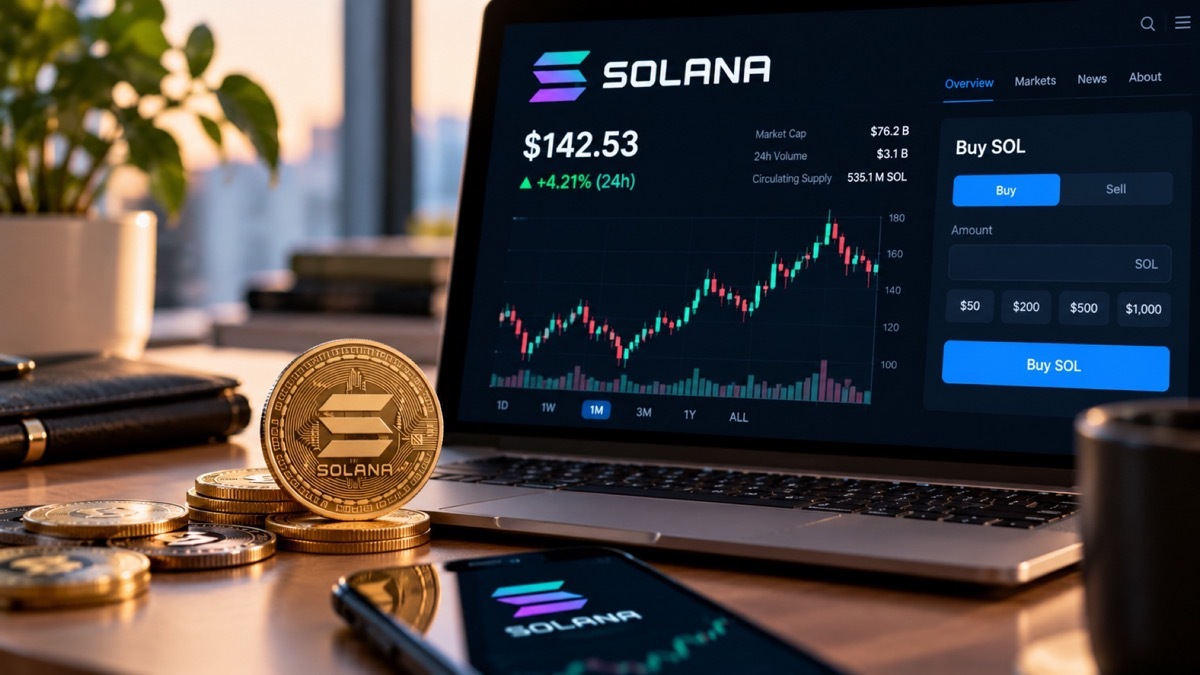
If you’ve spent any time around crypto, you’ve probably noticed that Solana tends to come up more frequently in conversations that used to be mainly about Bitcoin and Ethereum. The interest isn’t random – Solana’s blockchain has served as a launchpad for so many projects over the past few years, from popular wallets like Phantom to apps and even digital versions of stocks. Its price has had quite a ride, too, having hit an all-time high (ATH) of $293 in January 2025 thanks to a burst of activity on the network and more attention from institutional investors. Over the years, it has earned the nickname “Ethereum killer”, though Ethereum remains the leader in terms of market value.
Like most of crypto, Solana hasn’t moved in a straight line. The price has cooled off since then, which some investors see as a chance to buy the dip. If you’re among those market watchers looking to learn how to buy Solana and figuring out how it might fit into your portfolio, it’s worth taking a look at what it brings to the table and how other investors are approaching this move.
First, let’s understand Solana
Solana is a blockchain, a shared public ledger of transactions that no single company controls. Its white paper was issued in 2017 and the network has been live for over six years. It’s a layer-1 blockchain, meaning it runs on its own, independently of other networks, and was built to support scalable and decentralized apps (dApps). It was built to handle a lot of activity at high speed and low prices; therefore, it uses a dual consensus mechanism that combines proof-of-history with proof-of-stake. Solana can validate thousands of transactions per second, outshining the platform known as the pioneer of smart contracts, Ethereum. Its native coin, SOL, is what investors buy when they want exposure to Solana, and it’s also what people use to pay transaction fees and to stake, meaning to lock up coins to help secure the network in return for rewards.
Developers build all sorts of apps on it, from exchanges to payment tools – much like they do on Ethereum. Solana has recorded some of the strongest developer growth in the crypto space and at times it has outpaced Ethereum. 2024 was a standout year as surpassed Ethereum in the total number of developers that joined the network. Ethereum reclaimed the top spot in 2025, when it pulled in over 16K new developers in the first nine months, which left Solana second with around 11,5K new devs. Not bad for a project that many counted out in 2022.
Why investors keep an eye on it
Much of the interest that Solana attracts comes down to the fact that the network was built for heavy traffic, with high throughput and fees that are barely noticeable. Fees matter a lot because they can add up quickly, all the more if we talk about someone who trades often or sends small amounts. On busier networks, a simple transfer can sometimes exceed the value of the transfer itself. The cheaper the fees, the more money stays with the user.
This affordability has also turned Solana into a busy marketplace for stablecoins, which represent tokens pegged to currencies like the USD, and for tokenized real-world assets, a broader category that covers things like bonds and fund shares. In practice, a business could pay a supplier in stablecoins and spend less on the transaction than it would by sending an international bank wire. More and more activities on Solana involve assets with real-world value, an evolution that investors always see as a healthy sign.
Wall Street steps in
Access to cryptocurrency has gotten easier thanks to the launch of spot exchange-traded funds (ETFs), and Solana has joined Bitcoin and Ethereum on the list of cryptos with such funds trading in the US. An investor can now buy a fund that holds actual SOL through the same brokerage account they use to invest in stocks, without needing to set up a crypto wallet. But retail investors aren’t the only ones paying attention – big institutional investors are getting involved as well. Goldman Sachs was the largest holder of Solana ETFs as of mid-2026, while Morgan Stanley has moved to launch a Solana fund of its own. With heavyweights like these on board, Solana receives a level of credibility and legitimacy that many cryptos don’t. This also brings fresh demand since the money that flows into a spot ETF goes toward the SOL the fund has to buy and hold.
Where does it fit?
Ask around and you’ll see that many view portfolios in layers. Bitcoin is usually at its core since it’s the long-term store of value. Ethereum comes next as the most established network for apps. Cryptos like Solana tend to show up after them as a higher-growth crypto for those who believe that faster and cheaper blockchains will continue to attract users.
Like most younger assets, it tends to fluctuate more than Bitcoin and Ethereum, a volatility that’s part of the appeal for investors who prefer assets with more room to grow, even if it means a few bumps along the way. Many investors size their positions based on how long they want to keep it and how much movement they can tolerate. A popular way to invest in a crypto, Solana included, is dollar-cost averaging, and involves buying a fixed amount at regular intervals, say once a month, no matter where the price is. The idea is simple: you don’t need to keep your eyes glued to charts because purchases can be automated. The highs and lows tend to even out over time since you buy at different prices. This takes the pressure off trying to time Solana’s performance.
Does Solana belong in your portfolio?
Solana has become one of the busiest blockchains around, with low fees, a growing app scene, a more solid presence in traditional finance, and a clear edge in transaction speed and affordability that most networks can’t match. If you’re going to invest in it, figure out the amount of risk you’re willing to carry and how much of a swing you’re comfortable seeing in any direction. Whatever you decide, go in with your eyes open.