

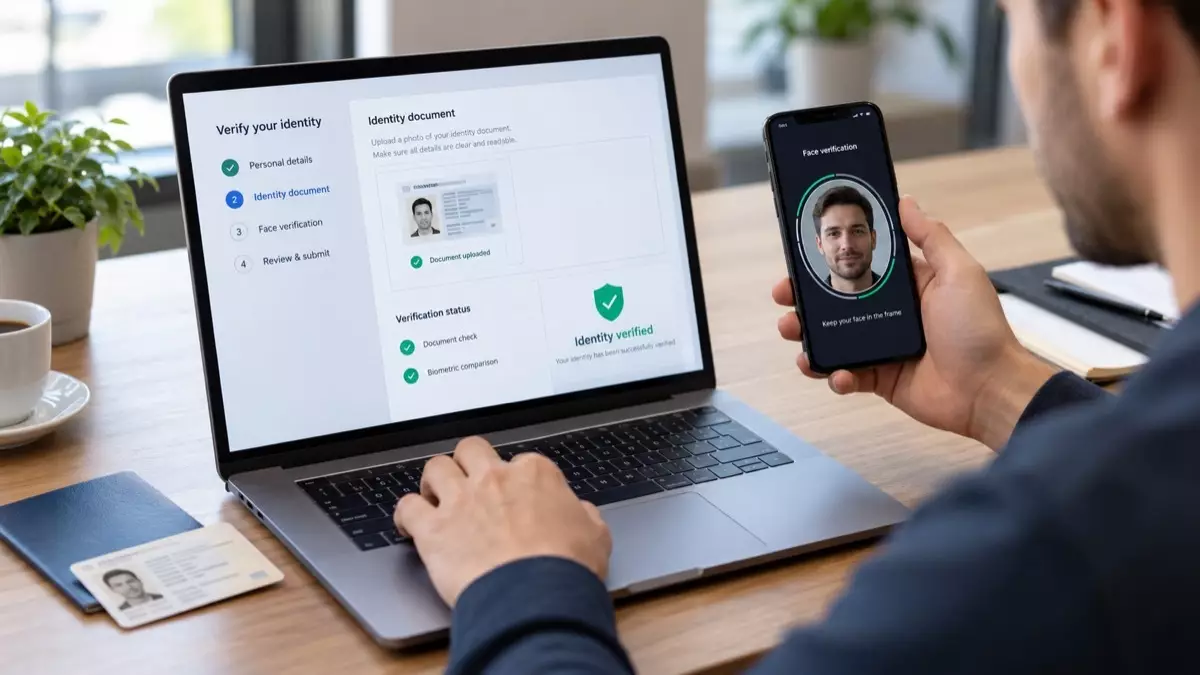
As more services move online, businesses increasingly need reliable ways to establish who their customers are. Opening an account, applying for a financial service, registering for a digital platform or accessing certain services may require an organisation to confirm a person’s identity.
An electronic identity verification, often called eIDV, provides a way to perform these checks digitally. Instead of relying entirely on manual document reviews or face-to-face interactions, organisations can use electronic data and automated matching processes to verify identity information.
When designed properly, eIDV can help organisations balance security, regulatory requirements and a convenient customer experience.
What Is Electronic Identity Verification?
Electronic identity verification is the process of checking information about an individual against trusted data sources to determine whether the identity details provided can be verified.
The process can involve different types of information depending on the organisation, country and purpose of the verification. It may be used as part of customer onboarding, Know Your Customer (KYC) procedures, anti-money laundering (AML) processes, fraud prevention and other compliance workflows.
Rather than treating identity verification as a single check, modern systems can use multiple layers of information to establish whether the details provided are consistent with available records.
1. It Can Make Digital Onboarding Faster
Traditional identity checks can sometimes require manual intervention. Customers may need to submit information, wait for it to be reviewed and provide additional details if something does not match.
Electronic verification can automate parts of this process. When identity information can be checked electronically, organisations may be able to make onboarding faster while reducing unnecessary manual reviews.
This is particularly relevant for businesses where customers expect to register and begin using a service quickly.
2. It Supports KYC and AML Processes
KYC and AML requirements are important considerations for many organisations, particularly in financial services.
Electronic identity verification can form part of these processes by checking customer information against appropriate data sources. Depending on the verification system and use case, additional screening may also be carried out for politically exposed persons (PEPs) and sanctions.
These checks can help organisations identify cases that require further review rather than relying solely on manual processes.
Verification Is Not the Same as a Complete Compliance Programme
It is important to distinguish between identity verification and overall compliance.
An eIDV system can support a compliance process, but organisations still need appropriate policies, risk assessments, recordkeeping and human oversight where required. The right verification process will depend on the organisation, jurisdiction and level of risk involved.
3. It Can Help Reduce Fraud Risks
Identity-related fraud can be a concern for businesses operating online. Someone may attempt to create an account using false, stolen or inconsistent information.
Electronic verification can compare identity attributes against trusted data and identify information that does not appear to match.
Some systems are designed to use multiple data sources rather than relying on a single database. This can provide a broader basis for verification and potentially reduce unnecessary false positives.
4. It Can Reduce Unnecessary Manual Reviews
Not every verification case needs the same level of investigation.
A well-designed system can automatically process straightforward cases while identifying situations that may need additional attention. This can allow compliance teams to focus their time on cases that require human judgement.
Automated matching is particularly useful when an organisation handles a large number of customer applications.
5. Global Services Need Flexible Verification
Digital businesses may serve customers across multiple countries. Identity information can vary significantly between jurisdictions, including differences in databases, naming conventions and available records.
A global eIDV approach can help organisations adapt their verification processes to different markets rather than applying one rigid process everywhere.
This is especially relevant to financial services, telecommunications, online platforms, healthcare, education and other industries with international users.
6. It Can Improve the Customer Experience
Security checks can sometimes create frustration when they are slow, repetitive or difficult to understand.
Electronic verification can reduce some of this friction by automating checks that would otherwise require manual processing. The goal is not simply to make verification stricter, but to make the process efficient while maintaining appropriate controls.
A smoother onboarding experience can be particularly valuable for digital services where customers expect quick registration.
7. Different Industries Can Use eIDV in Different Ways
Electronic identity verification has applications across many sectors.
Financial Services
Banks, fintech companies and other financial platforms can use identity verification during customer onboarding and KYC processes.
Telecommunications
Telecommunications providers can use identity checks during activities such as account creation, SIM registration and activation.
Healthcare
Healthcare organisations can use identity verification to support accurate patient records and secure access to digital services.
Education
Schools, universities and education platforms may use identity checks when registering students or applicants.
Retail and Online Services
Online businesses can use verification to support account registration, customer protection and fraud prevention.
These examples show that eIDV is not limited to one type of business. Its role depends on the information an organisation needs to verify and the risks associated with its services.
8. A Layered Approach Can Be More Practical
Identity verification does not necessarily need to rely on one universal check for every customer.
Organisations can consider different verification requirements based on factors such as the service being accessed, location, customer journey and risk level. A lower-risk interaction may require a simpler process, while a higher-risk activity may require additional checks.
This type of flexible approach can help organisations avoid making every customer go through unnecessarily complicated verification procedures.
Conclusion
Electronic identity verification has become an important part of the digital customer journey. It can help organisations confirm identity information, support KYC and AML processes, reduce certain fraud risks and make online onboarding more efficient.
However, effective eIDV is about more than simply matching a name against a database. Organisations need reliable data, appropriate verification methods and processes that account for different levels of risk.
When these elements are combined thoughtfully, electronic identity verification can provide a practical balance between security, compliance and a smoother digital experience.