

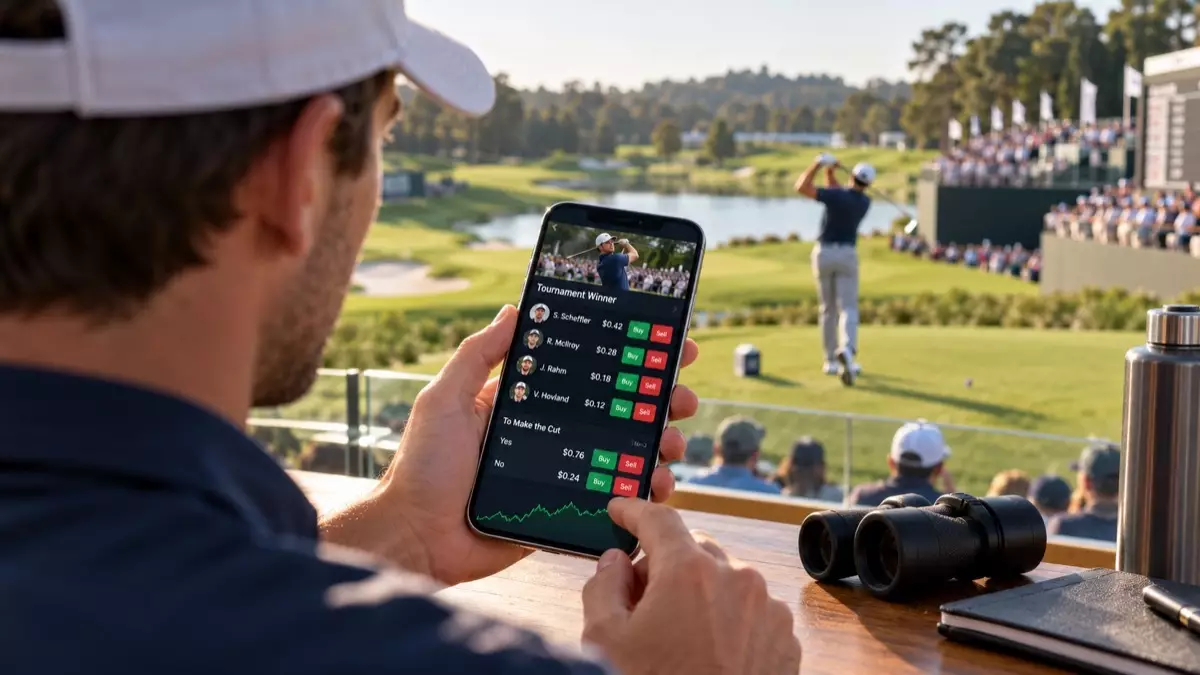
Event contracts have moved from a niche instrument to a mainstream product category in a short space of time. Politics gave them cultural visibility, but sports gave them volume.
Golf is a useful place to understand how they actually work, because the sport’s structure makes the underlying mechanics unusually visible. If you have followed how the category grew through election cycles and Super Bowl trading windows, golf offers a slower, more legible version of the same machinery.
This guide covers how a golf contract is constructed, where its price comes from, how the category compares with macro and crypto markets, and what the regulatory framework means in practice.
Why Golf Suits Event Contracts
Three features of the sport map neatly onto how event contracts function.
Discrete, verifiable outcomes. A tournament produces an unambiguous winner, a cut line, and a finishing order. There is no interpretation required at settlement, which is the first requirement for any contract to work.
A long resolution window. Four rounds across four days means positions can be opened, adjusted and closed over an extended period. Compare that with a single match, where the window is a few hours.
Continuous information flow. Shot-by-shot scoring, weather, tee time draws and course conditions all produce new information throughout the event. Prices respond to each of these, which is what makes the probability estimate meaningful rather than static.
How a Golf Contract Is Structured
A contract is tied to a specific question with a binary answer.
Will this player win the tournament?
Will this player finish ahead of that one?
Will this team win the match play event?
Each contract settles at a fixed value if the answer is yes, and at zero if it is no. The price between those two points expresses the market’s current estimate of probability.
A contract trading at $0.30 implies roughly a 30% chance of the outcome. If the price moves to $0.45 during Saturday’s round, the market has revised its estimate upward, and a position opened earlier can be closed at the new level.
The two-sided structure matters. You can sell a contract as well as buy one. Taking a position that a heavily favoured player will not win is as available as backing one who will, which is a different proposition from a one-directional product.
Where the Price Comes From
Order-driven rather than posted
Prices emerge from participants trading against each other. There is no house setting a number and adjusting it to balance exposure.
That distinction has practical consequences. Spreads reflect the depth of participation in a given market, and a thinly traded contract on an obscure player will behave differently from a heavily traded contract on a major championship favourite.
What moves a golf price
- Live scoring, which repices the board continuously during rounds
- Tee time draws, where morning and afternoon conditions can advantage half the field
- Weather forecasts, particularly wind, which affects scoring more in golf than in most sports
- Withdrawals and injury news, which redistribute probability across the remaining field
- Course setup changes between rounds, including pin positions and rough length
The Market Types Available
Most venues offering golf prediction markets list several contract types for a single tournament. Fanatics Markets, for example, covers golf alongside twelve other sports and runs market types including moneylines, spreads and props, with the Presidents Cup carrying team-level markets on which side wins.
Outright winner. One contract per player, tied to winning the tournament. Large fields spread probability thinly, so most contracts in this type trade at low prices.
Head-to-head matchups. Two named players, with the question being which finishes higher. This reduces a field-wide problem to a binary comparison, which many participants find easier to price.
Team competitions. Match play events such as the Presidents Cup and the Ryder Cup produce team-level contracts, typically a moneyline on the winning side plus related markets.
Props and derivatives. Contracts on outcomes within the tournament rather than the tournament itself. Round leaders, cut lines and finishing position ranges are common examples.
How Golf Compares With Other Event Categories
If you already follow prediction markets in other categories, the differences are worth knowing before you assume the same approach transfers.
Against macro contracts. An interest rate decision has a handful of possible outcomes and resolves in a single moment. A golf tournament has over a hundred and resolves across four days. Golf offers more opportunities but far more variables.
Against single-match sports. A football match is binary from the outset and concentrates its information into a few hours. Golf spreads the same process across a much longer window.
The Regulatory Framework Behind These Markets
This is the part that separates event contracts from adjacent products, and it is worth understanding before choosing any venue.
Event contracts in the United States fall under the Commodity Futures Trading Commission. Contracts are listed on a designated contract market, and the firm holding customer accounts is registered as a futures commission merchant. That structure is what brings CFTC oversight to a category that could otherwise sit outside established derivatives rules.
Fanatics Markets operates within that framework. Morton St. Trading Investments, LLC, doing business as Fanatics Markets, is registered with the CFTC as a futures commission merchant and is a member of the National Futures Association. Contracts are offered through Crypto.com Derivatives North America under Nadex rules, with contract specifications for sports markets published separately.
What this means practically is that settlement terms are written down, fees are disclosed, and the venue sits inside a supervisory structure. The CFTC also publishes its own educational material on prediction markets, which is worth reading alongside any platform’s own documentation.
Practical Questions to Settle First
A few checks are worth completing before opening a position on any venue.
- Confirm the registration status of both the exchange listing the contracts and the firm holding your account
- Read the contract specification for the specific market, particularly how it settles
- Check what happens on withdrawals, disqualifications and weather-shortened rounds, since golf produces these regularly
- Review the fee disclosure, because costs affect outcomes and sit outside the quoted price
- Understand how exiting a position before settlement works, including how pricing is determined at that point
Understanding the Risks
Trading event contracts involves significant risk and is not appropriate for everyone. Platforms state this directly, and it is worth taking at face value.
Contracts can settle at zero. Prices move against positions as readily as they move in favour of them. Past performance does not indicate future results.
Live data and probabilities displayed on any platform are provided for information and may be delayed or incorrect. They are not a basis for relying on a particular outcome.
Anyone considering participation should read the risk disclosures in full and consider carefully whether these products suit their circumstances.
The Takeaway
Golf turns an already probabilistic sport into contracts that make those probabilities explicit, tradeable and continuously updated.
The mechanics are consistent with event contracts in any other category: a defined question, a binary settlement, an order-driven price, and the ability to close a position before resolution. What changes is the texture, with field size, course dependence and a four-day window all shaping how prices behave.
Before participating, the documentation matters more than the price. Read the contract specifications, the fee disclosure and the risk disclosures, and decide from there.