

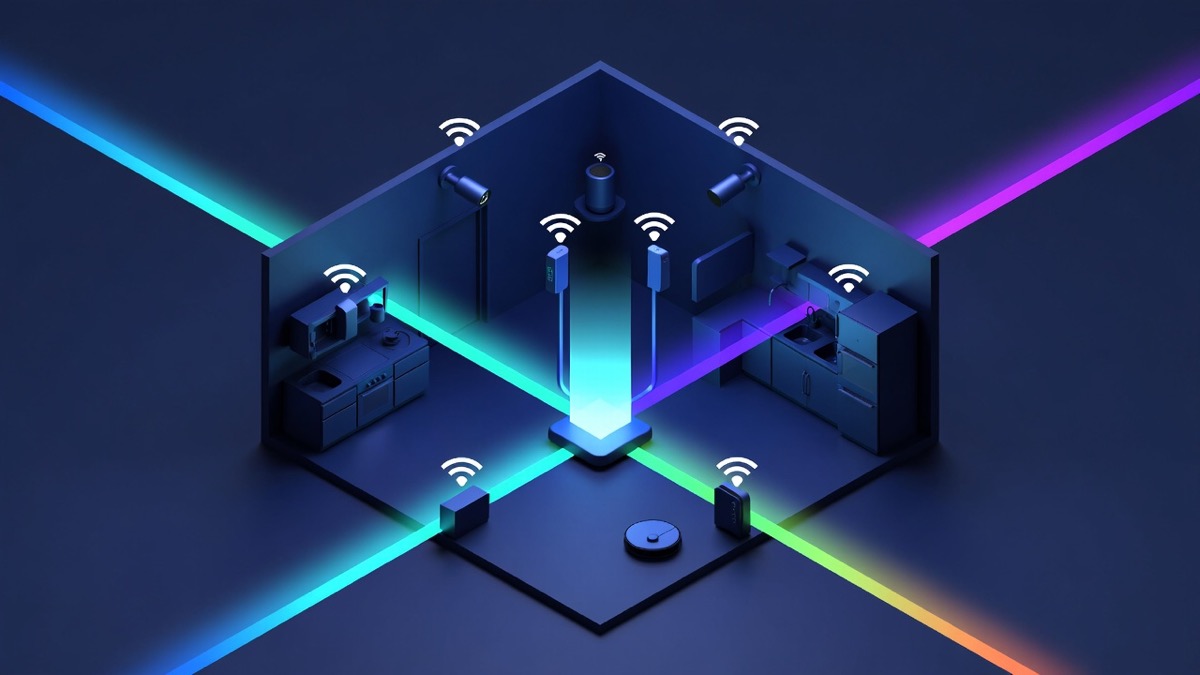
Matter 1.4 shipped in late 2024 with a promise that almost sounded too good: one protocol to bridge Apple, Google, Amazon, Samsung and the long tail of smart home device makers. Two years in, the reality is messier and more interesting than the marketing suggested. Your smart bulb talks to your Apple Home setup without drama, but your robot vacuum still needs three apps to reach its full feature set. Matter works — it just works inside a broader stack of protocols that most buyers never see.
I’ve been rebuilding my own home network three times in the past eighteen months trying to find a setup that actually stays stable through a router reboot. Here’s what I learned about how Matter, Thread, Wi-Fi 7 and the rest actually fit together in 2026, what works well, and where the industry still hasn’t figured it out.
What Matter actually solved (and what it didn’t)
Matter is an application-layer standard. That matters more than the word “standard” suggests. It sits on top of existing wireless protocols (Thread, Wi-Fi, Ethernet) and defines how devices describe themselves and respond to commands. When a Matter-certified light bulb joins your network, every Matter-certified controller on that network understands what it is and how to talk to it. No cloud account, no manufacturer app, no vendor lock-in at the protocol level.
Where Matter genuinely delivered: basic device categories. Lights, plugs, sensors, thermostats, door locks, window coverings. If it fits one of the thirty-odd device types Matter has defined, it works across ecosystems. I swapped an Aqara hub for a Home Assistant Green last spring and my dozen Matter-over-Thread light bulbs migrated in about twelve minutes. That wasn’t possible in 2022.
Where it didn’t deliver: anything complex. Cameras joined the spec late and camera support remains patchy across ecosystems. Robot vacuums, washing machines, ovens — the so-called “major appliances” — have partial Matter support at best. Manufacturers expose a subset of features through Matter and keep the good stuff locked inside their apps, where they can serve ads, collect usage data, and push premium subscriptions. That’s not a Matter failure. It’s a business model problem that no protocol can fix.
Thread vs Wi-Fi: the decision that actually matters for your network
Underneath Matter, Thread is doing the heavy lifting for small devices. It’s a mesh networking protocol built on 802.15.4 (the same radio layer as Zigbee), designed for low power and low latency. Battery-powered sensors that used to die in six weeks on Wi-Fi now run two years on Thread. Motion sensors respond in 50-100 milliseconds instead of the half-second lag that killed so many early smart home setups.
The catch: Thread needs border routers. These are devices that bridge your Thread mesh to your Wi-Fi/IP network. Apple HomePod mini, Apple TV 4K, Google Nest Hub 2nd gen, Amazon Echo 4th gen, Samsung SmartThings Station — they all include border routers now. In principle, multiple border routers from different vendors cooperate on a single Thread network. In practice, this worked unreliably until Thread 1.4 rolled out in mid-2025. It still requires firmware updates on every device involved and an afternoon of patience.
For anything that needs bandwidth (cameras, TVs, speakers), Wi-Fi remains the backbone. Wi-Fi 7 shipped in consumer routers through 2024-2025, and the 6 GHz band is where smart home video traffic should live if you can afford the equipment. The problem is most smart home devices still ship with Wi-Fi 5 or 6 radios, stuck on 2.4 GHz, crowding a band already saturated by microwaves, Bluetooth, and your neighbors’ networks. Buyer advice I’ve given friends more times than I can count: separate your smart home devices onto their own SSID on 2.4 GHz, keep Wi-Fi 6/7 and 5/6 GHz clean for streaming and work.
Cameras, privacy and the cloud question
Smart home cameras are where the 2026 privacy conversation is getting real. The FTC’s January 2025 action against a major camera vendor for retaining footage past stated deletion windows put the industry on notice. European regulators pushed harder — the Irish DPC’s July 2025 ruling against another vendor cost them €47 million and forced architectural changes across their camera line.
What changed practically: more cameras now offer local-first processing. Motion detection, person/vehicle/pet differentiation, even facial recognition now run on-device on chips that didn’t exist at consumer prices in 2023. Cloud becomes optional for most features. This is the single biggest win for privacy-conscious buyers, and it’s also why Matter’s camera spec (still lagging) matters less than the hardware shift.
Buyer reality check: before you drop money on a camera that claims “local processing,” verify it actually works offline. I’ve tested four models this year that advertised local AI and still pinged their cloud every thirty seconds for telemetry. AirAvis had a useful teardown of a popular mid-range camera’s traffic patterns that saved me from a purchase I was about to make — the level of network-capture detail in their reviews is rare in the consumer press. Worth checking before you commit to any connected device over $150.
The kitchen is the last frontier (and it’s going badly)
If you want to see smart home tech at its most frustrating, look at kitchen appliances. Ovens, induction cooktops, refrigerators, espresso machines — the feature sets available through manufacturer apps are often extensive, but cross-ecosystem integration is dreadful. A smart oven from one vendor might work with Google Home but not Apple Home. A high-end fridge might expose inventory tracking through one assistant but not schedule-based temperature changes.
The underlying issue is cost. Oven manufacturers have razor-thin margins on the hardware. They’d love to recoup through connected services, app subscriptions, recipe marketplaces. Matter standardization threatens that plan. So they drag their feet on certifications, ship half-implementations, and keep premium features behind their walled apps. Expect this to keep going through at least 2027.
One bright spot: recipe integration with cooking appliances is starting to work. If your oven speaks your preferred assistant’s language, you can send a recipe from a recipe site or app directly to preheat the oven and set timers. Mr Recettes has been experimenting with this workflow and their recipe pages now include direct-send buttons for compatible ovens — still rough, but the direction is right. The dream of “click this recipe, your kitchen gets ready” is finally within reach for probably 20% of households with the right appliance combinations.
Home AI: where voice assistants stopped being toys
Alexa, Google Assistant and Siri all got large language model upgrades in 2024-2025. The results range from genuinely useful to embarrassingly broken. Alexa+ (Amazon’s premium tier) can now handle multi-step requests like “check the weather for Saturday, if it’s below 15°C set the thermostat to 21 for the morning, and add gloves to my shopping list.” That’s a real capability shift from 2023. The problem is you pay for it, and the free tier has degraded in subtle ways to push adoption.
Gemini on Google Home devices is probably the most capable generalist right now — answering contextual questions, controlling devices across rooms, reasoning about conditional routines. Siri is closing the gap with Apple Intelligence, particularly for HomeKit-integrated setups, but still feels clumsy compared to the alternatives.
The darker side: all three vendors have expanded what their assistants “understand” about household routines, purchases, schedules and family members. Some of that data processing is now local, but the line between local and cloud is deliberately opaque in the settings UIs. If data minimization matters to you, Home Assistant with a local LLM (Llama or similar) is doable in 2026 and getting easier — it was painful a year ago and requires a reasonably technical owner, but the community tooling has caught up. It’s still the only setup that gives you real privacy guarantees.
Beyond the home: what connected living really looks like at scale
Step back from individual devices and look at how connected living actually plays out. The highest-spending segment isn’t early adopters anymore — it’s homeowners in the 45-65 range renovating to age in place, who install falls detection, medication reminders, and automated lighting as insurance hedges. That market went from niche to mainstream between 2023 and 2026, and it’s what’s actually funding the industry.
The design side of the smart home conversation is also maturing. For years, smart home tech was visible — hubs on shelves, motion sensors stuck to walls, cameras perched on bookshelves. That’s reversing. Recessed sensors, in-wall speakers, integrated displays hidden behind mirrors. The good interior designers have started treating smart home infrastructure like they treat lighting or HVAC: something planned in, not bolted on. DécorationTendance has been tracking this shift in home integration design, and their coverage of how connected tech is being woven into contemporary interiors is worth following if you’re renovating or building.
There’s also a hobby dimension worth naming. The most engaged smart home users aren’t buying off-the-shelf setups anymore. They’re building custom Home Assistant configurations, flashing open-source firmware on commercial devices (ESPHome, Tasmota), and integrating 3D-printed sensor housings into their homes. The DIY home automation scene overlaps meaningfully with the maker movement — MyHobbyLinks maintains one of the more useful directories of open-source smart home projects, and the ESPHome and Home Assistant communities have turned into gateways for a whole new generation of hardware tinkerers.
What to buy in 2026, what to wait on
Buy now: Matter-over-Thread lighting, smart plugs, door/window sensors, thermostats. The ecosystem is mature enough that cheap Chinese OEM products work as well as premium-brand equivalents. Get a decent border router if you don’t already have one (Apple TV 4K or a Home Assistant Green with a Thread radio are both solid picks).
Wait on: major appliances with “smart” features unless you specifically need them. The protocol fragmentation and the manufacturer business models make these purchases risky for anyone keeping a device 10+ years. Buy the best non-connected appliance you can afford, and layer smart plugs or dedicated sensors around it if you need visibility.
Skip: anything branded “AI-powered” in the smart home space that doesn’t explain what the AI actually does. Most of it is marketing grafted onto 2020 feature sets. The real AI capabilities (local person detection, smart grouping, anomaly alerting) are increasingly table stakes, not premium features.
The smart home in 2026 works better than it ever has. It’s also more fragmented along business-model lines than protocol maximalists predicted. The protocol wars are mostly over. The platform wars are just getting interesting.