

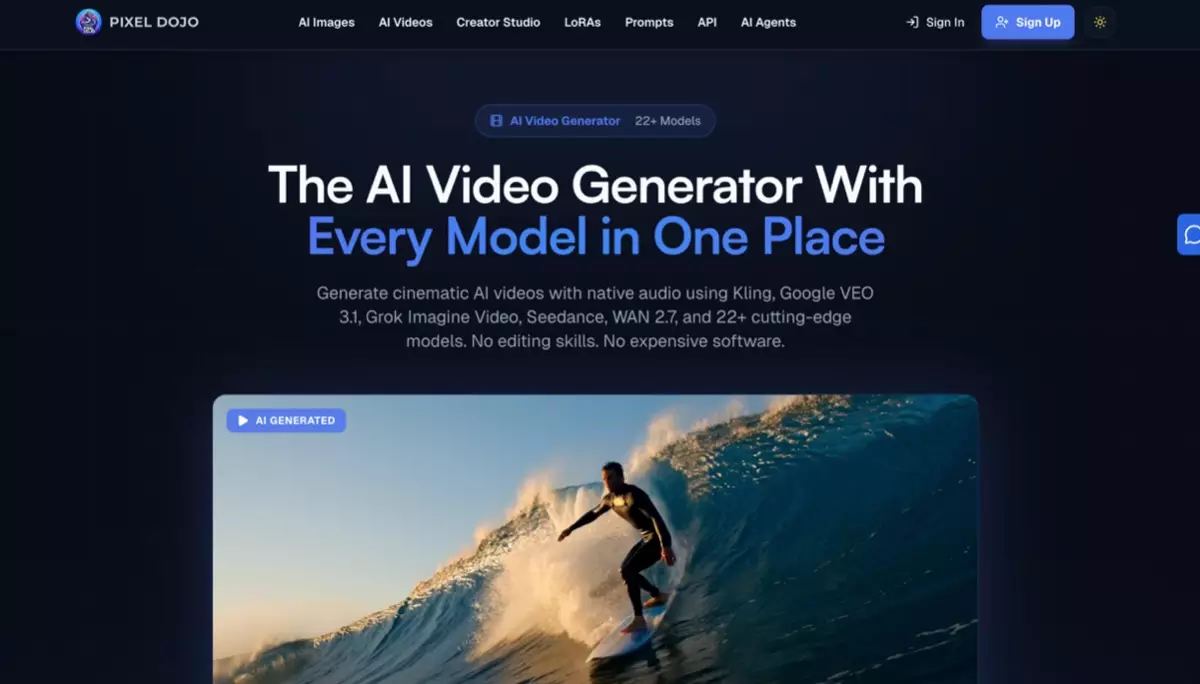
Most small teams hit the same wall. They know video outperforms every other content format on social feeds, landing pages, and email campaigns, but actually producing it has always meant hiring out or burning hours they don’t have.
That’s shifting fast.
With the right AI Video Generator, a two-person marketing team can now ship work that would’ve required a full production crew three years ago.
And it’s not just about speed.
The real shift is in who gets to participate.
The Old Bottleneck Was Never Ideas
Small teams rarely struggle with what to say.
They struggle with getting it on screen.
Traditional video production involves scripting, storyboarding, shooting, editing, color grading, and sound mixing, each step requiring either specialized software knowledge or a freelancer’s invoice.
Even a simple 60-second explainer video could eat up a week and a few thousand dollars.
That bottleneck kept video as a “nice to have” for most lean operations.
Blog posts and static graphics filled the gap because they were achievable, not because they performed better.
The data always pointed toward video.
Engagement rates, click-throughs, and time on page video won on almost every metric that mattered. Small teams just couldn’t afford to play that game consistently.
What Actually Changed
The breakthrough wasn’t one single tool.
It was a convergence: better text-to-video models, affordable editing platforms with built-in AI features, and a general improvement in how these systems handle things like lip sync, scene transitions, and natural motion.
A modern AI video generator can take a script or even a rough prompt and return usable footage in minutes.
Not perfect footage that distinction matters, but footage that’s good enough for Instagram Reels, YouTube Shorts, LinkedIn posts, and internal training materials.
For a small content team publishing three or four videos a week, “good enough at scale” beats “perfect once a quarter” every single time.
There’s also the matter of iteration speed.
When generating a draft takes minutes instead of days, teams can test thumbnails, hooks, and formats without the sunk-cost anxiety that comes with traditional production.
You’re not married to a concept just because you spent $2,000 shooting it.
Where Small Teams Are Using It Right Now
The use cases that have gained the most traction aren’t the flashy ones.
They’re practical, even boring by tech-demo standards.
- Product walkthroughs SaaS companies generating short feature demos without scheduling screen recordings or coordinating with product teams.
- Social media content: Repurposing blog posts and podcast clips into short-form video with AI-generated visuals layered over narration.
- Personalized outreach, Sales teams creating one-off video messages using AI avatars, cutting the time per prospect from 15 minutes to under two.
- Internal training Onboarding videos that used to require an L&D department now get built by whoever wrote the documentation.
None of these replaces a polished brand film or a high-production ad spot.
They don’t need to.
They fill the gaps where video should exist, but previously couldn’t because the cost-to-value ratio didn’t make sense.
The Quality Question Is More Nuanced Than People Think
Critics of AI video tend to fixate on uncanny motion or weird hand artifacts, and those issues are real.
But the quality conversation misses the point for most small teams.
A startup founder recording a Loom walkthrough with bad lighting and a cluttered background isn’t competing with Pixar-level animation.
They’re competing with silence by not having any video at all.
The relevant comparison isn’t AI video versus professional production.
It’s an AI video versus a static image with overlay text, or a blog post nobody reads past the first paragraph.
Framed that way, even a slightly rough AI-generated clip is a massive upgrade.
That said, quality is improving on a curve that’s hard to overstate.
What looked obviously synthetic twelve months ago now passes casual inspection on most social platforms.
Motion consistency, facial expressions, and scene coherence have all taken significant jumps, particularly from models like Sora, Runway Gen-3, and Kling.
What Still Requires a Human Touch
AI video hasn’t eliminated the need for creative judgment; it’s actually made it more important.
When anyone can generate footage, the differentiator becomes editorial taste: knowing which clips to use, how to structure a narrative arc, where to cut, and what tone fits the audience.
Small teams that treat AI video as a “set it and forget it” tool tend to produce generic, forgettable content.
The ones getting results are using it as a starting point, generating raw material, then applying human editing sensibility to shape something that actually connects.
The tool handles the labor.
The person handles the storytelling decisions that make content land.
Script quality matters more than ever, too.
A well-written prompt or script fed into an AI video tool produces dramatically better output than a vague one.
The garbage-in-garbage-out principle hasn’t changed; if anything, it’s more pronounced now because the generation step is so fast that people skip the thinking step.
Practical Advice for Teams Just Getting Started
If you’re running a small team and considering AI video, a few things are worth knowing upfront.
First, start with repurposing.
Don’t try to create original video content from scratch on day one.
Take your best-performing blog post or newsletter and turn it into a 60-second video.
You already know the content works, you’re just changing the format.
Second, pick one platform and one format.
Trying to produce YouTube long-form, TikTok shorts, and LinkedIn clips simultaneously will dilute your effort.
Choose the channel where your audience actually lives and build a rhythm there before expanding.
Third, don’t over-polish early on.
The teams that move fastest treat their first dozen AI videos as learning reps, not portfolio pieces.
Volume teaches you what works better than any tutorial.
You’ll develop a feel for prompting, pacing, and editing that no amount of planning can substitute for.
The Bigger Picture
AI video isn’t a gimmick or a shortcut.
For small teams, it’s an equalizer, a way to compete on a format that used to be gated by budget and headcount.
The teams that figure out how to blend AI generation with genuine creative intent are already outproducing competitors twice their size.
The technology will keep improving.
But the advantage right now belongs to the teams willing to start before everything is perfect, learn by doing, and treat AI video as one more tool in a broader content operation, not a magic button, but a genuinely powerful one.