

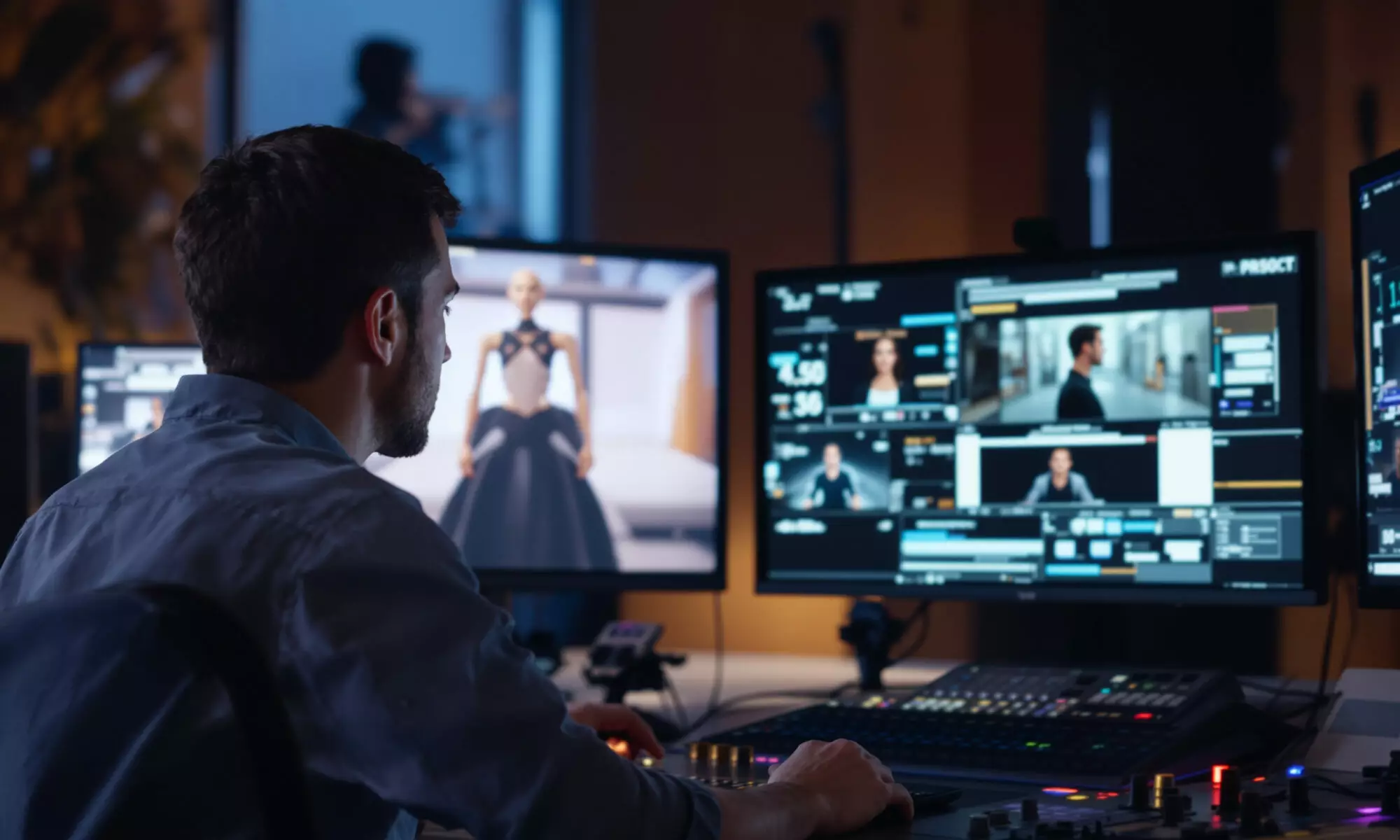
Runway wants real-time AI video to behave less like a rendering queue and more like a live production tool. Its proposed workflow is prompt, stream, steer and correct: frames appear as they’re generated, letting you catch deviations and change direction before a full clip is finished. The idea could transform AI filmmaking, but Runway hasn’t released the general-purpose model or disclosed its speed, resolution, hardware needs or price.
Real-time AI video changes the creative loop
Most generative video systems follow a familiar sequence: submit a prompt, wait, inspect the completed clip and rerun it if something went wrong. Runway described that prompt-to-finished-video process on September 10, 2026, while presenting research aimed at low time-to-first-frame and streaming output.
The difference isn’t merely faster rendering. Streaming turns generation into an ongoing interaction. You could see a character begin moving incorrectly, adjust the context and have later frames respond without discarding the entire sequence. Runway hasn’t documented the exact steering controls planned for its broader model, so sliders, camera controls or live prompt editing remain possibilities rather than confirmed features.
In practical terms, the proposed loop becomes prompt, stream, steer and correct. That’s a meaningful break from batch generation because review happens during creation rather than afterward. For directors and motion designers, it could make AI feel closer to operating a virtual set than ordering a finished shot.
The shift also fits a wider change in production, where synthetic performers such as AI actor Tilly Norwood are testing Hollywood’s assumptions about authorship, labor and control. Faster output alone won’t settle those questions, but interactive direction would make them harder to ignore.
How Runway turns a video model into a stream
Runway’s September 2026 research starts with a foundation model such as Gen-4.5 and converts it into a causal, frame-by-frame autoregressive generator. Instead of resolving a whole clip through many repeated denoising passes, the distilled model uses only a few generation steps for each frame.
At every autoregressive step, the system receives an initial frame, a caption and latent states created earlier in the sequence. New latent representations then pass through causal video and audio decoders, which can emit media as those representations arrive. Waiting for the complete sequence is no longer a structural requirement.
That design resembles predictive systems more than traditional offline renderers. Each output becomes part of the next input. It’s also why research into smaller, faster models matters: as our analysis of compact AI models in 2026 explains, lower inference demands can matter more than maximum parameter count when response time determines whether an application feels live.
Runway says faster models can consume less GPU time and reduce the cost of each output. Treat that as a direction, not a price promise. The company published no cost-per-minute, frame rate, resolution or hardware figures for its forthcoming general-purpose system as of September 21, 2026.
The hard problem: errors become history
Autoregressive generation carries a nasty weakness. A malformed hand, altered face or misplaced object doesn’t necessarily remain a one-frame defect; it enters the historical context used to construct later frames. Small errors can compound into temporal drift, structural inconsistency or conspicuous visual morphing.
Conventional off-policy training makes the mismatch worse. During training, a student model may receive clean ground-truth context from a teacher or dataset. During inference, it must continue from its own imperfect output, a situation it hasn’t adequately rehearsed.
Runway’s answer is on-policy distillation. The student performs autoregressive rollouts during training, and each student-generated latent is fed into its next step. By learning on flawed trajectories resembling actual inference, the model gets opportunities to recover from its mistakes rather than blindly amplify them.
The company also reports better results from gradually increasing sequence length. Starting with long rollouts can let the student’s output diverge so severely that teacher guidance becomes unstable or irrelevant. Short sequences establish control first; longer ones then train endurance.
There is outside evidence that drift reflects a deeper representational problem. A paper submitted on July 29, 2026 linked compounding error to collapsing effective rank in hidden representations. With representation regularization, its reported VBench Aesthetic Quality score rose from 38.65 to 55.56, while Imaging Quality increased from 44.37 to 72.08. Those are research results, not benchmarks for Runway’s unreleased model, but they support the diagnosis.
What is available now, and what remains research?
The distinction matters. As of September 21, 2026, Runway’s public API listed only gwm1_avatars in its real-time category. That model powers conversational characters and accepts text while returning synchronized video and audio; it isn’t the general-purpose prompt-driven streaming generator described on September 10.
| 2026 offering or research | Availability | Published performance | Published pricing |
|---|---|---|---|
Runway Characters / gwm1_avatars |
Listed in the public real-time API on September 21 | HD at 24 fps; 37 ms effective model time per frame; 1.75-second server-side turn latency | 2 credits upfront plus 2 credits per six seconds; each credit costs $0.01 before tax |
| General-purpose streaming generator | Research announced September 10; not listed as generally available by September 21 | No frame rate, resolution or hardware disclosed | No price disclosed |
| Synchronous stream moderation | Described September 16 | Average moderation latency below 0.5 seconds, according to Runway | No separate price disclosed |
The existing avatar service provides a useful cost calculation. A 60-second conversation consumes the 2-credit upfront charge plus ten six-second blocks at 2 credits each, for 22 credits or $0.22 before tax in 2026. That arithmetic shouldn’t be applied to the forthcoming model; its pricing could differ substantially.
Its timing numbers also reveal a subtle pitfall. At 24 fps, one frame has a 41.7 ms playback budget. The stated 37 ms model time fits within that window by about 4.7 ms, yet users still face 1.75 seconds of server-side turn latency. Real-time throughput and instant responsiveness aren’t the same measurement.
Judge the release by more than frame rate
When the broader real-time AI video model arrives, headline speed won’t tell you whether it works. Shared infrastructure must produce frames at or above playback speed for multiple concurrent sessions, while preserving identities, geometry and motion over longer sequences. A short demonstration can hide failures that emerge after a minute.
You should examine five things before treating it as a production tool:
- Time to first frame, measured separately from sustained frames per second.
- Maximum stable duration before characters, objects or camera geometry drift.
- Resolution and audio quality under actual concurrent server load.
- Which properties can be changed midstream and how quickly the output obeys.
- Credit cost for discarded, corrected and moderated footage, not just saved clips.
Safety adds another live dependency. Runway says its synchronous moderation averages under 0.5 seconds and can halt prohibited output while it is streaming, followed by a contextual check before downloading or sharing. Its disclosed system uses Zentropi’s CoPE-B, described as a LoRA adapter over Gemma-4-26B-A4B-it with 25.2 billion total parameters and 3.8 billion active per forward pass.
Runtime intervention is the sensible approach for media that doesn’t exist until milliseconds before display. It also mirrors the broader move from written rules toward AI governance enforced through runtime controls. Still, sub-half-second moderation could represent many displayed frames at 24 fps, and Runway hasn’t published a detailed account of buffering or what viewers see before a stop.
Abuse deserves equal attention. Interactive synthetic video could improve creative direction, but low-latency faces and voices also sharpen the threat described in reporting on real-time deepfake attacks against businesses. Honestly, a release isn’t ready for sensitive communication merely because its image quality looks convincing.
Why the idea matters even before launch
Runway said on September 16, 2026 that increasingly powerful real-time models were planned for release “in the coming months,” without giving a product name or launch date. Its claim that most pipeline gains come from on-policy rather than off-policy distillation also lacks an independent benchmark or accompanying technical paper.
Skepticism is warranted. Even so, the research identifies the right target: not a marginally shorter wait for a completed clip, but a model that can absorb correction while an imagined scene unfolds. If long-horizon consistency holds, real-time AI video could make iteration dramatically less wasteful.
My view is that recovery matters more than raw speed. A system generating 24 clean frames each second but drifting irreversibly after one mistake is a fast failure. A slightly slower system that recognizes and repairs its own unstable trajectory would be far more useful for filmmaking, advertising, training simulations and interactive characters.
FAQ about Runway’s real-time AI video
Is Runway’s general-purpose real-time video model available?
No. As of September 21, 2026, the public API listed the gwm1_avatars avatar model, while the broader prompt-driven streaming system remained research with a release planned for an unspecified future date.
What does real-time AI video mean?
It means video begins streaming while the model is still generating later frames, ideally at or above playback speed. Runway’s proposed version also allows later output to respond to updated context, creating a stream-and-correct workflow.
How much does Runway Characters cost?
In September 2026, it cost 2 credits upfront and 2 credits per six seconds. At $0.01 per credit before tax, a 60-second session costs $0.22 under the documented pricing formula.
Why does autoregressive video drift?
Each generated frame or latent state conditions what comes next. Errors therefore become part of the model’s context and may compound, causing identity changes, broken geometry or large visual morphs over time.
Can you steer Runway video while it generates?
The research architecture supports subsequent output responding to updated context in principle. Runway hadn’t documented the exact steering interface or controls for its forthcoming general-purpose model by September 21, 2026.
 EN
EN  FR
FR  ES
ES