

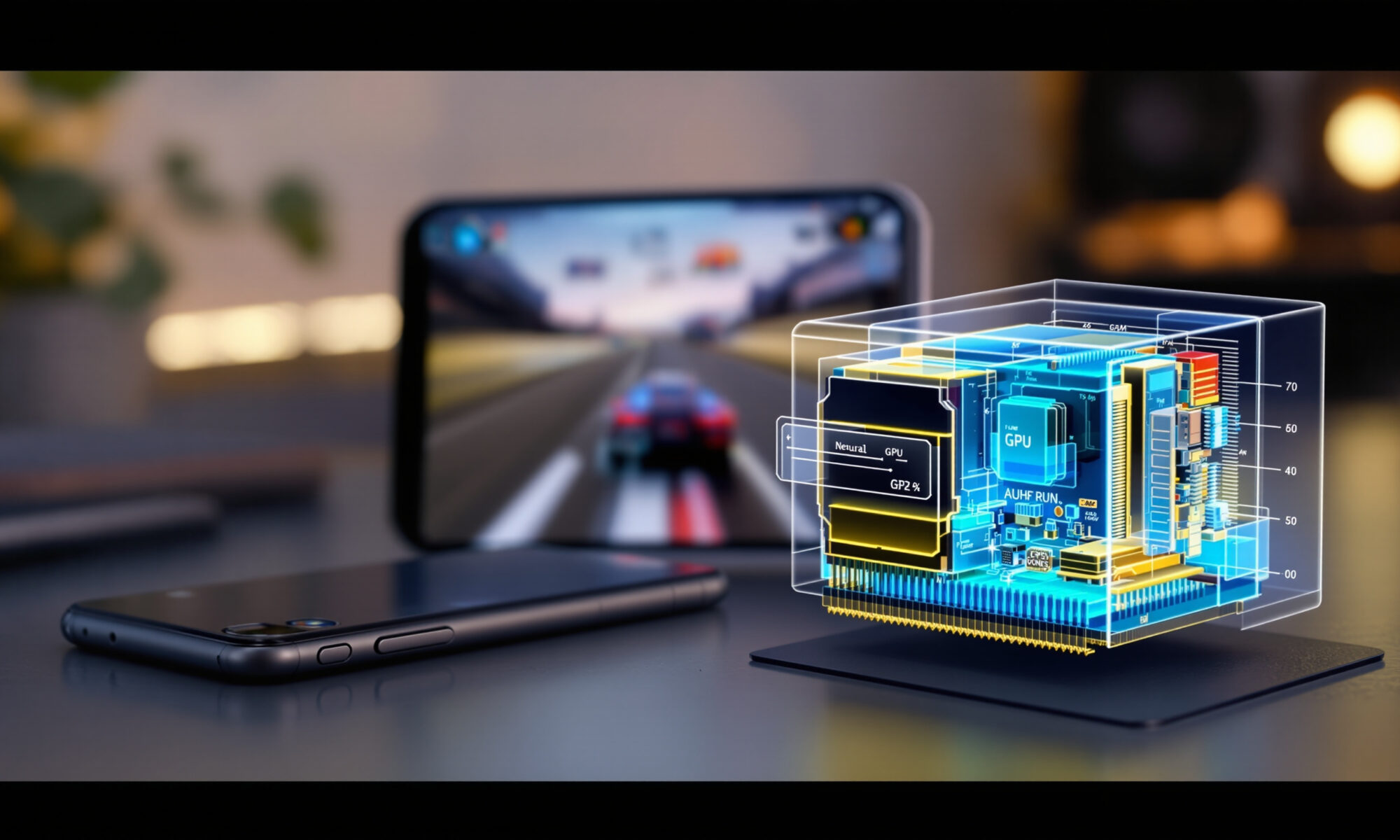
AI Upscaling Is Moving Directly Into Android GPUs because Arm and Qualcomm now want super resolution, denoising, and frame generation to run inside the mobile graphics pipeline, not as a side trip to a separate NPU. The short version: games should get lower latency and better power efficiency, but only when developers support the new tools and phones have enough thermal headroom.
AI Upscaling Is Moving Directly Into Android GPUs: what changed?
Arm made the shift explicit on September 8, 2026, when it announced CSS for Mobile 2 with the Mali G2-Ultra NX GPU. Arm calls it the first “AI-native” Mali GPU, with dedicated neural accelerators built into the GPU and shader-core architecture for mobile graphics workloads.
For you, the phrase matters less than the placement. Neural Super Sampling, Neural Frame Rate Upscaling, and Neural Super Sampling and Denoising are designed to sit close to motion vectors, depth buffers, optical flow, frame history, and render targets. That is the real story.
Android Authority framed the same change on September 7, 2026: Arm’s Mali G2-Ultra brings neural processing directly into mobile GPU architecture for upscaling and frame generation. A day later, Arm’s technical material added the details: INT8 and INT16 neural processing, optical-flow acceleration, shared GPU resources, and third-generation ray tracing.
AI Upscaling Is Moving Directly Into Android GPUs because the old split is becoming awkward. A phone already has an NPU, but graphics frames are born inside the GPU. Sending image data out to another block, then bringing results back, costs time, bandwidth, and power.
Why not just use the phone’s NPU?
An NPU is excellent for many AI jobs: camera segmentation, speech, image classification, small on-device models, and background inference. If you follow on-device AI more broadly, the same pressure toward local computation is visible in Edge AI trends for 2026. Gaming is different because the clock is brutal.
At 60 frames per second, the phone has 16.7 milliseconds to finish a frame. At 120 fps, it has 8.3 milliseconds. If an upscaler adds even 2 ms, that is roughly 12% of a 60 fps frame budget and 24% of a 120 fps budget before the game has drawn a single new pixel.
Qualcomm’s 2024 Snapdragon Game Super Resolution 2 developer material gives a useful anchor. It says the temporal anti-aliasing and upscaling implementation targets under 2 ms on Snapdragon 8 Gen 3 at maximum GPU frequency when scaling to 1260×2800. That is fast, but it also shows why every memory transfer matters.
The hidden pitfall is synchronization. A separate NPU may be free on paper, yet the graphics pipeline can still stall while textures, vectors, or frame history are handed off and returned. Honestly, this is the part many spec-sheet comparisons miss: an idle accelerator doesn’t help if the GPU is waiting at the fence.
The desktop clue: DLSS already proved the architecture
Nvidia supplied the template on PCs. In 2022, DLSS 3 used RTX 40-series Tensor Cores and an Optical Flow Accelerator for AI frame generation. In 2025, DLSS 4 added Multi Frame Generation for RTX 50-series GPUs with fifth-generation Tensor Cores.
The important comparison is not that phones are catching high-end desktop cards. They aren’t. The comparison is architectural: Nvidia colocated AI graphics acceleration in GPU silicon, where the renderer’s data already lives.
Mobile chipmakers are now adapting that idea under tighter constraints. A desktop GeForce card can draw far more power and push heat into a large cooler; an Android phone has a thin chassis, a small battery, and your hand acting as the thermal complaint department. AI Upscaling Is Moving Directly Into Android GPUs, but mobile silicon has much less room for waste.
Arm’s 2026 claim of up to 4x higher performance per watt for neural graphics with Mali G2-Ultra NX plus Arm Neural Technology is therefore more meaningful than a raw performance boast. Performance per watt is the metric that decides whether a feature survives a 20-minute gaming session.
| Technology | Year | Where AI graphics work runs | Named capabilities | Practical read |
|---|---|---|---|---|
| Arm Mali G2-Ultra NX with Arm Neural Technology | 2026 | Dedicated neural acceleration inside GPU/shader-core architecture | Neural Super Sampling, Neural Frame Rate Upscaling, denoising, optical flow, INT8/INT16 | Designed for GPU-side mobile upscaling and frame generation |
| Qualcomm Adreno Neural Fusion | 2025/2026 roadmap | Unified Adreno graphics pipeline spanning neural processing, GPU, CPU, and NPU resources | AI super resolution and frame generation | Qualcomm is also moving AI rendering closer to graphics execution |
| Snapdragon Game Super Resolution 2 | 2024 | Adreno-optimized GPU implementation | Temporal anti-aliasing and upscaling | Developer target under 2 ms on Snapdragon 8 Gen 3 at maximum GPU frequency for 1260×2800 scaling |
| Nvidia DLSS 3 | 2022 | RTX 40-series Tensor Cores plus Optical Flow Accelerator | AI frame generation | Desktop proof point for colocated neural graphics hardware |
| Nvidia DLSS 4 | 2025 | RTX 50-series fifth-generation Tensor Cores | Multi Frame Generation | Shows how dedicated GPU-side AI blocks can become a platform feature |
What frame generation on Android actually needs
Arm says Neural Frame Rate Upscaling uses rendered frames plus motion and depth data to generate intermediate frames for smoother gameplay. That sounds simple until you remember how messy real game scenes are. Thin geometry, particles, UI overlays, reflections, and fast camera pans are exactly where generated frames can look wrong.
A racing game is a friendly case. Motion is directional, frame pacing tends to be predictable, and road surfaces hide minor reconstruction errors. A twitch shooter with transparent effects, weapon sway, and rapidly changing HUD elements is much less forgiving.
Ray tracing adds another layer. PC Gamer reported on June 12, 2026, that Arm’s neural graphics demo with Sumo Digital showed ray tracing, AI denoising, and frame generation on mobile and handheld-class hardware. Denoising is a natural partner for upscaling because ray-traced mobile scenes often cannot afford huge sample counts.
There’s a counter-argument, though: generated frames don’t make the game simulation run faster. If a game renders at 40 fps and inserts frames to appear closer to 80 fps, animation may look smoother, but input response still depends heavily on the real rendered frame cadence. Pretty motion is not the same as lower input latency.
Battery and heat: the calculation that matters
AI Upscaling Is Moving Directly Into Android GPUs partly because rendering fewer native pixels can save work. Suppose a game targets a 1260×2800 display output, about 3.53 million pixels. Rendering internally at 900×2000 is 1.8 million pixels, roughly 51% of the output pixel count, before the upscaler reconstructs the final image.
That gap is the opportunity. If shading, bandwidth, and post-processing scale with internal resolution, the GPU has less conventional rendering work to do. But the upscaler is not free, and frame generation adds optical-flow and neural processing cost on top.
On a phone, the winning setup is not always the highest advertised mode. A balanced preset that renders at a sensible internal resolution, uses super resolution, and avoids aggressive frame generation may hold steady performance longer than a showy mode that spikes heat in the first five minutes. At this size and power envelope, sustained behavior beats a benchmark screenshot.
If you’re choosing a handset for gaming, the broader phone market still matters: cooling design, battery capacity, and software update cadence can matter as much as GPU branding. Our guide to budget smartphones in 2026 is a useful reminder that a newer chip in a badly cooled body can disappoint.
Developer support will decide how fast you see it
Hardware announcements don’t automatically improve your games. Developers need SDKs, engine integrations, QA time, and confidence that enough phones will support the feature. Android Central reported in 2026 that Arm’s Neural Graphics Development Kit was available in early access and that Mali-only support could limit near-term Android device coverage.
Qualcomm is pursuing its own path. On September 2, 2026, the company said Adreno Neural Fusion extends Adreno Matrix acceleration across NPU, CPU, and now GPU, bringing neural processing, AI super resolution, and frame generation into a unified graphics pipeline. That helps Snapdragon devices, but it also means Android developers may face multiple vendor paths.
The practical checklist for a game studio is short but demanding:
- Pick the target devices and GPU families before committing to a neural rendering path.
- Test native rendering resolution against upscaled output, not just peak frame rate.
- Measure frame pacing, input latency, heat, and battery drain over long sessions.
- Handle UI, particles, and transparent effects separately when frame generation creates artifacts.
- Keep a clean fallback for phones without Mali G2-Ultra NX, Adreno Neural Fusion, or similar support.
Smaller on-device models may also matter because mobile graphics features cannot afford bloated inference workloads. The same logic behind smaller AI models in 2026 applies here in miniature: compact, specialized models often win when latency and power are tight.
Android’s update rhythm is another gating factor. A feature can ship in silicon and still wait on drivers, game engines, and OS-level compatibility work; the cadence around recent Android platform changes shows how much of the user experience depends on rollout timing, not just chip design.
What it means for you before buying a phone
AI Upscaling Is Moving Directly Into Android GPUs, but you shouldn’t buy only on that sentence. Look for named support from the chip vendor, real game announcements, and independent long-session tests. A demo is evidence of direction, not proof of everyday quality.
Arm’s CSS for Mobile 2 package includes the Arm C2 CPU cluster, Mali G2-Ultra NX GPU, enhanced system IP, physical implementations, and a developer-ready software ecosystem. That sounds broad, and it is. Still, phone makers choose configurations, cooling, memory, and software policies, so two devices based on similar IP can behave very differently.
Qualcomm’s Adreno roadmap points the same way from another camp. The more both major Android GPU ecosystems converge on GPU-pipeline AI rendering, the more likely engines such as Unity and Unreal will treat super resolution and frame generation as normal mobile options rather than exotic vendor demos.
My read: the first wave will be uneven. Flagship phones and gaming handhelds should benefit first, especially in titles built with these techniques in mind. Midrange devices may get simpler super resolution before convincing frame generation, because thermal budget is where marketing language meets physics.
FAQ
Is AI Upscaling Is Moving Directly Into Android GPUs good for battery life?
It can be, if the game renders at a lower internal resolution and the neural upscaler costs less than the pixels it saves. In 2026, Arm claims up to 4x higher performance per watt for neural graphics with Mali G2-Ultra NX plus Arm Neural Technology, but real battery gains will depend on the phone and game.
Will Android AI upscaling work in every game?
No. Games need developer support, engine integration, drivers, and a fallback path for unsupported phones. Early coverage may be limited by GPU vendor and device generation.
Is Android frame generation the same as Nvidia DLSS?
It is similar in concept, not identical in implementation or performance. Nvidia DLSS runs on desktop RTX hardware with Tensor Cores, while Arm and Qualcomm are adapting GPU-side neural rendering for phone-class power and heat limits.
Does frame generation reduce input lag?
Not by itself. Generated frames can make motion look smoother, but input response still depends on how often the game renders real frames and how the pipeline handles latency.
 EN
EN  FR
FR  ES
ES