

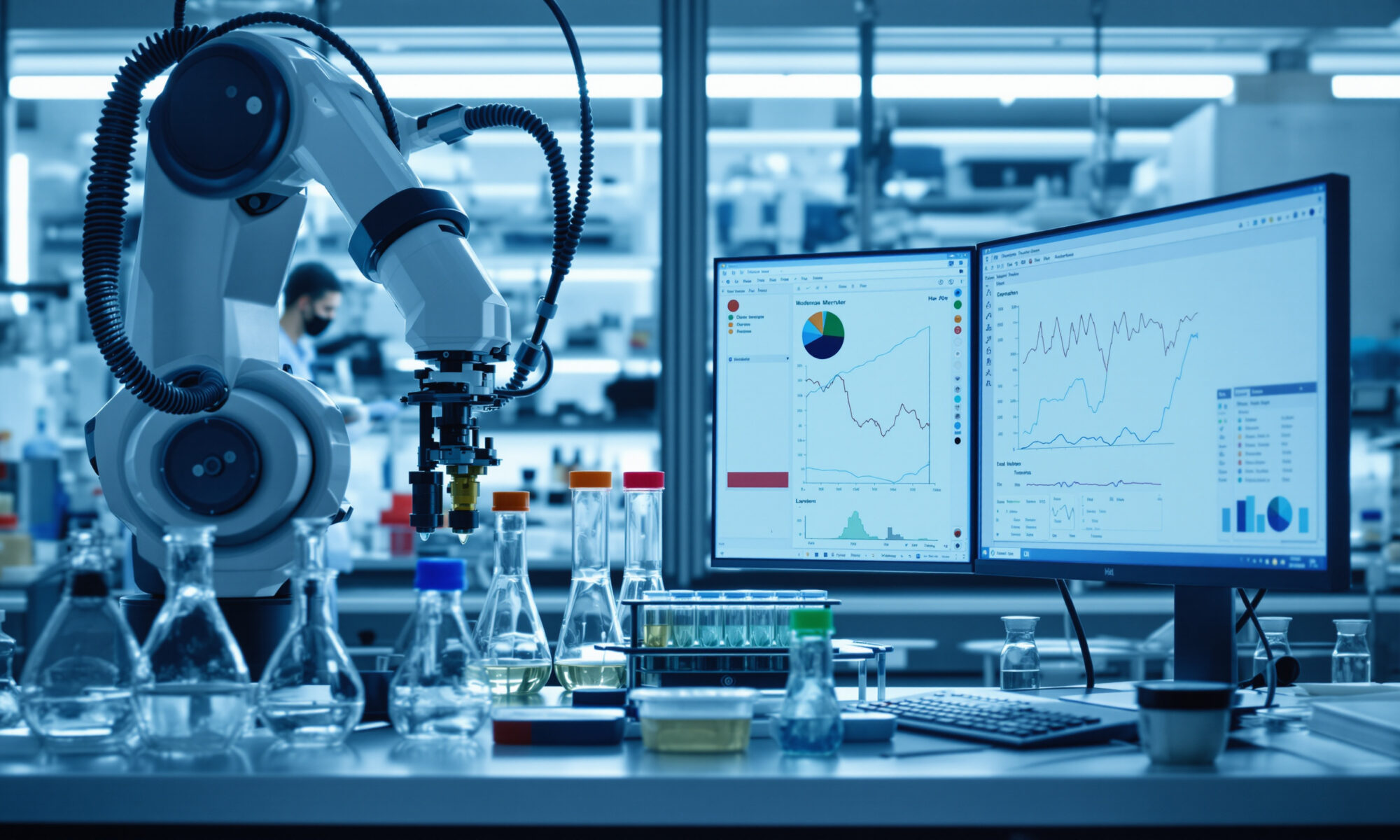
AI scientific discovery now means more than summarizing papers. By 2026, leading systems can generate hypotheses, write scientific code, propose experiments, and in some labs help control instruments. The strongest evidence comes from Google’s Co-Scientist, Carnegie Mellon’s Coscientist, Microsoft Research’s AI for Science work, and the rise of self-driving labs in chemistry, materials, and biology.
AI scientific discovery in 2026: what has actually changed?
The shift is practical, not mystical. AI scientific discovery used to mean better literature search, protein-structure prediction, or faster simulations; now the frontier is agentic software that can plan work, critique its own ideas, call tools, and hand tasks to automated lab equipment.
Google’s 2026 Nature paper on Co-Scientist described a Gemini-based multi-agent partner that iteratively generates, debates, and evolves hypotheses for complex scientific problems. A year earlier, Google had introduced an AI co-scientist built with Gemini 2.0 for biomedical hypothesis generation, with an arXiv paper reporting that it recapitulated unpublished experimental results for a bacterial gene-transfer mechanism.
Carnegie Mellon showed the lab-control side in 2023 with Coscientist, published in Nature. It combined multiple large language models and could design, plan, and perform chemistry experiments, including reading cloud-lab documentation and controlling liquid-handling instruments.
Microsoft Research is pushing from another angle. In 2025 and 2026, its AI for Science group described work across machine learning, quantum physics, computational chemistry, molecular biology, climate modeling, molecular dynamics, materials design, and drug discovery. Peter Lee, Microsoft Research president, forecast in 2026 that AI would move beyond summarizing papers into generating hypotheses, using tools that control experiments, and acting as AI lab assistants.
If you follow model development more broadly, the relevant background is the move from chatbots to agents; our comparison of AI browser agents in 2026 shows the same pattern in a less risky setting: software that plans, clicks, checks, and revises instead of merely answering.
Can AI make scientific discoveries?
Yes, but the honest answer is narrower than the hype. AI can help make discoveries when it proposes a testable idea, runs or helps run a valid experiment, and the result survives human review, replication, and domain-specific validation.
Google’s AI co-scientist work is a good example because it did not merely produce plausible prose. The 2025 paper reported novel hypotheses and the ability to recapitulate unpublished experimental results involving bacterial gene transfer. That matters because unpublished results are harder to fake through memorization of public literature.
Still, AI scientific discovery is not the same as an autonomous Nobel laureate in a box. The strongest systems are better described as tireless research partners: they generate many candidate ideas, rank them, debate them internally, write code, or pass instructions to instruments. Humans still choose problems, set safety boundaries, interpret ambiguous results, and take responsibility.
A useful calculation makes the value clearer. Suppose a graduate student can seriously develop three experimental hypotheses per week after reading papers and talking with colleagues. If an AI system proposes 60 candidates in the same period and a scientist discards 90% as weak, six remain for serious review. Even if only one is worth testing, the bottleneck has moved from “having ideas” to “choosing and validating the right idea.” That is a real productivity change, but it’s not magic.
From paper assistant to lab assistant
The first layer is familiar: read papers, summarize methods, compare claims, extract datasets, and draft code. Google announced Gemini for Science in 2026 with experimental tools for Hypothesis Generation, Computational Discovery, a Paper Assistant Tool, and ScholarPeer, aimed at pieces of the research workflow that normally consume weeks of attention.
Computational work is where the gains may show up fastest. Google said in 2025 that Empirical Research Assistance used Gemini to write and optimize scientific code for computational experiments, and in 2026 said it helped build the Computational Discovery prototype available through a trusted tester program in Google Labs.
Then comes the lab bench. Nature Communications defined self-driving labs in 2025 as systems combining automated execution, experiment selection, hypothesis refinement or generation, and collaboration among research groups. That is a much higher bar than a robot arm repeating a protocol.
The same year, another Nature Communications risk paper warned that AI scientist agents were already being deployed in chemistry and biology to design experiments, control laboratory equipment, and make research decisions. Frankly, that warning is overdue. Once an AI can change experimental conditions, buy reagents through a workflow, or steer a robot, the safety discussion has to move from “bad answers” to “bad actions.”
Readers interested in the physical automation side may find the site’s overview of AI-powered robotic technology useful, because self-driving labs are robotics, software, and scientific method fused into one system.
Major AI scientific discovery systems compared
The names sound similar, which is annoying. Google has used “AI co-scientist” for the 2025 Gemini 2.0-based system and “Co-Scientist” for the 2026 Nature system, while Carnegie Mellon’s Coscientist is a separate chemistry agent from 2023.
| System or initiative | Year | Organization | What it does | Domain focus |
|---|---|---|---|---|
| Coscientist | 2023 | Carnegie Mellon University | Designs, plans, and performs chemistry experiments, including control of liquid-handling instruments | Chemistry automation |
| AI co-scientist | 2025 | Google Research, Google DeepMind, Google Cloud AI | Generates hypotheses and research proposals using a Gemini 2.0-based multi-agent system | Biomedical science |
| Co-Scientist | 2026 | Google DeepMind and Google Research | Iteratively generates, debates, and evolves hypotheses for complex scientific problems | General scientific hypothesis work |
| AI for Science | 2025-2026 | Microsoft Research | Applies machine learning to simulations, materials, chemistry, biology, climate, and drug discovery | Cross-disciplinary research |
| MatterSim-MT | 2026 | Microsoft Research | Multi-task simulation of materials properties beyond potential energy surfaces | Materials science |
| The AI Scientist | 2026 | Nature paper on AI research automation | Creates research ideas, writes code, runs experiments, analyzes results, and writes papers | Machine-learning research |
One number-based comparison stands out: these systems attack different bottlenecks. Coscientist targets the physical experiment loop; Google’s Co-Scientist targets hypothesis formation; Microsoft’s MatterSim work targets simulation cost and materials prediction; The AI Scientist targets machine-learning research automation. Calling all of them “AI scientists” hides the part you actually need to evaluate.
Where the best results are likely to appear first
AI scientific discovery will not spread evenly. It favors domains where experiments are digital, heavily instrumented, or easy to standardize. Computational chemistry, molecular dynamics, materials modeling, and some biomedical workflows are natural early winners because data, simulation, and automation already sit close together.
Materials science is especially attractive. Microsoft Research announced MatterSim updates on May 12, 2026, describing faster simulations, links to experimental synthesis, and MatterSim-MT for multi-task materials modeling. The point is not just speed; it is fewer dead-end candidates before a human team spends money and lab time.
Chemistry labs are moving too. C&EN reported on June 25, 2026, that self-driving chemistry labs are changing how chemists work, including new AI-agent and robotics setups. The article cited Atinary Technologies opening a Boston chemistry lab where a human scientist can query an AI agent for routes to make molecules or materials.
Scientific American reported in 2026 that autonomous labs are running experiments around the clock in areas including battery chemistry and cancer therapies. Around-the-clock work sounds glamorous, but the real advantage is consistency: a machine can run the same protocol at 3 a.m. without being tired, impatient, or distracted.
Biomedical AI deserves a separate caution. A hypothesis about cancer therapy or gene transfer can be valuable and still be far from a treatment. For context on how AI is entering medical research without replacing clinical judgment, see this discussion of AI in multiple sclerosis research and care and the report on precision oncology work by ConcertAI and Bayer.
Use AI scientific discovery without fooling yourself
The pitfall few glossy explainers mention is contamination by success criteria. If an AI proposes a hypothesis, writes the code, chooses the experiment, analyzes the output, and drafts the paper, the whole pipeline can become a closed loop that rewards plausible confirmation rather than truth.
Good labs will separate roles. One agent can propose. Another can criticize. A human can define exclusion rules before the run. Independent software can check statistics. External researchers can replicate. Boring controls are where credibility lives.
- Ask what stage the AI controls: literature review, hypothesis generation, code, instrument control, analysis, or writing.
- Demand pre-set evaluation rules: decide what counts as success before the experiment starts.
- Keep raw data accessible: summaries are not enough when an agent may have filtered awkward results.
- Watch reagent and tool permissions: a lab agent should not have open-ended authority to order, mix, or execute.
- Separate novelty from usefulness: a new hypothesis can be trivial, unsafe, or impossible to test.
There is also a labor issue. AI lab assistants may reduce drudgery, but they will change training. If early-career scientists skip the slow work of failed protocols, manual data cleaning, and skeptical reading, they may become excellent prompt managers and poor experimentalists. That trade-off is rarely priced into vendor demos.
For the broader governance question, the useful debate is not whether AI progress should stop. It will not. The harder question is how researchers keep control when systems become more agentic, a theme also raised in this analysis of human control after the AI hype cycle.
What is an AI co-scientist?
An AI co-scientist is an AI system designed to help researchers form, test, and refine scientific ideas rather than merely summarize existing papers. Google’s 2025 AI co-scientist used Gemini 2.0, while the 2026 Co-Scientist described in Nature used a multi-agent process to generate and debate hypotheses.
Is Google Co-Scientist available to researchers?
Google said in 2026 that Co-Scientist would be made available through an experimental Hypothesis Generation tool at labs.google/science. Access was described around research use rather than a general consumer product.
Can AI run lab experiments by itself?
In limited settings, yes. Carnegie Mellon’s 2023 Coscientist controlled liquid-handling instruments for chemistry experiments, and 2025 Nature Communications papers described AI scientist agents and self-driving labs that can select and execute experiments under defined systems.
Will AI replace scientists?
Not in any serious near-term sense. AI can accelerate reading, coding, simulation, hypothesis generation, and some automated experiments, but humans still define problems, judge meaning, handle ethics, and validate claims.
Which fields will benefit most from AI scientific discovery?
The near-term leaders are likely to be computational chemistry, materials science, molecular biology, drug discovery, climate modeling, and machine-learning research. These fields already have data-rich workflows and toolchains that AI agents can use.
 EN
EN  FR
FR  ES
ES