

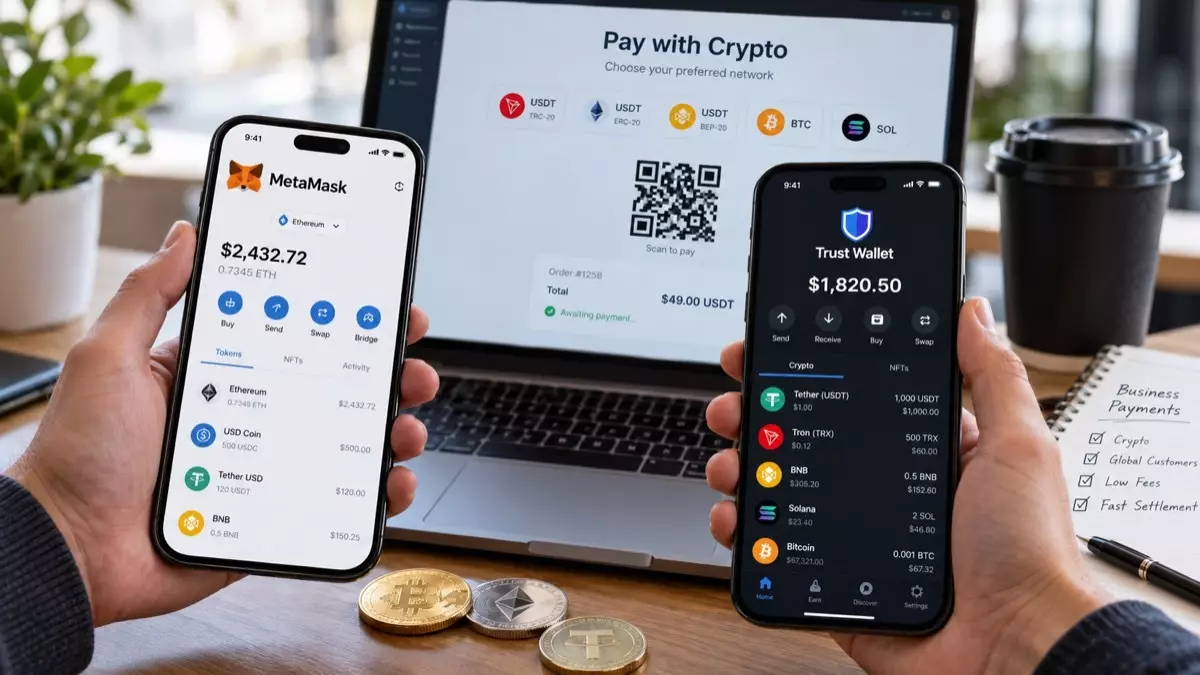
Most comparisons of these two wallets are written for people buying tokens. The criteria change completely when the wallet is going to receive customer payments, because a business cares about which networks its customers actually pay on, whether it can generate a fresh address per order, and how the wallet connects to a payment gateway.
Judged that way, the MetaMask vs Trust Wallet question has a clearer answer than the general reviews suggest — and it turns on network coverage more than on interface or features.
What Each Wallet Was Built For
The two wallets started from different assumptions, and those assumptions still shape them.
MetaMask began as a browser extension for interacting with Ethereum applications. Its design centre is the EVM ecosystem — Ethereum and the chains compatible with it, such as BNB Smart Chain, Polygon and Arbitrum. It has since broadened beyond EVM, but its strengths remain developer tooling, dApp connectivity and fine-grained control over transactions.
Trust Wallet began as a mobile multi-chain wallet. Breadth was the point from the start: it supports Bitcoin, Tron, Solana, the EVM chains and a long list of others in one application, without networks needing to be added manually.
Both are non-custodial. In both cases you hold the seed phrase and the provider cannot move or freeze your funds. That shared property is why either can sit behind a merchant payment setup at all.
Network Support and Stablecoins
For a merchant, this section decides the comparison.
EVM Chains and Beyond
MetaMask handles EVM networks natively and adding a custom one takes a minute. Outside EVM its coverage is narrower, and one gap matters commercially: MetaMask does not support Tron.
Trust Wallet covers Bitcoin, Tron, Solana, BNB Chain, Ethereum and many more out of the box, with no manual network configuration.
Handling USDT Across TRC-20, ERC-20 and BEP-20
USDT is the asset most business customers actually pay with, and it exists on several networks at very different costs.
| Network | Typical USDT transfer cost | Settlement | MetaMask | Trust Wallet |
| BNB Smart Chain (BEP-20) | ~$0.03–0.05 | ~1 second | Yes | Yes |
| Tron (TRC-20) | ~$2 (≈$4 to a new address) | ~1 minute | No | Yes |
| Ethereum (ERC-20) | ~$3–15 | ~13 min to finality | Yes | Yes |
*Costs as of September 2026.*
The practical consequence is direct. TRC-20 carries a very large share of stablecoin payment volume — it is what most customers hold and what most exchanges default to when withdrawing USDT. A merchant using MetaMask alone simply cannot receive on that rail.
If your customers pay in USDT, check which network they use before choosing a wallet. A wallet that cannot receive TRC-20 will push customers onto ERC-20, where a $40 order can carry a $12 network fee — and that is a checkout abandonment problem, not a wallet preference.
Security Model and Key Control
Neither wallet holds your keys, so the security difference is about surface area and workflow rather than custody.
- Seed phrase — both generate a 12-word recovery phrase that is the sole means of recovery. Lose it and funds are unrecoverable in either.
- Attack surface — MetaMask’s browser extension is exposed to malicious sites and fake extensions; Trust Wallet’s mobile-first model avoids that but inherits mobile device risk.
- Hardware wallet support — MetaMask integrates cleanly with Ledger and Trezor, which is the stronger option for holding meaningful balances.
- Transaction visibility — MetaMask shows more granular detail before signing, useful when interacting with contracts.
For a business, the hardware wallet point carries real weight. If payment volume accumulates rather than being swept regularly, pairing a hardware device with MetaMask for EVM holdings is a meaningful upgrade over a hot mobile wallet.
Using Either Wallet to Receive Merchant Payments
Generating Receiving Addresses
Reusing one address for every order makes reconciliation guesswork. The moment two customers pay the same amount within a short window, you cannot tell which order each transaction belongs to.
The solution is a unique address per invoice, derived from an extended public key (xpub). Trust Wallet’s multi-coin HD structure lends itself to this across chains including Bitcoin and Tron. MetaMask’s account model is oriented around EVM accounts, where a single address per chain is the norm and per-order derivation is less natural.
This is why most merchants do not use the wallet interface directly for order attribution — they let a gateway handle derivation.
Connecting to a Payment Gateway
In a non-custodial setup the gateway never holds funds. You provide an xpub or receiving addresses; the gateway derives a fresh address per order, watches the blockchain, and notifies your store when a payment confirms. The money goes straight from the customer to your wallet.
The flow in practice:
- Export the xpub or receiving address from your wallet.
- Connect it in the gateway dashboard for each network you accept.
- The gateway generates a unique address per order at checkout.
- The customer pays; funds land in your wallet directly.
- A signed callback tells your store to mark the order paid.
Bcon Global works this way across Bitcoin, Ethereum, Solana, Tron and BNB Chain plus major stablecoins — merchants connect their own wallet, keep the keys, and pay a flat 1% with no KYC and no intermediary balance. Because both MetaMask and Trust Wallet are non-custodial, either can sit on the receiving end; the constraint is only which networks your chosen wallet can actually hold.
Which One Should a Business Choose?
| Requirement | Better choice |
| Receiving USDT on Tron (TRC-20) | Trust Wallet |
| Widest network coverage in one app | Trust Wallet |
| EVM-focused operations and dApps | MetaMask |
| Hardware wallet pairing | MetaMask |
| Mobile-first, non-technical team | Trust Wallet |
| Granular pre-signing transaction detail | MetaMask |
A workable pattern for merchants handling real volume is to use both: Trust Wallet as the receiving wallet for broad network coverage including Tron, and MetaMask paired with a hardware device for EVM funds held longer term. Sweep from the hot receiving wallet to cold storage on a schedule rather than letting balances accumulate.
FAQ
Can I use MetaMask to receive USDT on Tron?
No. MetaMask does not support the Tron network. For TRC-20 you need a wallet with native Tron support, such as Trust Wallet.
Are both wallets non-custodial?
Yes. Both give you the seed phrase and neither can access or freeze your funds.
Which is safer for a business?
Neither is inherently safer — both are non-custodial and depend on your seed phrase handling. MetaMask’s hardware wallet support gives it an edge for larger balances.
Do I need a separate wallet for each cryptocurrency?
No. Trust Wallet holds many chains in one app; MetaMask covers EVM chains plus a narrower set beyond them.
Can I connect either to a crypto payment gateway?
Yes. A non-custodial gateway needs only a receiving address or xpub, which both wallets can provide for the networks they support.
Final Thoughts
For general crypto use, this comparison comes down to preference. For receiving business payments, it comes down to one question: can the wallet hold the assets on the networks your customers actually pay with?
If USDT on Tron is part of that answer — and for most merchants it is — Trust Wallet covers it and MetaMask does not. Everything else in the comparison is secondary to that.