

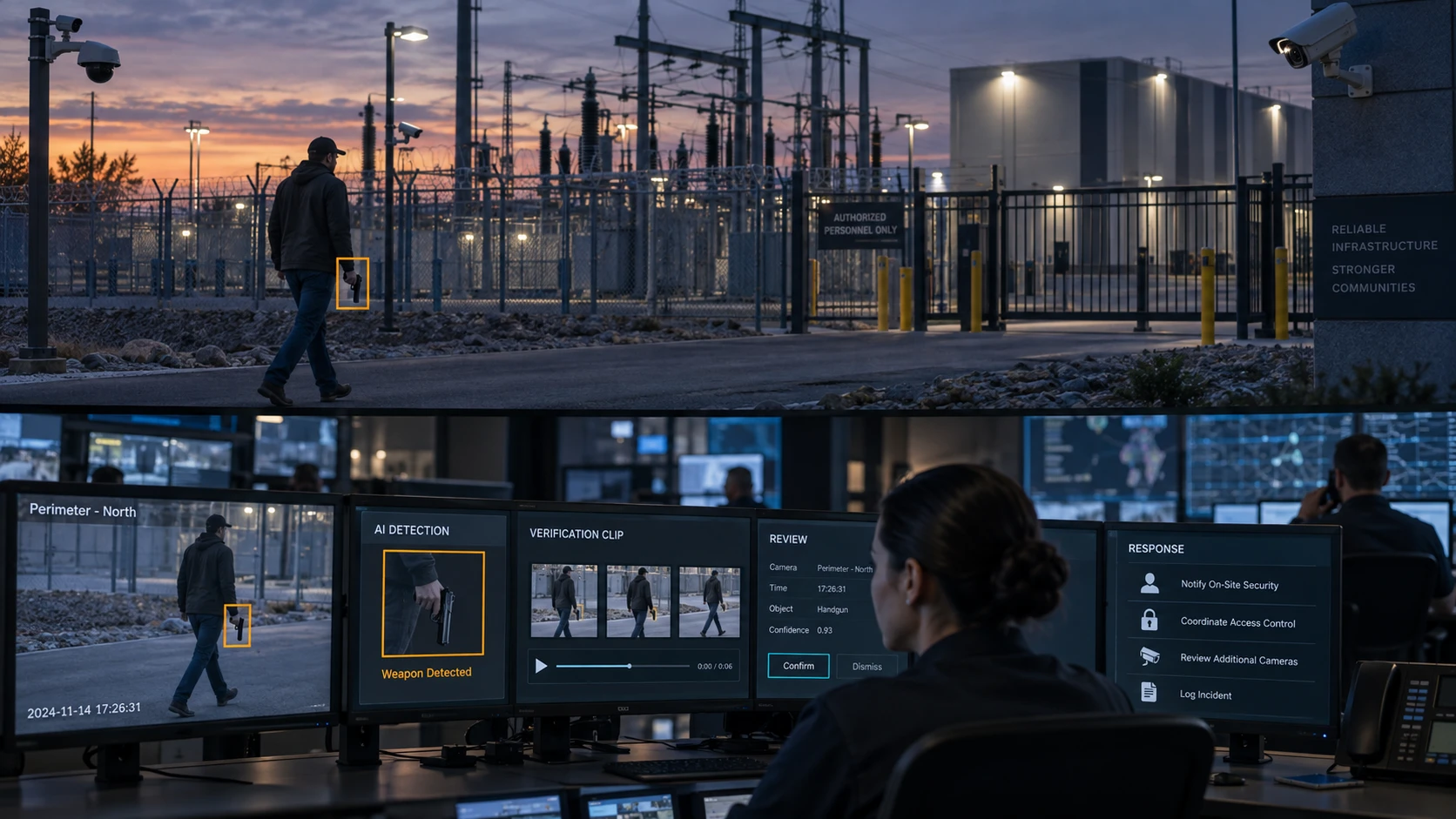
The demo always looks the same. Someone walks across a parking lot holding a pistol, a red box appears around it, an alert fires, and the room nods. What the demo never shows is the third week of deployment, when a facility that installed the same product is quietly ignoring its alerts because a flag on a pole keeps tripping the model at dusk. AI weapon detection is a capable technology, and the difference between a site where it protects people and aa site where it becomes background noise has very little to do with the model and almost everything to do with how the deployment was engineered.
That distinction matters more at critical infrastructure than almost anywhere else. A substation, pump station, chemical terminal, or regional data center typically runs with a small on-site team, long sightlines, cameras installed years ago for forensic review rather than live analytics, and no realistic option to funnel every approaching person through a screening lane. The security program is not trying to inspect people. It is trying to notice, early and reliably, that something is wrong outside the fence.
So the useful question for a security manager is not which vendor has the best detection claim, but what conditions that detection needs in order to hold up on their site. Platform vendors have converged on bundling weapon alerts with intrusion detection, visitor management, and access control precisely because the alert alone accomplishes nothing; the portfolio published by Rank One Computing reflects that pattern, pairing threat detection with secure-zone monitoring and identity verification for facilities. What follows is the practical side: what has to be true about your cameras, your thresholds, and your people before any of it works.
Your cameras are the real constraint
Weapon detection software inherits every limitation of the video it is given. A firearm occupies a small fraction of a frame, so the binding constraint is pixel density on the object, not megapixels on the spec sheet. A 4K camera covering a wide apron can easily deliver fewer usable pixels on a handgun at sixty feet than a well-placed 1080p camera at twenty. Before any pilot, walk the site and ask which cameras have a realistic chance of resolving a weapon in a human hand, and treat the rest as intrusion and context sensors instead.
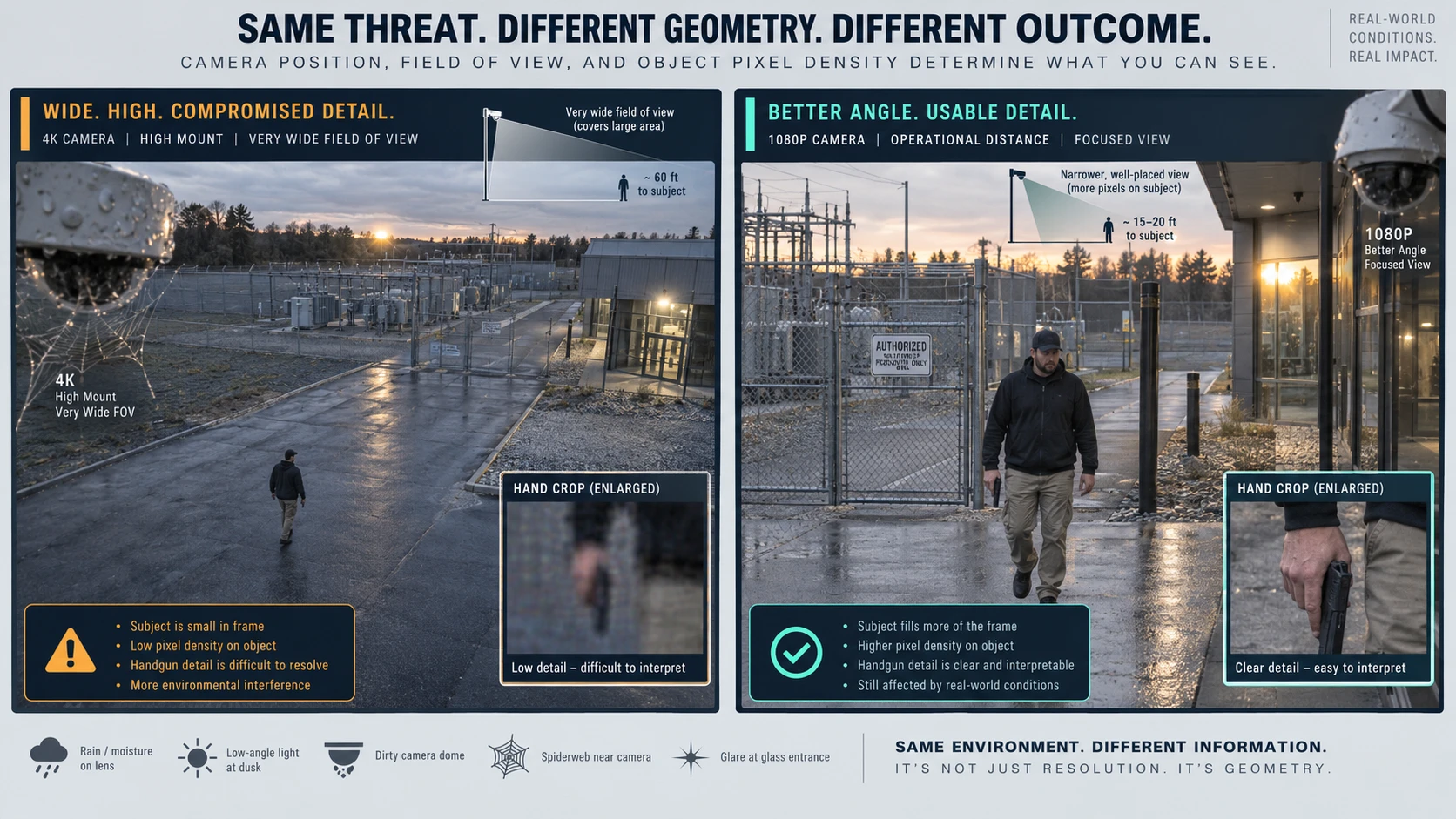
Three physical factors decide most outcomes. Mounting height and angle: cameras aimed steeply downward for license plate or door capture see the top of a head and little else, while detection wants a view of the torso and hands. Lighting transitions: dawn, dusk, headlights, and the blown-out band where an indoor camera faces a glass entrance are where false alerts cluster. Weather and optics: rain, insects, spiderwebs on housings, and an unwashed dome all reduce detection quality long before anyone notices the image looks soft.
None of this is exotic. It is the same site survey discipline that good video deployments have always required, applied with a new question in mind.
Alert thresholds are a policy decision, not a setting
Every detection model exposes a confidence threshold, and where you set it is a trade between missing real events and generating alerts nobody believes. Security teams often treat this as a technical default to accept. It is closer to a policy, and it should be set deliberately per camera and per zone.
| Zone type | Sensible threshold posture | Why |
|---|---|---|
| Outer approach, parking, fence line | Lower threshold, high alert volume routed to verification | Time matters most here; a human can dismiss a false alert in seconds |
| Staffed entries and lobbies | Moderate threshold tied to access control actions | Alerts trigger door holds, so precision matters more |
| Interior restricted areas | Higher threshold, immediate escalation | Any detection here is anomalous; false alarms are costly and rare |
The lesson embedded in that table is that perimeter security AI can tolerate more noise than interior alerting, because the response to an outer-zone alert is a human glance at a video clip, not a lockdown. Tuning every camera to one global number is how programs end up either blind or ignored.
Operator trust is the failure mode nobody budgets for
A weapon detection system fails in one of two directions, and only one of them shows up in a test report. The measurable failure is a missed detection. The common failure is alert fatigue: enough unverified alerts that operators stop opening them, at which point the real one arrives into a muted channel.
Protecting against that costs almost nothing if it is designed in from the start. Route every detection to a person with the clip, the camera location, and a one-click confirm or dismiss, so verification takes seconds rather than a phone call. Track dismissals per camera weekly, because a single camera producing most of the noise is a fixable placement or threshold problem, not a reason to distrust the system. Give operators the authority and the script for confirmed alerts, since an alert that leads to hesitation about who to call has bought nothing. And publish the numbers internally, because a team that can see false alerts dropping month over month stays engaged with the tool.
What firearm detection does not do
Honesty about scope protects the program politically as well as operationally. Camera-based firearm detection sees weapons that are visible. It will not find a pistol in a backpack, and no reputable vendor claims otherwise, which is why it complements rather than replaces access control, screening at high-risk entries, and behavioral reporting programs.
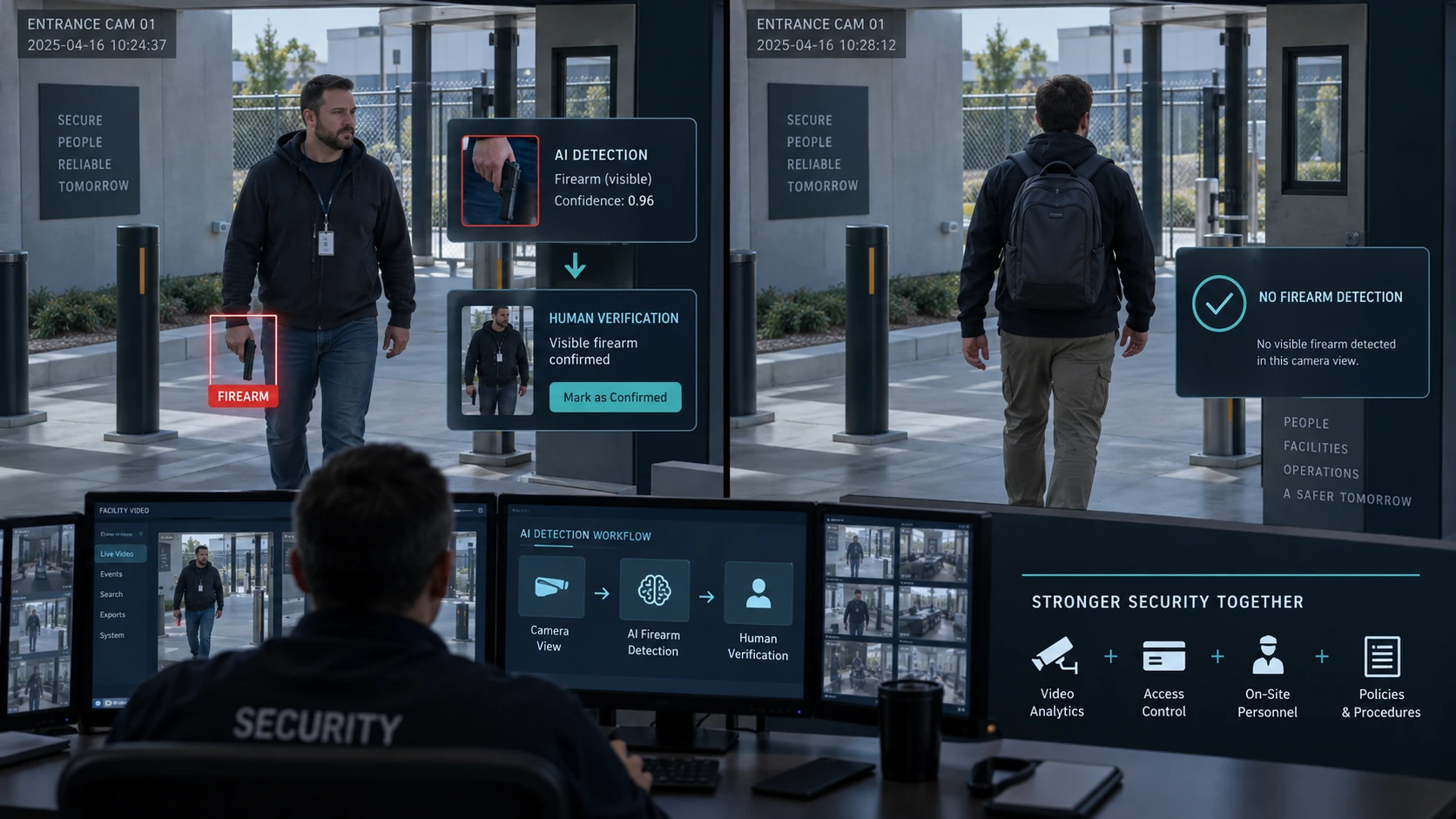
It is also object detection, not identity surveillance, and infrastructure operators should keep it that way in writing. A system scoped to weapon and intrusion alerts in defined zones, with human verification, documented retention, and protective automated responses limited to actions like holding a door, is one a security manager can explain to a works council, a regulator, or a local reporter without difficulty. Where face recognition is part of the broader stack for visitor management, insist on published third-party evaluation results, including accuracy across demographic groups, and review them rather than accepting a vendor summary.
How to run a pilot that tells you something
- Pick a mix of cameras, not the best ones: include a difficult angle and a lighting transition, because those set your real performance floor.
- Measure two numbers for four weeks, detection latency from event to operator notification, and dismissals per camera per week.
- Rehearse the response path end to end with staff, timing each hop from alert to door lock to call placed.
- Retune thresholds and, where needed, move or clean cameras, then measure again; the second month tells you more than the first.
- Only then negotiate scale, with the site survey findings written into the contract.
The bottom line
Weapon detection at critical infrastructure is an integration and tuning project wearing an AI label. Sites that survey their cameras honestly, set thresholds by zone, and design for operator trust get a system that buys real minutes during the worst event they will ever face; sites that install it as a feature get an alert feed nobody reads. Vendors working across this space, including the American vision AI developer ROC, publish enough technical detail for security teams to plan properly, and that planning is where the protective value is actually created.